
Illinois gerrymandering more extreme than Missouri map rejected by Supreme Court
Common metrics show Illinois’ congressional map is more skewed than a failed attempt in Missouri was.
Missouri Republicans’ midcycle attempt to maximize their party’s seats in the U.S. House failed last month at the U.S. Supreme Court.
And by two of the most commonly used measures of partisan gerrymandering, Illinois’ map is more tilted in favor of Democrats than the failed Missouri map was for Republicans.
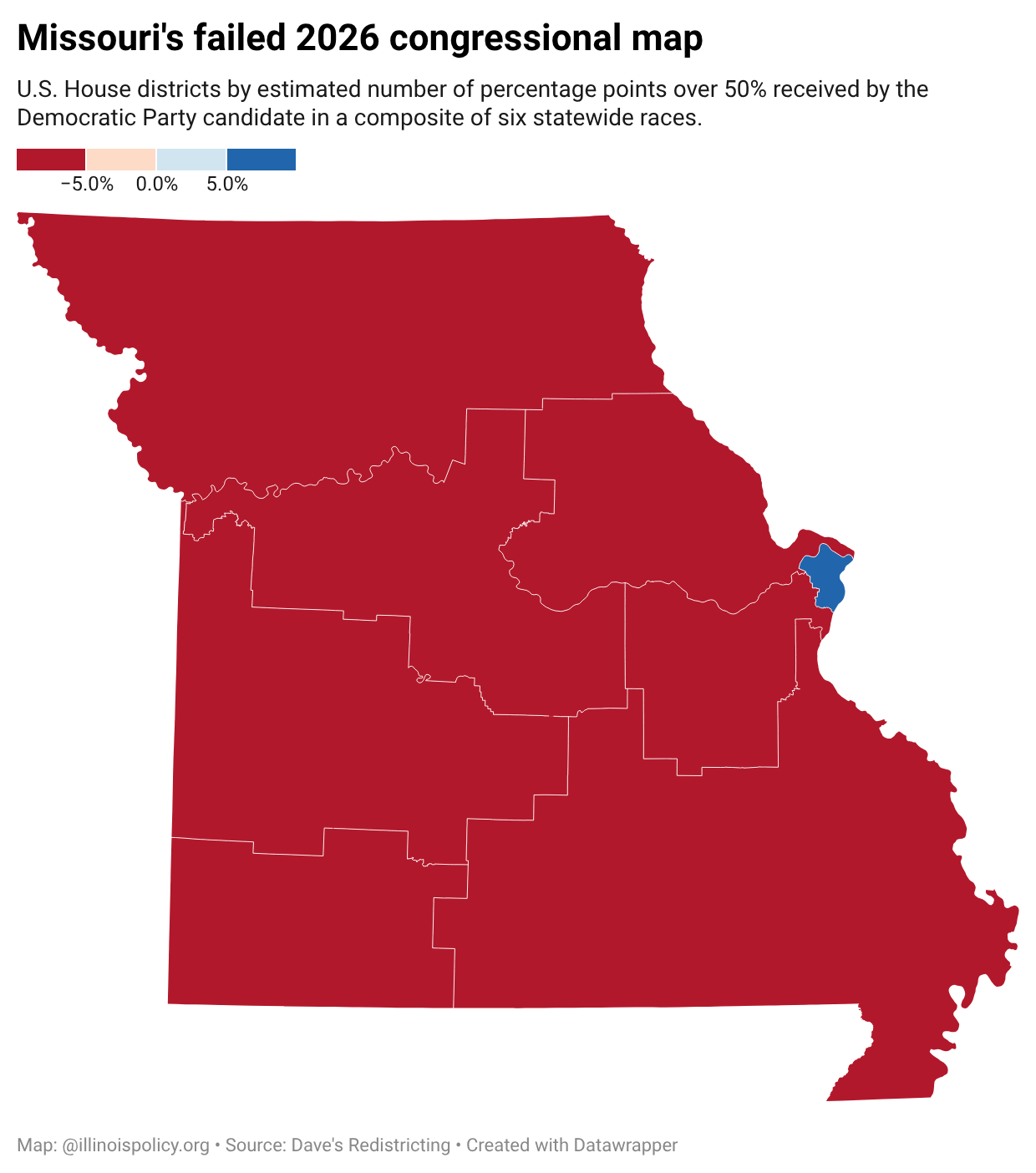
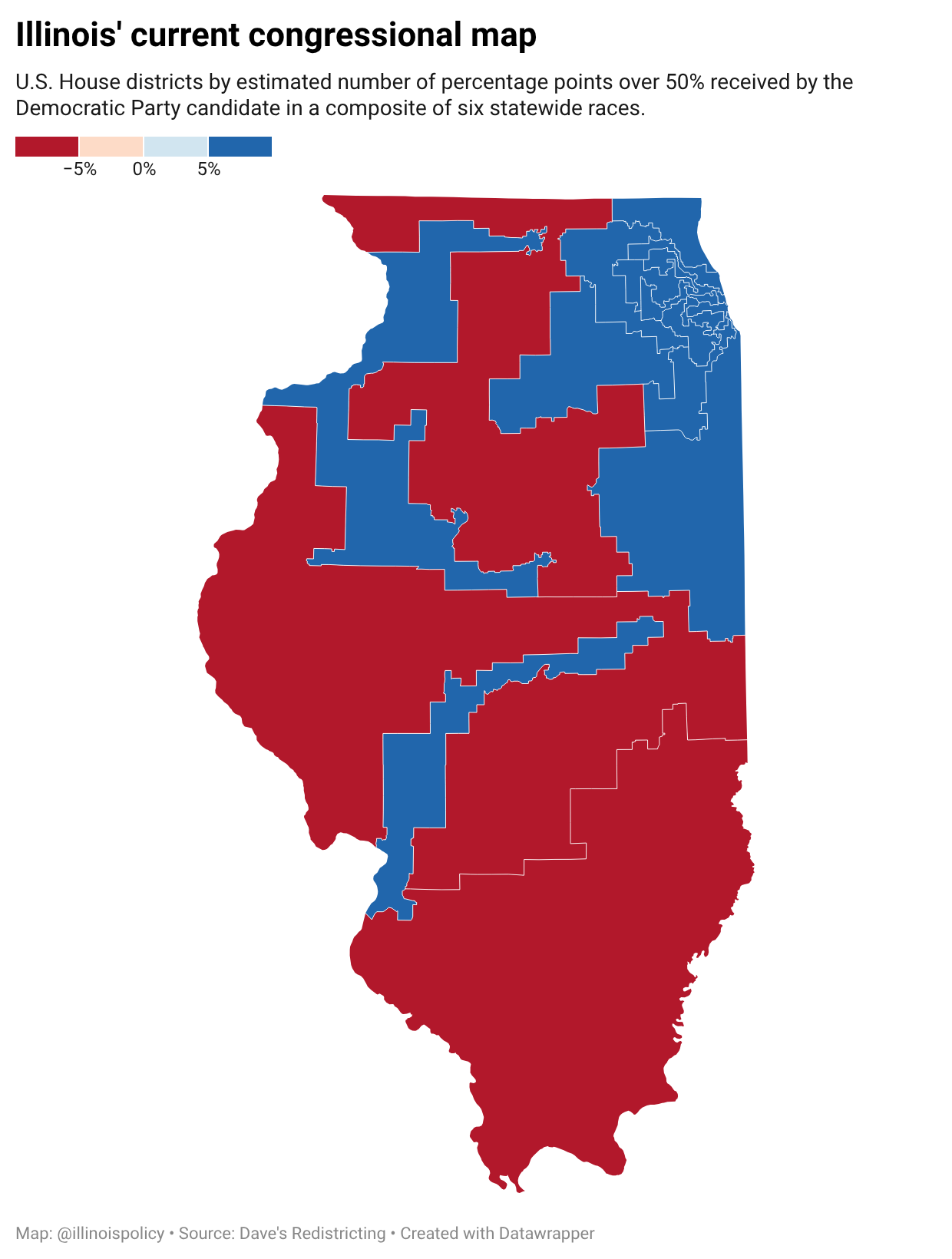
According to PlanScore, the failed Missouri congressional map had a lower efficiency gap — a comparison of how many votes a party “wasted” in winning an election — than Illinois’ map.
For example, if 1,000 voters, made up of 550 Democrats and 450 Republicans, are divided into five districts, a district of 150 Republicans and 50 Democrats would lead to four districts with 125 Democrats and 75 Republicans each. The Republican district’s 150 votes would be less efficient than the Democratic districts’ 125 votes because the Republicans would have 49 more votes than necessary to get a majority, while the Democrats’ districts would have only 24 more votes than needed to win.
The difference between Democrats and Republicans’ votes above the minimum needed for victory is known as the efficiency gap.
While Missouri’s efficiency gap was +17.6% in favor of Republicans, Illinois’ 2022 map was +20.9% in favor of Democrats.
In fact, Illinois’ map is more skewed than 99% of nationwide historical plans analyzed by PlanScore.
Missouri’s gerrymandered map also beats Illinois’ in declination, or a comparison of the ratio of the party’s average margin of victory to the portion of total seats won by that party. The greater the difference in those ratios indicates a greater likelihood of partisan gerrymandering.
While the failed Missouri map’s declination was +0.66% in favor of Republicans, Illinois was measured at +0.76% in favor of Democrats, again more skewed than 99% of the analyzed plans.
By both measures, Illinois’ map is more unfair than Missouri’s would have been.
Missouri’s midcycle redistricting plan has drawn plenty of scrutiny, and now the plan is dead. But Illinois’ congressional map is worse than Missouri’s by two of the most commonly used measures of partisan gerrymandering, yet it remains in place. So while the failed effort in Missouri means Democrats maintained their voice in Congress, Illinoisans outside the party continue to be muzzled by state Democrats.
Related:
Thanks to gerrymandering, over 90% of recently passed bills in Illinois were sponsored by one party