Close races and over 50 tax questions highlight stakes for Illinois voters
PRESS RELEASE from the
ILLINOIS POLICY INSTITUTE
CONTACT: Micky Horstman (312) 607-4977
What to know about the Nov. 3 ballot statewide and in Chicago
Close races and over 50 tax questions highlight stakes for Illinois voters
CHICAGO (Oct. 29, 2026) — Illinois voters will decide at least 53 local tax and borrowing questions in the Nov. 3 general election alongside races for governor and U.S. Senate. Chicago and Cook County voters will weigh an advisory income tax question, decide whether to retain judges and choose the city’s first fully elected school board.
Ten state legislative races since 2022 were decided by fewer than 1,700 votes apiece, including one by just 47 votes, according to Illinois Policy Institute research. Among the 175 contested state House and Senate races since 2022, half were decided by a margin smaller than 1-in-10 of the eligible adults in that district.
“Even if you think the results for the races at the top of the ticket are certain, many local questions and races in Illinois can directly impact your cost of living and deserve consideration. High taxes were a top concern for 58% of Illinoisans in our most recent Lincoln poll, and voters in districts across the state will be able to voice their concerns about these issues,” said Joe Tabor, senior director of legal research at the Illinois Policy Institute. “This election gives residents a chance to demand economic relief from their representatives and weigh in directly on local proposals that could increase their tax bills.”
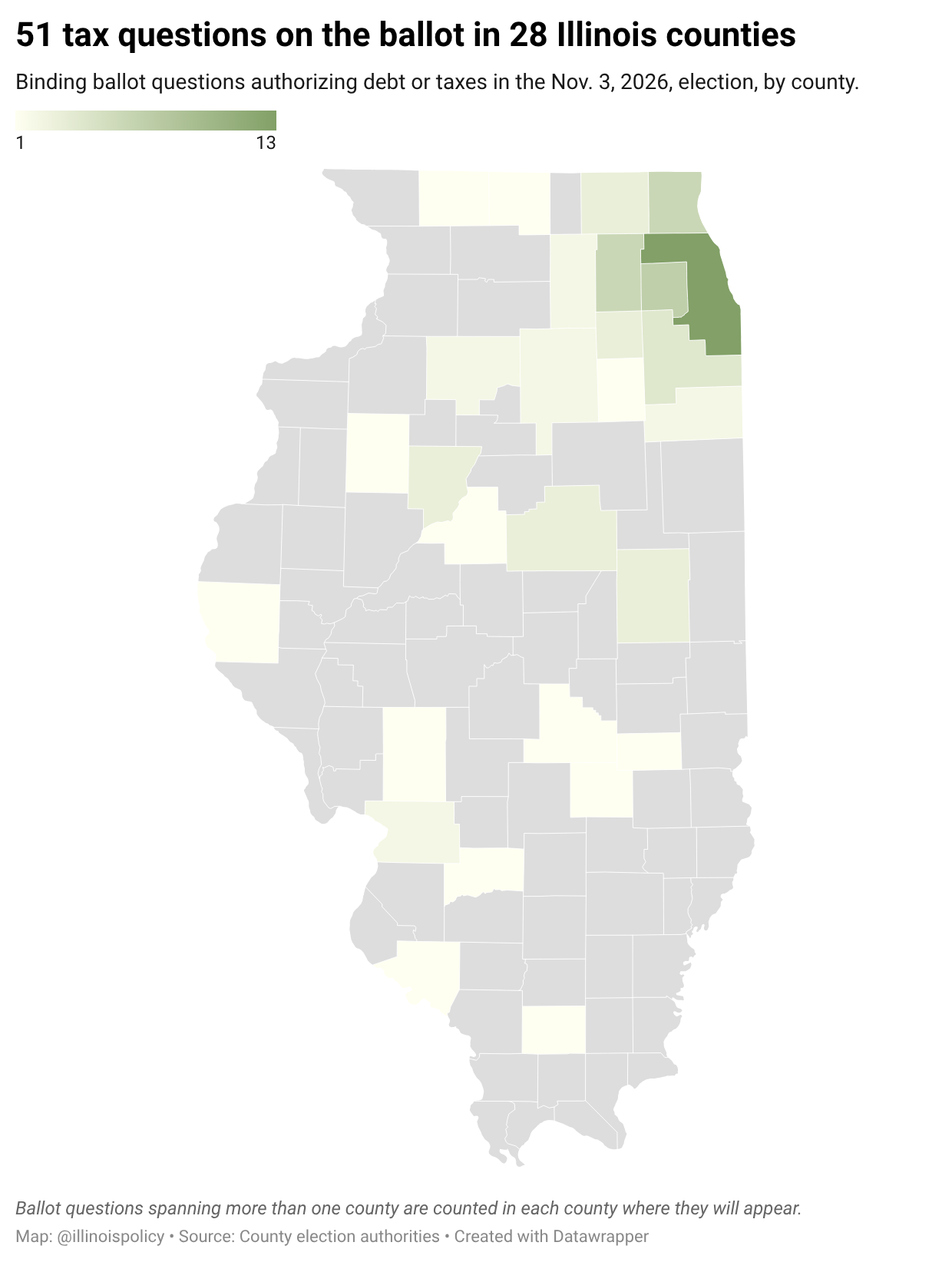
What is on ballots across Illinois:
- Property taxes: At least 27 questions would authorize higher property tax levies or new levies. They include proposals in eight fire protection districts, six school districts, the Bourbonnais Library District, the Herrin Park District and Antioch Township.
- Sales taxes: Adams, Crawford, Lake and Tazewell county voters will consider a new 1% sales tax for school-related purposes. Crawford will consider another 1% sales tax on tangible personal property to fund public safety. Coulterville voters will decide whether to double the village’s municipal sales tax from 0.5% to 1%.
- Bond debt: Borrowing requests range from about $1 million to more than $350 million and appear in at least 12 school districts, three library districts, two fire protection districts, the Skokie Park District, Lake Zurich and Moraine Valley Community College District 524. District 300’s $355 million proposal would add an estimated $101 annually to the property tax bill on a $400,000 home.
- Federal and state offices: Voters will elect a U.S. senator, all 17 of the state’s U.S. representatives, the governor and lieutenant governor, attorney general, secretary of state, comptroller and treasurer. All 118 Illinois House seats and 39 state Senate seats also are up for election, alongside many county and judicial offices.
What is on the ballot in Chicago and Cook County:
- Cook County income tax question: A nonbinding question asks whether Illinois should adopt a 3% income tax surcharge on millionaires, with half the revenue designated for property tax relief and half for education. The vote itself would not raise taxes, as such a surcharge would require a constitutional amendment.
- Chicago festival space question: An advisory question asks whether the city should develop a permanent festival and outdoor event space. It does not specify a location, cost or funding source, and passage would not require the city to build it.
- Judicial elections: Six seats are on the ballot for Illinois Appellate Court judge. Three partisan elections are set to fill vacancies on the court with a majority vote, though only one of those elections is contested. Three appellate court judges are seeking retention, while sixty Cook County circuit judges and 69 downstate judges are seeking retention. Each judge seeking retention needs at least 60% of the votes cast on their retention question to remain in office. Twenty-five downstate vacancies are set to be filled by partisan elections, seven of which are contested.
- Chicago Public Schools board: Chicago voters will choose the city’s first fully elected school board. The Chicago Teachers Union has endorsed and/or funded 16 candidates through its political action committee, making the election a test of its influence over the board that oversees CPS spending and approves its contract.
“Voters should know which school board candidates CTU is backing and how those candidates would approach district spending, school options and the union’s contract,” said Mailee Smith, vice president of policy and litigation at the Illinois Policy Institute. “Chicagoans have an opportunity to choose a board that exercises independent judgment and puts students and families first.”
To read more about Illinois’ election, visit illin.is/election-2026.
For bookings or interviews, contact media@illinoispolicy.org or (312) 607-4977.