Illinois students could soon benefit from scholarship money to help them find a tutor, attend ACT or SAT prep sessions, pay tuition, get special education services or assist with other academic needs.
That will happen in Illinois only if Gov. J.B. Pritzker lets the state’s schoolchildren benefit from the Federal Scholarship Tax Credit program, established by the Educational Choice for Children Act.
If he doesn’t, money from Illinois donors will go to children in other states.
Imagine a third-grader struggling in math. If his household income is less than 300% of the median income in his area, he would qualify for donor money for tutoring or other academic services, whether he’s at a public school or a private school. But only if Illinois opts into the program.
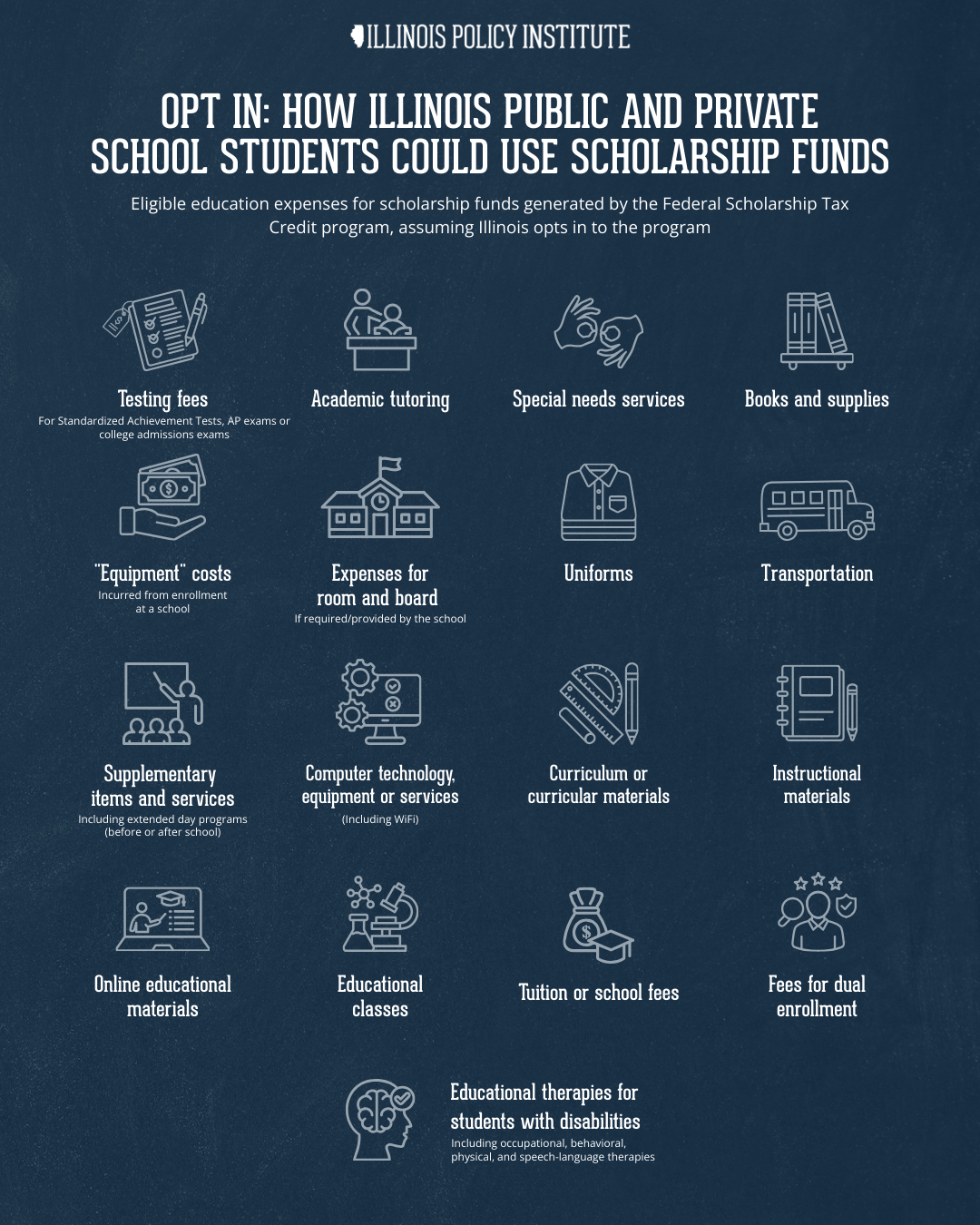
Here’s what you need to know about the program and how it would help public and private school students throughout the state:
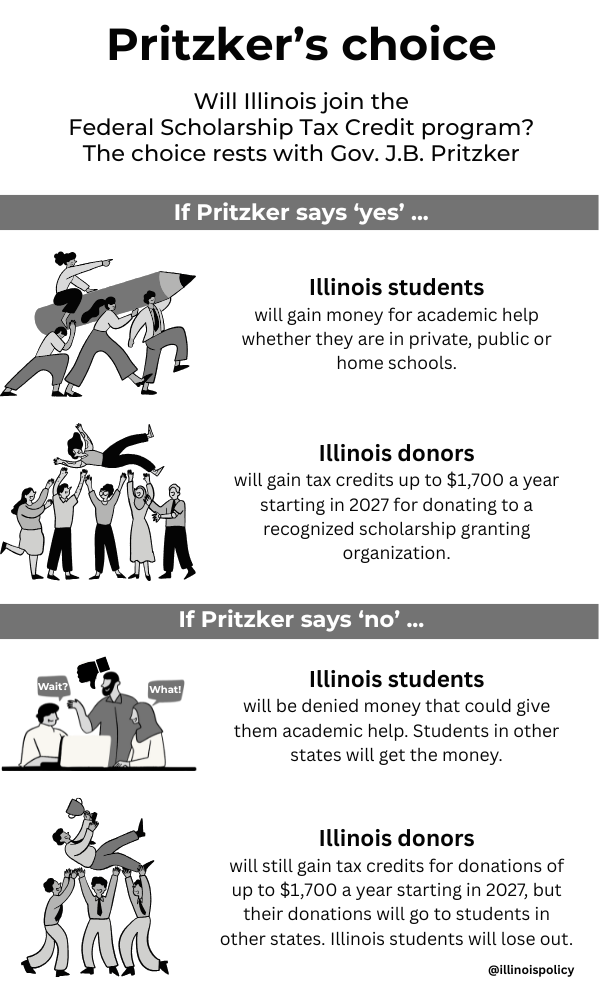
The program benefits public and private school students
Starting in 2027, students in public or private schools can use the scholarship money for educational services such as tutoring, additional classes, books or online educational materials, fees for standardized or college admission exams and fees for dual enrollment.
That means public school students who might be struggling in certain areas or who need extra help or materials won’t have to leave their local public schools to find the support or opportunities they need. Or their families could get tuition assistance to help send them to a private school if that better fits their needs.
The most recent state test scores for Illinois show only half of students were reading at grade level in spring 2025. Just 39% were proficient in math.
Illinois students are struggling. The scholarship program offers families a way to provide the academic support their children need, whether at home, at their local public school or at a private school.
The program takes no money from public schools
The program does not take money away from public schools. It will not divert federal or state money from public schools to fund the scholarships.
Instead, the scholarships are donated by taxpayers, who will get federal tax credits for giving up to $1,700 each year. That limited credit will matter little to a billionaire but can benefit middle-income givers. Any taxpayer can receive a dollar-for-dollar federal tax credit for making a qualified contribution to a scholarship-granting organization. Those are tax-exempt and provide money to students.
That means the only cost to the federal government is minimal foregone income tax revenue. There is no cost to states, only the benefit of more help flowing directly to students.
Public schools can keep dedicated funds local
The program provides a way to keep money local by donating to a local public school scholarship-granting organization.
If Illinois opts into the program, taxpayers will have two options:
- Donate $1,700 to an eligible scholarship-granting organization and directly fund education.
- Send that money to the federal government via taxes for the government to use on any number of priorities or agendas.
The best way to help public education will be to donate to a local scholarship-granting organization, including eligible public school foundations. Public school foundations already raise private donations to support their schools. A 1:1 tax credit would incentivize more of this giving, allowing foundations to expand their fundraising and increase the number of students they serve.
Illinois taxpayers can get the tax credit no matter what — so rejecting the program will only deprive kids of available funding
If Illinois does not opt into the program, taxpayers will still be able to take the credit — they just won’t be able to use it for Illinois children. Their donations would go out of state and no Illinois students would be eligible for the money.
It’s not a good look for teachers unions or other opponents of the federal scholarships, who falsely say the program takes money from public education. The program promises to add money from donors to public, private and home school students.
Opponents are against Illinois children receiving donor money for tutoring and other academic services. If they succeed, other states’ children will benefit and Illinois children will be left behind.
Most states have indicated they will opt into the program
At least 28 states have already decided they want to let private donors help students find extra academic help.
That includes Colorado, where Democratic Gov. Jared Polis has said, “The more Democratic governors learn about it, I fully expect that most will come around and participate….Because from our perspective, it’s free money.”
Illinois will be in the minority if it does not opt into the program. Our students will not get donated money —students in other states will.
The program has bipartisan support
The Federal Scholarship Tax Credit program has Democratic leaders voicing support.
Examples include:
- Jared Polis, the Democratic governor of Colorado, has said, “The more Democratic governors learn about it, I fully expect that most will come around and participate… Because from our perspective, it’s free money.”
- Illinois Comptroller Susana Mendoza has called the decision to opt in an “easy one.” She wrote: “Participation in the program does not change Illinois’ public school funding formula in any way. It does not reduce state funds for public schools. It simply allows voluntary private donations, incentivized through federal tax credits, to provide additional educational support within our state. There is no cost to states, but there is significant missed opportunity if we opt out.”
- Arne Duncan, education secretary under President Barack Obama, has said: “Opting in doesn’t take a single dollar from state education budgets. It simply opens the door to new, private donations, at no cost to taxpayers, that can support students in public and nonpublic settings alike. That’s why opting in isn’t just defensible; it’s a no-brainer.”
- Jorge Elorza, CEO of Democrats for Education Reform, has said that “if a state does not opt in, then by default, the first $1,700 in every single federal taxpayer’s taxes is going to leave your state.” Referring to polling, Elzora said that “opting in is not just popular, it is overwhelmingly popular.”
- Third Way, a centrist Democratic think tank, is urging states to opt in. “It’s not a traditional voucher,” Director of Education Michelle Dimino told The Washington Post.
The program provides additional resources to students with disabilities
The money can be used for educational therapies for students with disabilities enrolled in the public school system or in a private or home school.
Most students with disabilities enroll in public schools. In the 2024-2025 school year, nearly 375,000 with disabilities were enrolled in public schools in Illinois.
Nationally, 95% of school-aged students with disabilities were enrolled in regular public schools in fall 2022, according to the National Center for Education Statistics. Only 2% were placed in regular private schools by their parents.
Because most families of students with disabilities enroll their children in public schools, families could gain access to money for additional educational therapies to help their child thrive in their public school.
Most Illinois voters support opting into the program
More than half of Illinois voters support the state opting into the program, according to a new poll.
Only 22% oppose the move.
Nearly 55% of 579 registered Illinois voters favor the state opting into the Federal Scholarship Tax Credit program. The voters were polled Feb. 9-11 by M3 Strategies for the Illinois Policy Institute.
The poll also showed more support for opting in than opposition across all ages, regions, races and political ideologies.
The bottom line: Illinois families in public, private or home schools could benefit from the donated scholarship money. Taxpayers will get credit for their donations no matter what.
The only question is whether Pritzker will let Illinois’ students benefit or whether he will essentially hand the money to children in other states.
Need more information?
Check out one of our many articles explaining the Federal Scholarship Tax Credit program, what the law says, and how it can help students:
- Federal scholarship could help rural Illinois students find education options
- 4 myths about federal scholarship tax credit program
- Illinois students could boost ACT scores with scholarships
- IFT vows to fight funding to help Illinois public school kids
- Donors can help Illinois students, but will Pritzker let them?
- Donation tax credits can boost Illinois public school foundations
- What’s the law say about new scholarships for school kids?
- Most states already say ‘yes’ to donations for students