
Not even 19% of CTU spending in 2026 went to teacher representation
The Chicago Teachers Union spent more money running itself than on representing its members.
The Chicago Teachers Union’s recent federal filing shows it does not prioritize its members in its spending.
The union just filed its annual LM-2, which details its receipts and disbursements from its 2026 fiscal year. What it reveals:
- Less than 19% of CTU’s spending was on “representational activities.”
- CTU spent more running its internal operations than on representing teachers.
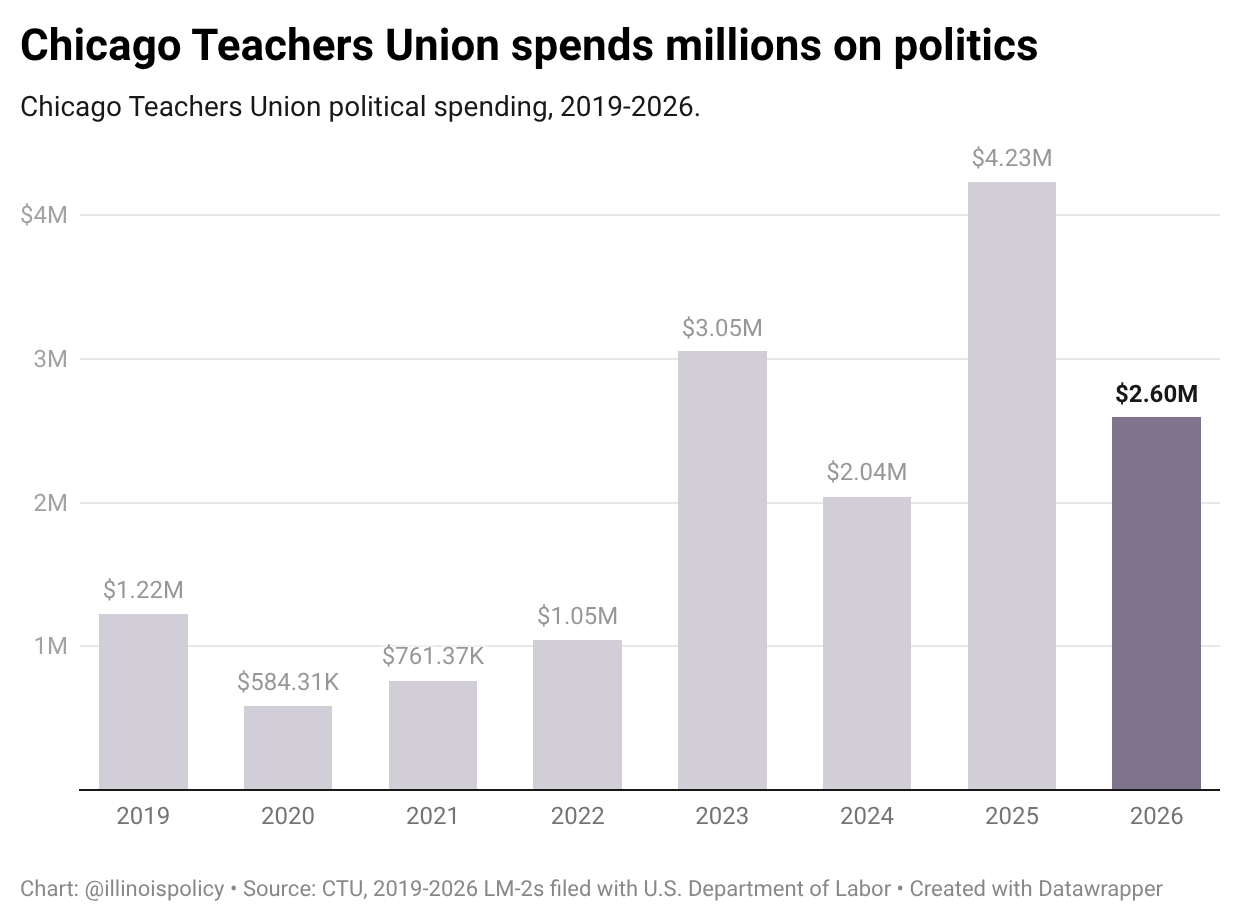
- CTU spent nearly $2.6 million on politics.
- Stacy Davis Gates gave herself a 7.5% raise, bringing her total compensation to more than $310,000. (That includes her pay from the Illinois Federation of Teachers, where she also is president.)
- More than 50 CTU employees made over $100,000.
With CTU members paying more than $1,500 a year in union dues, they may question whether they are getting a good return on their money.
Less than 19% of the CTU spending was on ‘representational activities’
CTU spent over $39 million in 2026. Just $7.4 million was on representing teachers — what should be the core purpose of the union. The rest went to politics, overhead and other union leadership priorities.
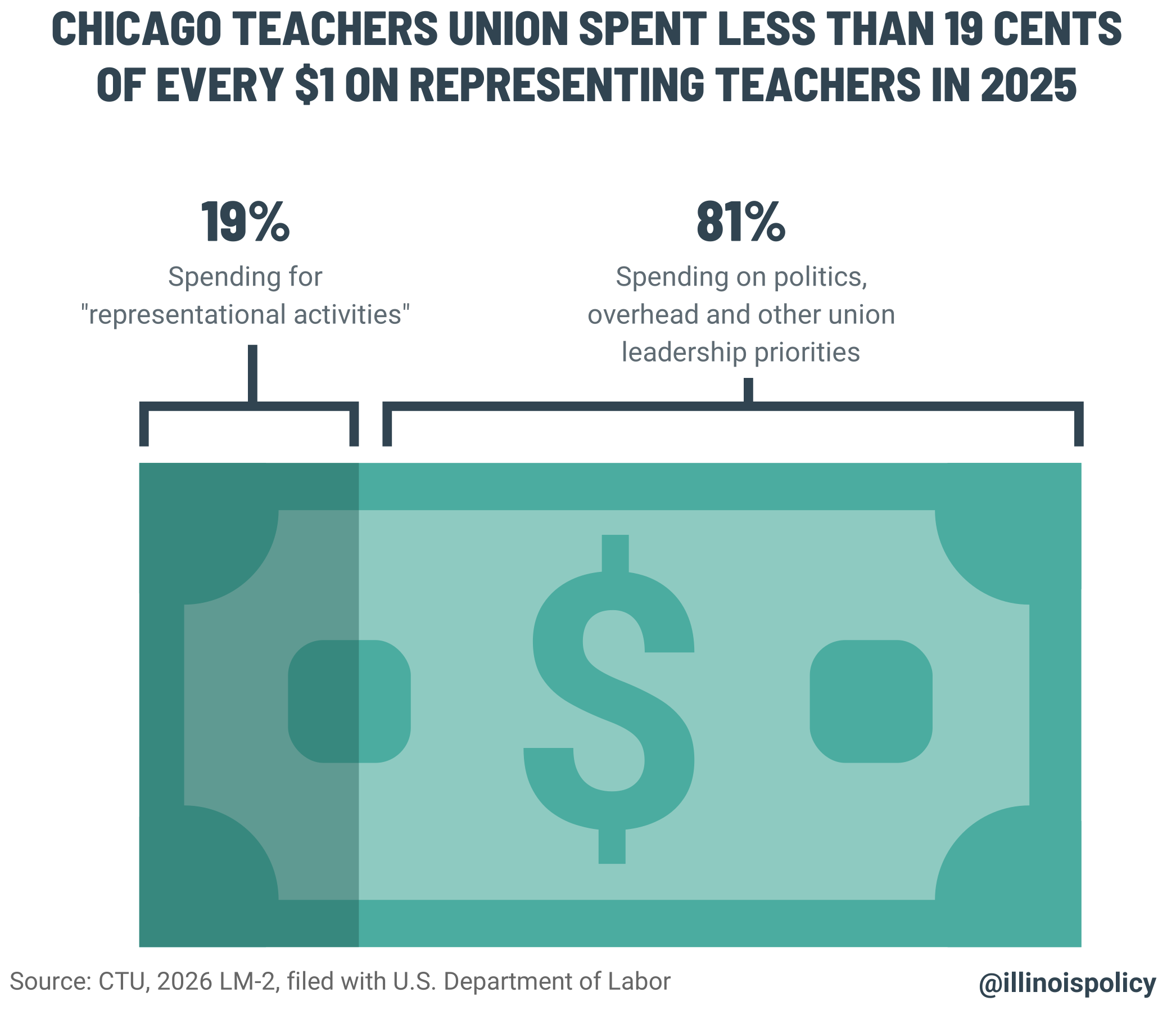
The U.S. Labor Department defines “representational activities” as those “associated with preparation for, and participation in, the negotiation of collective bargaining agreements and the administration and enforcement of the agreements.”
Examples of what the union did spend on “representational activities” may not allay member concern. One example: over $31,000 on the “dues increase vote” campaign. That was the effort to increase dues, which members voted down in May.
The union also paid more than $325,000 to On Point Studios in New Mexico for “Professional Service Consulting.” Last year, that entity was listed on the LM-2 as a “recording studio.” While its address is no longer listed at a poolside residence, it is still unclear what it does for CTU. But CTU nearly doubled what it spent there in 2026.
To put this in perspective, the Better Business Bureau’s “Standards for Charitable Accountability” say at least 65% of a nonprofit’s total expenses should be on program activities. In other words, that percentage should be used “to fulfill” a charity’s “mission.”
While the BBB tracks spending by traditional charities, CTU’s spending on representing teachers falls far short of this mark.
CTU spent more running its internal operations than on representing teachers
CTU’s spending on overhead and administration totaled more than $8.9 million. In fact, CTU routinely spends more on these types of internal costs than it does on representing its members.
The Labor Department requires a listing of multiple categories of spending in the LM-2 reports. The two directly relating to running internal union operations are administration and overhead.
The department defines administration as “disbursements relating to the nomination and election of union officers, the union’s regular membership meetings, intermediate, national and international meetings, union disciplinary proceedings, the administration of trusteeships, and the administration of apprenticeship and member education programs.”
That is not to be confused with contract administration, which is part of the representational spending.
Overhead is defined as spending “that cannot be allocated to any of the other disbursement categories,” such as representational activities, political activities and lobbying or administration.
Examples of CTU’s administrative spending in 2026 included:
- Nearly $100,000 for a “mediation service” related to an “officers election.”
- More than $33,000 for catering, supplies and preparation for May Day.
- Nearly $6,000 to a “float and display company.”
Examples of the union’s overhead spending included nearly $190,000 for additional catering. Some of that was itemized for purposes such as “holiday event” or “women’s appreciation event.” But nearly $75,000 was not itemized at all, so there is no way for members to know for what purposes the catering was contracted.
Another overhead expense: $9,400 for headshots.
CTU spent nearly $2.6 million on politics
While CTU’s spending on “political activities and lobbying” decreased from the year before, the union still spent nearly $2.6 million on it in its fiscal 2026.
Of that amount, nearly $994,000 went to the CTU PAC. From there, members have no say in how the money is spent.
An additional $742,000 went to officers and employees to support unspecified political causes or candidates.
That doesn’t include an additional $187,000 in “contributions, gifts and grants,” which are often political in nature. Contributions in 2026 included:
- $25,000 to Local Progress Policy Action, which works on a “broad intersectional progressive agenda” and hosts a program “designed to help progressive state and local elected officials develop the leadership and governance skills they need to be powerful and effective leaders.”
- $10,000 to Equality Illinois, which works to defeat bills limiting girls’ sports to biological females, a polarizing issue for many Illinoisans.
- $5,000 to Center on Halsted for the “Pride Southside” festival.
CTU may want to take a step back from its relentless political activities. According to a 2026 poll, half of Chicago voters are less likely to vote for a candidate who takes CTU money.
What’s more, CTU hasn’t gotten a lot of bang for its political buck in recent years. Its school board candidates lost six of nine contested races in 2024, and its endorsed candidates in the March 2026 primary lost seven of 13 contested races.
Between public disfavor and failed campaigns, CTU is practically throwing away members’ money on politics.
Stacy Davis Gates gave herself a 7.5% raise, bringing her total compensation from two unions to more than $310,000
CTU President Stacy Davis Gates earned $209,521 from the union in 2026, up from $194,955 the year before. That’s an increase of $14,566, or 7.5%.
Her compensation didn’t stop there. She is also the president of the Illinois Federation of Teachers, the parent affiliate of CTU. In IFT’s fiscal 2025 report, Davis Gates earned $100,607.
So from CTU and IFT alone, she’s making more than $310,000.
It is likely to ultimately end up much more than that. When IFT filed its most recent federal report, Davis Gates had been IFT president only since October. The bulk of her reported compensation would have been while she was still its executive vice president. The outgoing IFT president earned $274,965 that year. IFT hasn’t filed its fiscal 2026 report yet.
More than 50 CTU employees made over $100,000 in 2026
Davis Gates isn’t the only CTU employee making six figures. More than 50 CTU officers and other employees made $100,000 or more in the 2026 fiscal year.
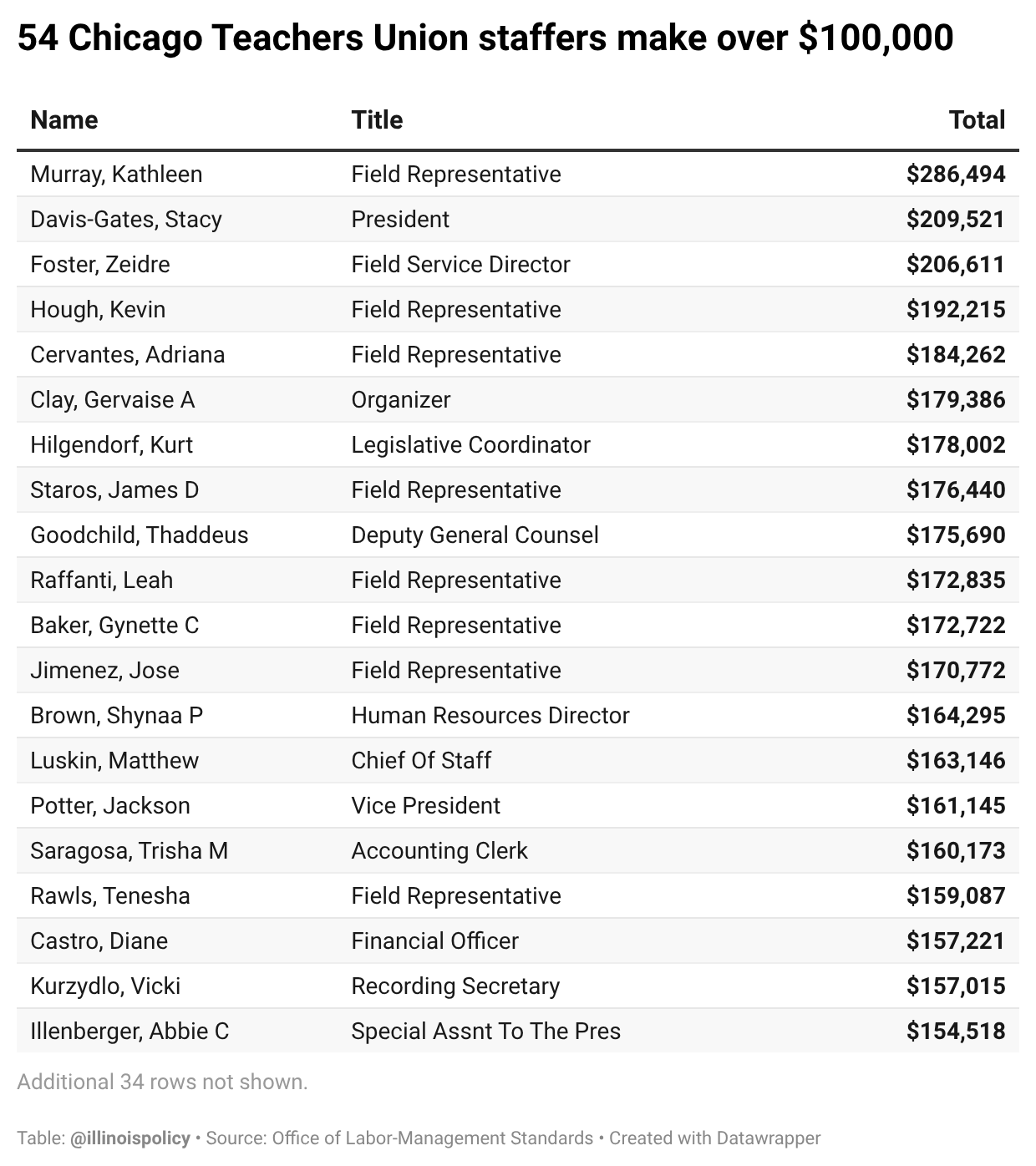
By comparison, the average teacher salary in Illinois is $78,495.
Altogether, CTU spent over $9.4 million on officer and employee salaries in 2026.
Fortunately, Chicago educators who want more control over their dues have options:
- Teachers can get liability insurance and legal protection elsewhere, often at a fraction of the price of union membership. Educators can join other associations, such as the Association of American Educators or the Teacher Freedom Alliance. TFA is donor-funded and free to teachers.
- Teachers can opt out of union membership and keep all employer-provided benefits. By opting out of union membership, a teacher stops paying dues to the union yet retains all benefits in the collective bargaining agreement with the school district.
CTU typically provides an annual window in which members can opt out and cease paying dues. Unfortunately that window is typically in August, but teachers interested in opting out can visit LeaveCTU.com for more information.