

Illinois unemployment: politicians living in an alternate reality
Illinois’ unemployment fell to 8.7 percent in November from 8.8 percent in October, adding 16,400 new payroll jobs. Despite this small decrease in the unemployment rate, Illinois is still a full percentage point above the national unemployment average of 7.7 percent, and 1.6 percentage points higher than the average of its neighboring states. That fact –...
Illinois’ unemployment fell to 8.7 percent in November from 8.8 percent in October, adding 16,400 new payroll jobs. Despite this small decrease in the unemployment rate, Illinois is still a full percentage point above the national unemployment average of 7.7 percent, and 1.6 percentage points higher than the average of its neighboring states.
That fact – that Illinois continues to trail its neighbors – is lost on Illinois politicians. Yesterday, House Deputy Majority Leader Lou Lang, D-Skokie, lauded Gov. Pat Quinn’s efforts to create jobs in Illinois:
“This is good news for Illinois, for Illinois workers and for Illinois’ governor,” Lang said. “Pat has been relentless in promoting new job growth at every opportunity, and his efforts are yielding results – new jobs for Illinois workers.”
But the reality is Illinois’ poor policies aren’t allowing the state to participate fully in the national recovery. If only Illinois’ unemployment rate were equal to the average of its neighbors, 100,000 more Illinoisans would be working. Yes, jobs are slowly returning to the state, but that’s despite Springfield’s policies of overspending, overtaxing and over-borrowing – not because of it.
A closer look at Illinois’ actual unemployment numbers reveals a starkly different world from the one Illinois’ politicians choose to see.
First, November’s job growth has done little to cure the state’s unemployment woes. Illinois has the 8th-highest unemployment rate in the nation; 575,000 Illinoisans are still unemployed. Even worse, more than 1.1 million Illinoisans are underemployed – meaning they are unemployed, involuntarily working part time or discouraged from finding a job.
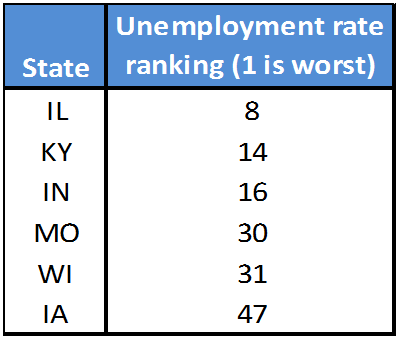
Second, Illinois’ neighbors are creating more job opportunities for their residents. In November, Kentucky had the 14th-highest unemployment followed by Indiana (16th), Missouri (30th), Wisconsin (31st), and Iowa (47th). Taken as a weighted average, the unemployment rate of Illinois’ neighbors is 7.1 percent, a full 1.6 percentage points lower than Illinois.
Third, and most alarmingly, Illinois is falling further behind both its neighbors and the nation in terms of employment recovery. Illinois’ neighbors are watching their unemployment rates drop faster than Illinois because they’re enacting positive growth policies, such as tax cuts and labor reforms. Illinois is doing just the opposite, raising taxes, avoiding reforms and borrowing more.
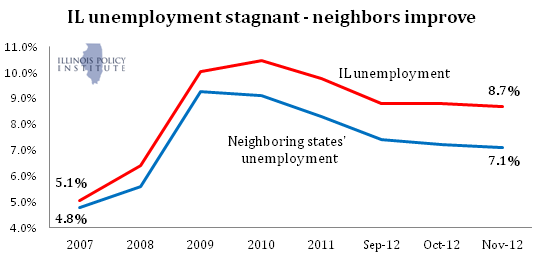
Source: U.S. Bureau of Labor Statistics.
Neighbors’ rates are a weighted average of Indiana, Iowa, Kentucky, Missouri and Wisconsin.
Hearing Lang’s comments, some politicians seem content to accept high unemployment as the “new normal” for Illinois’ economy. Illinoisans shouldn’t stand for such complacency.
As recently as November 2006, Illinois had the 22nd-highest unemployment rate at 4.4 percent, better than all of its neighbors but Iowa. Now, politicians would rather avoid reforms than attempt to return Illinois to that level of prosperity.
Illinois lawmakers just don’t get it – the status quo is failing Illinoisans. Unless legislators can get serious about spending reform and figure out a way to make the state’s business climate more fertile for job creators, unemployment will remain stagnant.