
Why the federal tax credit program won’t reduce Illinois public school funding
Under the state’s Evidence-Based Funding formula, they receive at least the same they did the previous school year.
Opponents of the Federal Scholarship Tax Credit claim public schools will lose funds if the state opts into the program.
That’s not the case.
But teachers unions are telling their members the donated money would divert funding from public schools and leave public school districts with less state funding if students leave for other schooling options.
That contradicts explicit statutory language and is not how Illinois funds its public schools. The federal program, also known as the Education Freedom Tax Credit, takes no money from public schools. Illinois state law includes a hold-harmless provision that guarantees school districts won’t receive less money than the year before even if students leave.
Schools won’t lose money under the federal program
The program takes no funding away from public schools. It will not divert federal, state or local money from public schools to fund the scholarships. The only cost to the federal government is foregone income tax revenue. There is no cost to states.
If Illinois opts into the program, students in the state could access over $2 billion in donated money to use on tutoring, school fees, extended-day programs, special education services and other qualified expenses.
Donors could give directly to local public school foundations that qualify as scholarship-granting organizations and already raise private donations to support their schools. This tax credit should supercharge local fundraising efforts to ensure that eligible students have all the academic services they need to thrive in school.
Illinois’ hold-harmless provision protects districts from losing money
Contradicting state law, Illinois Federation of Teachers Executive Vice President Cyndi Oberle-Dahm claimed public schools could lose money if the federal program prompts a “mass exodus” of students to private schools.
That could happen in other states, but Illinois’ school funding formula ensures that public school districts will not lose state funding if students leave for other schooling options. Additionally, local property tax dollars, the primary school funding source in Illinois, are not affected by student enrollment.
The Evidence-Based Funding formula includes a “hold-harmless provision” that protects public school districts from losing state money if students leave.
When lawmakers enacted EBF in 2017, they established a Base Funding Minimum (BFM) that ensures districts receive at least what they received in state funds the prior year regardless of any changes in enrollment.
That means even if a school district lost a significant portion of its enrollment it would still get at least the same in EBF money as it received the previous school year.
What’s more, if students were to leave public schools, EBF actually would leave students more resources relative to the previous year: Spending per student would increase, because funding stays stable despite a decline in enrollment.
Cicero Public School District 99 just west of Chicago lost over 1,300 students from 2021 to 2025. But because of the EBF hold-harmless provision, the district maintains its level of funding to educate fewer students.
Cicero has continued to receive $120 million in EBF each school year. Meanwhile, per-pupil spending in the district increased by nearly $6,500, thanks to stable EBF money as enrollment declined, the increasing rate of local property taxes and COVID relief funding.
The role enrollment plays
Enrollment does help determine the amount of additional EBF appropriations a school district receives beyond its BFM.
For each school district the funding formula calculates an Adequacy Target, an estimate of how much money that district needs to provide an “adequate education” based on its enrollment, student needs and the estimated cost of staffing and programs.
The gap between a district’s Adequacy Target and its existing resources helps determine how much new EBF money it receives.
That means fewer students will eventually reduce the amount the formula says the district needs to be adequately funded and reduce its eligibility for new EBF funding.
Even new EBF dollars are cushioned from enrollment declines
While the hold-harmless provision protects funding that districts have already received, EBF also cushions the effects of enrollment declines when determining who gets new money.
Because enrollment is a part of a district’s Adequacy Target calculation, it helps determine the district’s share of new EBF dollars. But the formula does not immediately reflect a drop in student enrollment.
Under state law, EBF generally uses the greater of a district’s prior-year enrollment or its average enrollment over the previous three school years when calculating the Adequacy Target.
That creates a lag: A district can lose students before the full decline is reflected in its Adequacy Target. As a result, a shrinking district may remain eligible for more new EBF funding than it would if the formula relied only on its most recent enrollment.
The federal program would unlock more money for Illinois students
The FSTC will benefit students in public schools if Illinois participates in the program.
If Gov. J.B. Pritzker opts in, he will unlock billions of dollars in donated money for Illinois students to use on a variety of education expenses, including tutoring, college-admissions test preparation, school fees or special education services.
Even if Pritzker doesn’t opt in, Illinois donors can still claim the federal tax credit by contributing to qualifying scholarship-granting organizations in participating states, but Illinois students would not receive any of the donated money.
So far, 32 states have indicated they will opt in to the FSTC, including seven with Democratic governors.
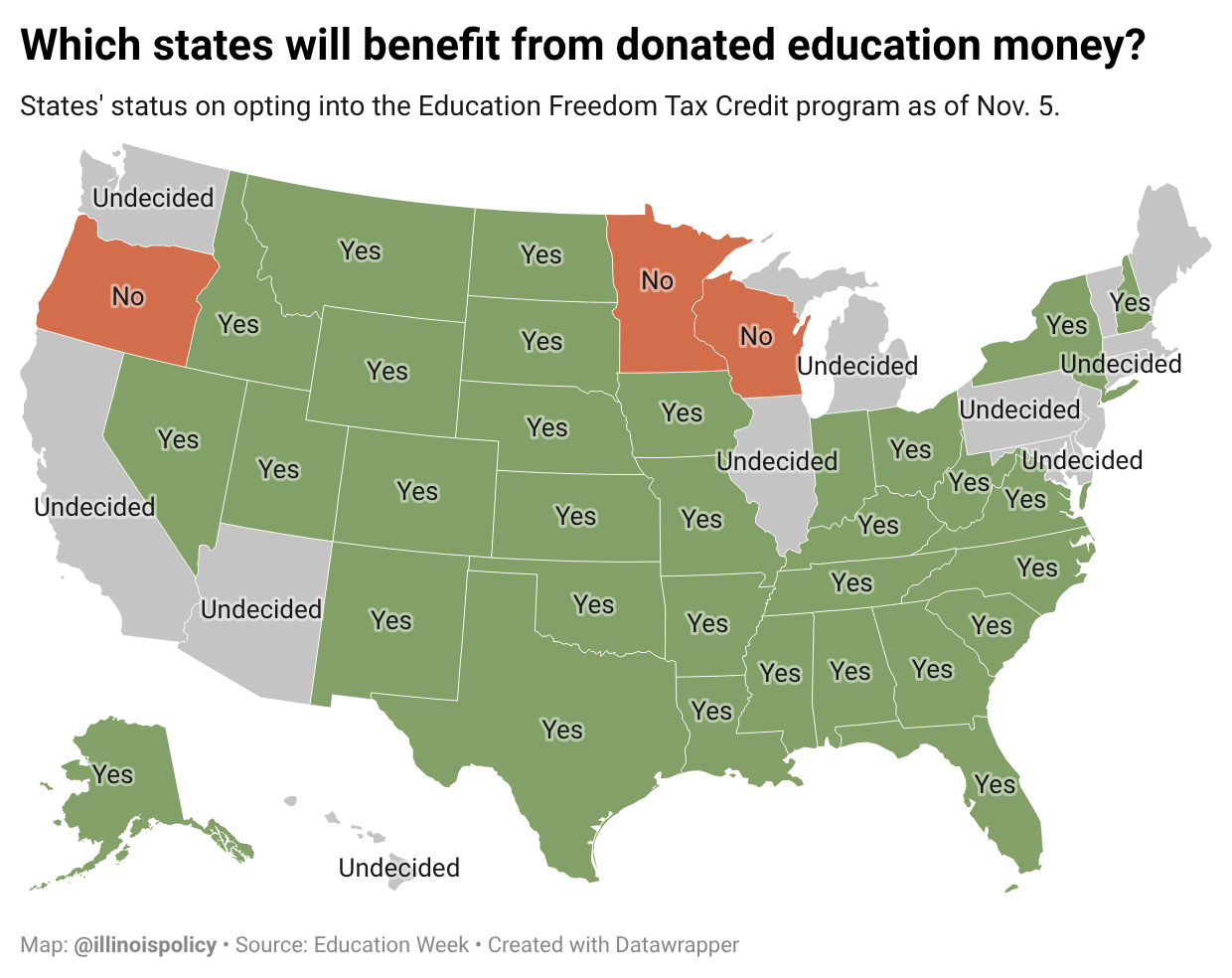
Pritzker must decide by Jan. 1, 2027, whether to opt Illinois into the program.