
California vs. Illinois: Who’s more reckless with pensions?
Gov. Gavin Newsom said no to a sweetener, while Gov. J.B. Pritzker added $11 billion to Chicago’s liabilities.
California Gov. Gavin Newsom took a stand against runaway pension spending this year, vetoing legislation aimed at raising benefits. Illinois Gov. J.B. Pritzker hasn’t done anything similar.
In California, union-backed Assembly Bill 1383 sought to increase pension benefits for public safety employees by reducing the retirement age and raising the pensionable earnings cap. Newsom vetoed the bill, saying it would “significantly increase state and local government costs” and that it “invites further changes that would expose our retirement system to additional risk.”
On the other hand, just last year Pritzker signed legislation to sweeten pension benefits for Chicago’s police and firefighters under Tier 2, a benefit system designed to control the growth of pensions for government workers hired since 2010.
The Pritzker-signed bill will add an estimated $11.1 billion in accrued liabilities by 2055. The move comes as Chicago’s four pension systems sit at a combined funding ratio of 28.1% and are at risk of future insolvency.
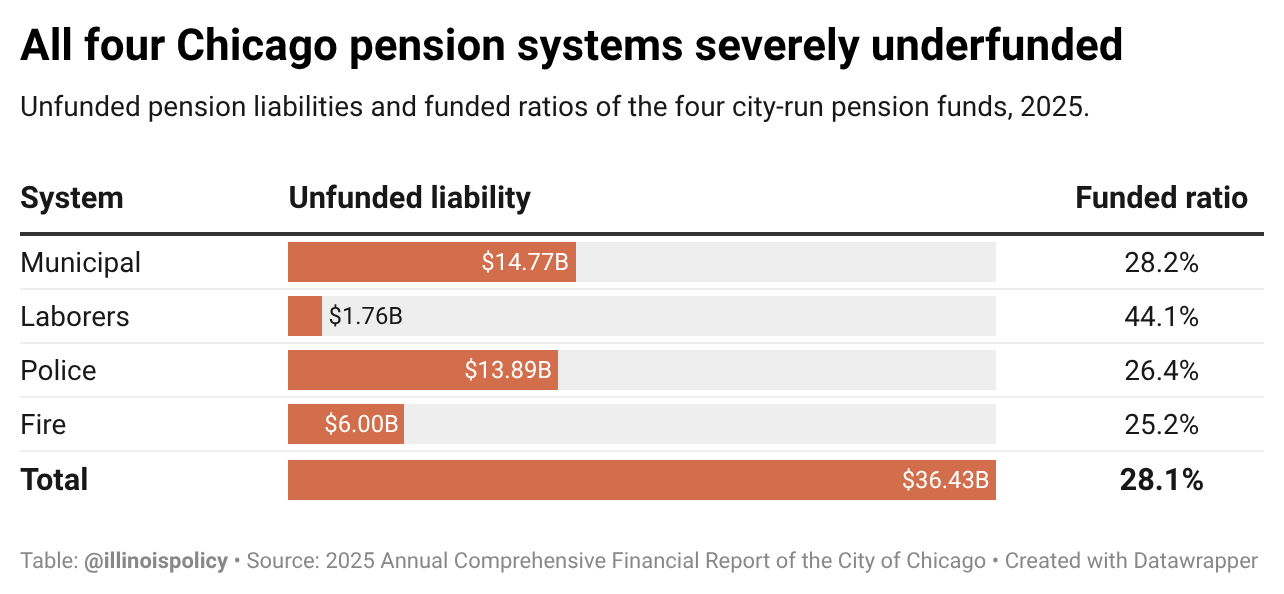
Illinois’ pension crisis is the worst in the country, says an annual report from the Equable Institute. The state’s public-employee pensions have a funding ratio of just 56.4%, lowest in the U.S.
Newsom’s veto should serve as a wakeup call for Pritzker. With a funding ratio of 89% compared to Illinois’ 56%, California’s pension system is in a much stronger fiscal position than Illinois’. Still, Newsom sees the importance of ensuring that state workers have a secure and reliable retirement fund.
It’s not too late for Pritzker to take steps toward fixing Illinois’ pension crisis, and a necessary first move is preventing state legislators from digging an even deeper hole.
State Rep. Stephanie Kifowit, D-Oswego, introduced legislation early this year that would drastically increase Tier 2 benefits.
While an actuarial analysis of House Bill 4673 has yet to be released, an earlier similar proposal from Kifowit was projected to add $60 billion in liabilities.
Given the opportunity, Pritzker should take Newsom’s cue, vetoing any sweetener bills like HB 4673 and putting government workers’ retirement security and Illinois taxpayers’ finances above short-term political wins.
Illinois Constitution prevents benefit reductions
Vetoes alone won’t fix Illinois’ pension crisis. To work toward holistic pension reform, the governor should provide state employees greater retirement mobility by offering defined contribution plans, similar to private-sector 401(k) systems.
Illinois does offer a pension buyout option, which allows retiring workers in the State Employees Retirement System, the State University Retirement System and the Teachers’ Retirement System to take out part or all of their pension’s net present value. They cash out some or all of their benefits at 60% to 70% of face value and can then roll the money into an IRA or 401(k)-style plan and control it.
The program has been extended to June 2028. Senate Bill 3404 would extend eligibility to those in Chicago and Cook County’s pension systems and to downstate police officers and firefighters.
Ultimately, Pritzker will have to deal with the state constitution. Under a 2015 Illinois Supreme Court ruling, a government worker’s pension benefits cannot be reduced in any way after their first day working for the state. That denies Illinois lawmakers the flexibility to make pension decisions necessary for the fiscal health of the state.
Newsom’s veto shows that pension restraint isn’t a partisan issue. It’s politically possible for lawmakers on both sides of the aisle to act against overzealous benefit demands and put forward policies that’ll save a system in crisis.
Related articles: