
Pritzker’s financial disclosure less transparent than Trump’s
Rules are stricter for federal officials than for Illinois politicians.
Illinois’ elected and appointed officials and candidates for office must disclose their financial interests every year, but the documents are an old joke.
Every year, lawmakers and state officials go through the motions of answering the questions on a “statement of economic interest.”
House Speaker Emanuel “Chris” Welch called them “worthless.”
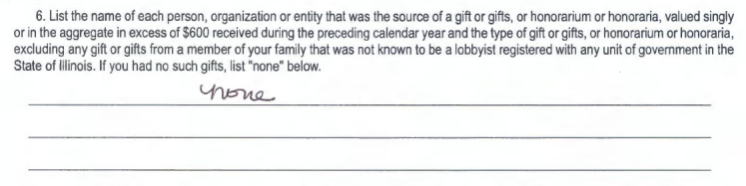
For decades, the forms have been known derisively in some quarters by a different name: “none sheets.” That’s because many filers will tend to answer most questions with one word: “none.”
See, for example, this from recently indicted House Rep. Carol Ammons:
For some, answering the questions requires more detail, but not much. Gov. J.B. Pritzker’s 2026 statement required a seven-page appendix identifying the sources of his assets and income worth more than the minimum threshold amount required by Illinois law: $8,700 for any one source of income and $11,600 for any individual asset.
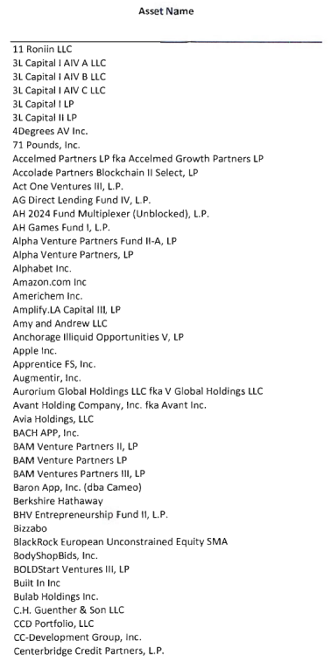
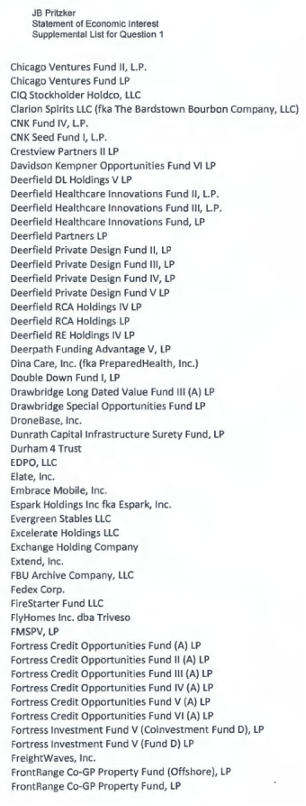
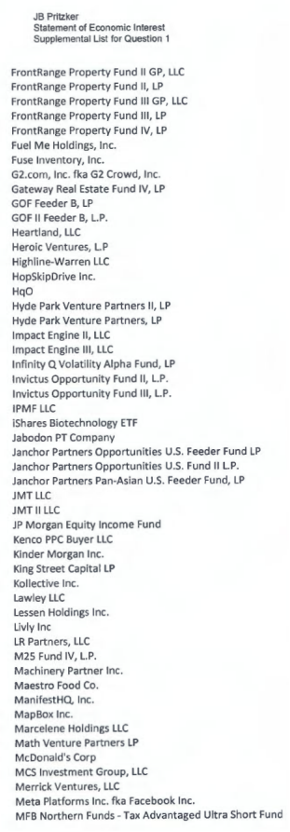


That translates to a long list of names — mostly investment vehicles — but little else.
Federal rules are more stringent.
Compare Pritzker’s relatively sparse disclosures to President Donald Trump’s 927-page report filed with the federal Office of Government Ethics in the same year. While Trump is not required to report the exact amount of his employment assets or income or the balances in retirement accounts, he does have to categorize them within ranges and do the same for his wife’s income.
Trump’s report also contains his ownership percentage for many of those assets and accounts, his liabilities, a list of transactions and their value range, and even a class designation and description for the trademarks he owns.
Asking Illinois to match federal requirements may be going too far, and not every local public servant or appointee deserves the same scrutiny as state-level officials and lawmakers.
But with Illinois’ longstanding culture of corruption, weak ethics rules and nonexistent conflict-of-interest prohibitions, the state could stand to impose more detailed financial disclosure requirements on its top-level officials and lawmakers.
At least something more than a list of “nones.”
Related articles: