
Indiana, Missouri top Illinois on removing barriers to work
The state beats most for low licensing barriers but should take notes from Missouri and Indiana.
A new index ranks Illinois relatively high for low barriers to occupational licensing, but two neighbors show how the state could improve.
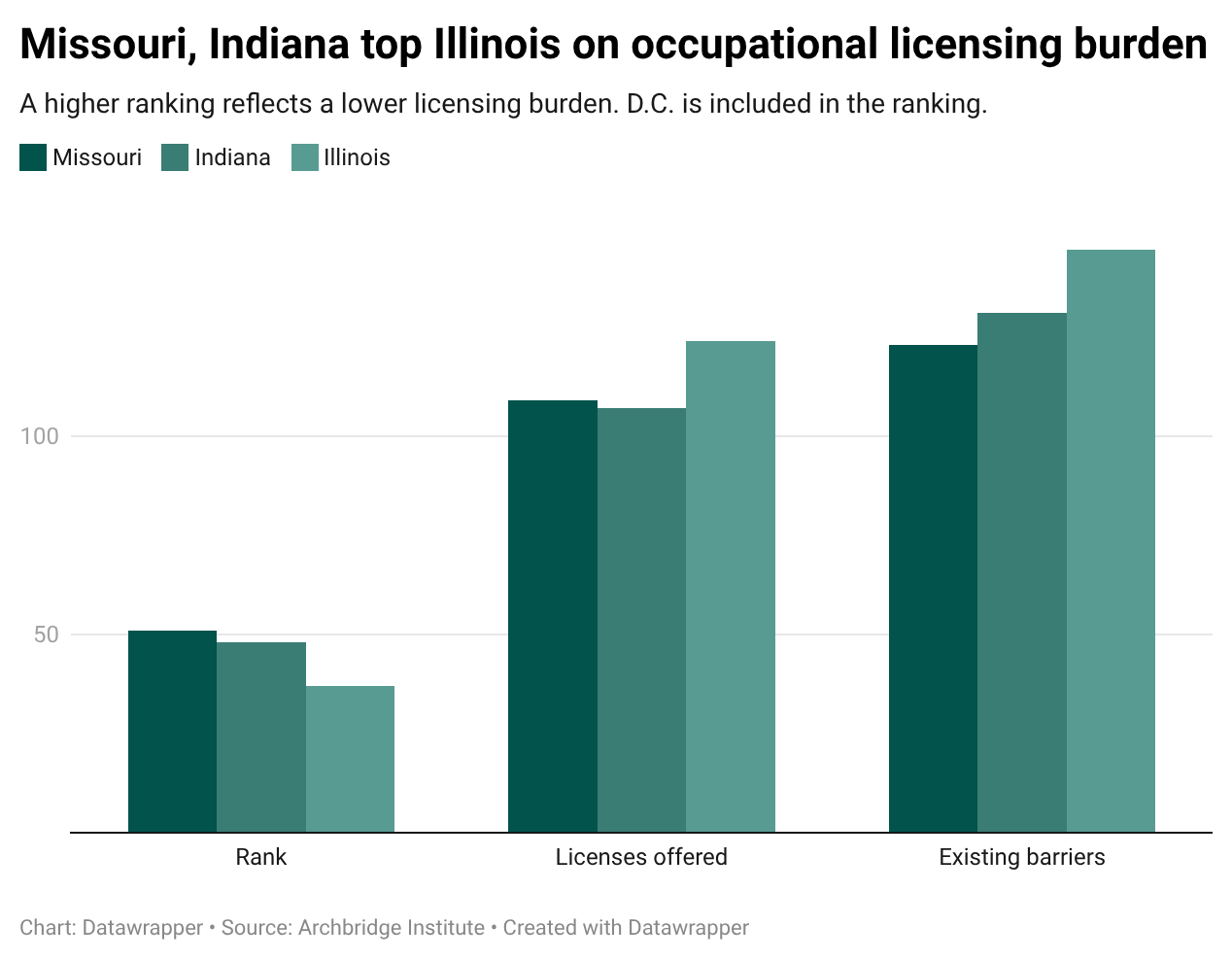
Illinois has the 15th-lowest occupational licensing burden in the nation, according to the Archbridge Institute. Missouri ranked best and Indiana came in fourth.
Defining ‘barriers’
Archbridge delineates two types of barriers, artificial and natural, and uses artificial in its index. They are “imposed from an external authority” … and “are typically those imposed by some level of government,” Archbridge says, but “occupational licensing requirements are one of the most direct forms of artificial barriers.”
What do Missouri and Indiana do differently?
Simply put, they require occupational licenses for fewer jobs and impose fewer barriers. Illinois requires licenses for 124 professions, and Archbridge counts 147 barriers to obtaining a license in the state.
Indiana requires licenses for 107 professions, with 131 barriers, and Missouri requires licenses for 109 jobs, with only 123 barriers to obtaining a license.
Both Missouri and Indiana have adopted universal recognition, which allows a worker with a license in another state to get permission to work in another state without repeating the entire licensing process. Illinois has no such law.
To get that permission, “applicants must hold a license in good standing in their home state” … and “they may still be required to pay fees or take exams administered by the board in the recognizing state,” according to the Institute for Justice.
Missouri and Indiana got “gold” ratings from Archbridge because their universal-recognition laws do not have a residency requirement or a “substantially similar” licensing requirement.
Some states “limit universal license recognition to residents” of that state, the Institute for Justice says. Other states “boards only grant licensure if the home state license requires ‘substantially equivalent’ education, experience, or training.” That can penalize a person coming from a state whose requirements aren’t as demanding.
Why does this matter?
Licensing determines whether someone must get government permission and often spend time and money before legally working in a particular occupation. This burden affects more than 20% of U.S. workers and close to 25% of working Illinoisans.
Here’s what Illinois could do:
- Strengthen sunset reviews, which ensure that occupational licensing restrictions aren’t more burdensome than necessary for public health and safety.
- Eliminate licenses for occupations safely practiced without them in other states.
- Establish alternative pathways to licensure. The state took a step in this direction this year, with Gov. J.B. Pritzker signing a law that will allow aspiring barbers, cosmetologists, estheticians, nail technicians and hair braiders to qualify for a licensing exam by completing a paid internship rather than potentially expensive schooling.
- Allow online educational options.
- Adopt universal licensing recognition.
In occupational licensing barriers, Illinois shouldn’t settle for beating the national average when neighboring Missouri and Indiana offer ways to do even better.
Related articles: