Solutions for vacant lots would reduce crime and poverty in Chicago
By LyLena Estabine
Solutions for vacant lots would reduce crime and poverty in Chicago
By LyLena Estabine
Around 41,000 privately owned and 7,100 city-owned vacant lots take up space across Chicago’s South and West sides. These vacant lots result from many years of negative government actions, from the sanctioning of racial discrimination starting in the 1930s to poor financial leadership that has led to high property taxes. They are not just a visual nuisance; they encourage crime, which in turn discourages community connection and economic development. Less housing and fewer businesses allow high poverty rates to persist.
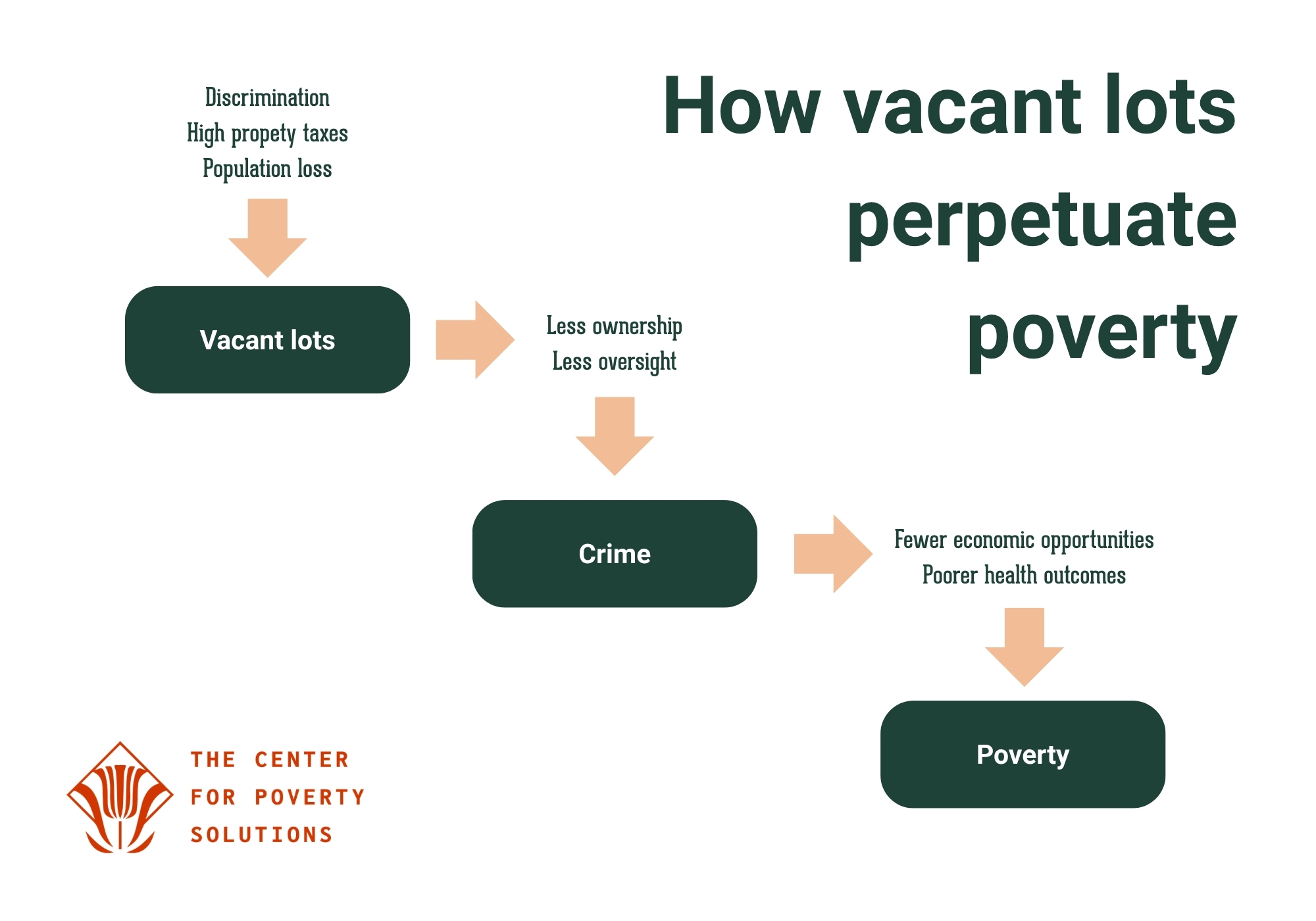
Breaking the cycle of poverty on the South and West sides, therefore, is tied to development of these vacant lots. Research has linked vacant lot redevelopment to increased feelings of safety, reduced crime and increased neighborhood engagement. That engagement is necessary to attract the business and housing development needed to enable people in these communities to rise out of poverty.
While the city of Chicago has taken steps to encourage the development of its vacant lots, more could be done. Free-market solutions for vacant lot eradication in Chicago include:
- Increasing options for vacant land development.
- Reducing the bureaucratic and regulatory barriers to building housing on vacant land.
- Lowering property taxes.
- Establishing temporary property tax abatements in community areas with greater than 10% vacant land.
These policies would address the challenges to development on the South and West sides, empowering more people, community groups and businesses to build, reducing poverty as a result.
Background: Chicago’s vacant land problem
Chicago has nearly 41,000 privately owned vacant lots, with 52% in areas zoned for single-family housing and the vast majority in areas where they could be used for housing or businesses. These lots are concentrated on the South and West sides.1
The city is the largest owner of vacant lots, with just over 7,100 parcels as of August 2026. Almost 70% of those are zoned for residential use.2
In 2023, the land mass of the city’s vacant lots was estimated to be roughly equivalent to the size of the downtown Loop neighborhood.3 The community areas with the highest number of vacant lots are Englewood, West Englewood, New City and North Lawndale.4
As of August 2026, 87% of city-owned vacant land sits in predominantly Black communities5, along with over 62% of privately held vacant land.6 This stems from the story of how so many vacant lots came to be.
Redlining’s tie to today’s distressed properties
The persistence of vacant lots on the South and West sides is a complex challenge that started with man-made — specifically government-made — actions.
From the 1930s to the 1960s, the federal government sanctioned “redlining,”7 or intentionally denying traditional home loans to residents in minority areas. The Federal Housing Administration created maps of every city that indicated where it was safe to insure mortgages, with the areas in red indicating where it was deemed too risky to do so. Those areas were where African-Americans lived or near where they lived.8
This led to the residents in these communities, barred from living elsewhere, being forced into contract sales to buy a home. Contract sales frequently exploit buyers by charging far more than a home is worth, imposing costly financing terms and denying them any ownership stake until the entire balance has been repaid. This unfair loan structure often led to default and eviction, or to a lack of upkeep on the home so that the buyers could keep up with the loan payments.9 Contract sales led to more abandonment of properties and the demolition of homes. With no additional investment coming in, these lots were left vacant and remain so in many neighborhoods to this day.
The Cook County Treasurer’s 2022 report “Maps of Inequality” found that nearly 57% of the vacant and dilapidated properties in Cook County’s 2022 Scavenger Sale were redlined in 1940, and 40% were “yellow-lined” (a term for areas considered at risk of being redlined). Only 3% are in areas the 1940s Home Owners’ Loan Corp. deemed “Best” or “Still Desirable.” The treasurer found that a formerly redlined property in Chicago is nearly three times as likely to be distressed today. For example, one in four properties on a redlined block in North Lawndale became vacant lots from 1938 to 1973, later doubling to one in two.10
As of August 2026, the city owns 773 parcels in North Lawndale, 500 of which are zoned residential.11
High property taxes compound these effects
Property taxes are a function of two figures: the assessed value of a home or business and the property tax rate set by the taxing body. A taxing body can raise the same amount of money by applying a lower property tax rate to a high-value property as it can by applying a higher rate to a lower-value property.
Illinois families pay the highest property taxes in the nation, and those rates are growing. In the most recent reassessment, in 2024, the median bill for Chicago homeowners rose 16.7%, the largest increase in 30 years.12 Differences in development mean this increase is not felt evenly across the city. In areas with fewer homes and businesses, those who do live and do business there pay more to the multiple taxing districts for any given property. That’s why median homeowner bills in 15 South and West side community areas rose an average of 30%.
At the neighborhood level these figures are even higher. In West Garfield Park the median bill more than doubled, from $1,482 to $3,448 (133%).13 North Lawndale rose from $1,905 to $3,791 (99%).14 Englewood, West Pullman, West Englewood, Fuller Park, New City, East Garfield Park and Riverdale each increased from 54% to 82%.15 By comparison, the median bill in Lincoln Park, an affluent neighborhood on Chicago’s North Side, rose 5.9%.16
These higher effective property tax rates on the South and West sides are partly due to the lower property values left from the discriminatory historical practices. Additionally, higher rates of vacant or blighted properties result in higher effective rates on the properties that remain. This can make ownership in these neighborhoods uneconomical, which creates a vicious cycle of vacancy: rising taxes, dilapidation and more vacancy as people leave.
The declining population on the South and West sides
High property taxes on top of the generally high tax burden Chicago families face and concerns about crime have led to major corporations and many families leaving Chicago. 2025 Census estimates put the city’s population around 2.7 million,18 up since the pandemic but still well below the over 3.6 million residents it had in the 1950s.19 Population loss on the South and West sides in particular amplifies the effects of vacancy.
In Englewood, for example, the population peaked in the 1960s at over 97,000. By 2000 it had fallen to roughly 40,000.20 In 2020 there were only about 24,000 residents.21 On Chicago’s South Side, drivers of population loss include high taxes, deindustrialization and crime. On the West Side, unrest in 1968 destroyed businesses that were never rebuilt.22
Demolitions of housing and businesses often result in land being left vacant. Englewood and West Englewood together had by far the highest number of city demotions in Chicago, and virtually all the lots cleared there remain vacant. Those who own the lots, including the city, come to own them through the foreclosure of demolition liens, the Cook County tax Scavenger Sale, property condemnation and direct purchase.23 Sometimes lots are bought but not redeveloped immediately, with the owner waiting for the value of an area to increase.24 Other times an owner may intend to develop the lot, but the costs of construction or the property taxes that would result from development would make a project unprofitable.
The neighborhoods full of vacant land now impose the highest costs on owners who stay. This discourages the marginal buyer, punishes those who improve their properties or blocks and unintentionally feeds the next round of abandonment. The Center for Poverty Solutions is concerned about vacant lots because of the correlation between the percentage of vacant land in a community and its poverty rate. While poverty can produce vacancy through abandonment, tax delinquency and demolition, vacancy also perpetuates poverty by providing an ideal environment for crime and reducing economic opportunities.
Government choices have encouraged the spread of vacant land; this report focuses on how returning power to the communities where this land is can reduce poverty by deterring crime and encouraging development.
Vacant lots worsen crime
One of the ways vacant lots can perpetuate or worsen poverty is by preserving an environment conducive to crime. Research has found that in low-income neighborhoods, “vacant lots provid[e] concealment for routine drug use and escape routes during police raids. Larger lots with rubble and overgrowth often [become] open-air ‘shooting galleries,’ where heroin and cocaine users sometimes congregated to buy syringes and inject behind bushes, discarded construction materials, or in the ruins of buildings.”25 The research team confirmed that drug dealers did this “to reduce the likelihood of being ‘snitched on’ (i.e., having the police called on them by neighbors).”
This is exactly what has happened in Chicago. The Cook County Treasurer’s 2022 report confirmed that out of the 15 wards with the highest percentage of distressed properties (vacant lots and abandoned houses), 14 had crime rates higher than the citywide average from 2010 to 2020. Past research has found an association between vacant land and the crime rate in Chicago.26 Across the city, neighborhoods where a higher percentage of land is vacant also report higher percentage of people who say “violence occurs in their neighborhood ‘every day’ or ‘at least every week.’”27
Vacant lots encourage crime because they provide space for crimes and visually indicate community decay. A vacant plot has an owner (a city or person who has the deed and pays the property taxes), but it doesn’t get the care and attention typically associated with ownership. In other words, it signals that this is an area where people can get away with behaviors such as gun violence, drug use and law enforcement evasion.28 Furthermore, Branas observed that:
“Urban violence leads to fear, even among residents not directly involved in the violence itself. Together, violence and fear can increase abandonment of previously vibrant city spaces and lead to a spiral of blight and decay in urban neighborhoods.”29
Increased crime worsens poverty
The lack of safety leads to reduced neighborhood connections, which further encourages crime in addition to further harming the physical and mental health of community members. Less-safe neighborhoods mean less walking around the neighborhood (exercise) and fewer connections between neighbors, which can lead to increased isolation, depression, anxiety, etc.30
Additionally, blocks that experience rising crime rates also see less private investment.31 Fewer businesses means fewer economic opportunities, namely jobs. Research indicates that full-time employment is one of the best ways to avoid and get out of poverty.32 Jobs also can reduce crime, particularly among young people.33 Fewer available jobs in these neighborhoods, therefore, reduces the opportunity for people to rise out of poverty.
All this data points toward a solution: Fewer vacant lots in these communities would likely lead to reduced crime, increased neighborhood connections and greater economic opportunity. Combined, these effects would help reduce poverty where it is most needed.
Better use of vacant lots reduces poverty
A better use of vacant lots has the power to reduce poverty in Chicago communities by reducing crime, increasing housing access, creating economic opportunities and facilitating community connections and ownership.
A study found that those near where vacant lots were eliminated through community care (community gardens) “experienced significantly reduced perceptions of crime…and vandalism…across all neighborhoods. This group of people also reported significantly reduced safety concerns related to going outside their homes and significantly increased use of outside spaces for relaxing and socializing.”34
This is important because other scholars have observed that social engagement within a community is important for managing criminal activity. Research has found that crime rates “are related to neighborhood ties and patterns of interaction…social cohesion and informal social control…institutional resources…and routine activity patterns, especially mixed land use and proximity to schools and malls.”35 Perhaps more significantly, while these results were observed across all neighborhoods, in “neighborhoods below the poverty line these effects were…more pronounced with reductions in all crimes…gun assaults…and burglaries.”36
In addition to health benefits from walking around the neighborhood and street-level socialization, reducing vacant lots could encourage businesses to return to these areas, given the subsequent increase in foot traffic and the establishment of a safe environment. When vacant lots are turned into housing and businesses specifically, the positive effects are even more pronounced than when turned into a community garden. One study found “an association between vacant lot redevelopment [i.e. housing and businesses] and lower rates of aggravated assault, firearm aggravated assault, and overall firearm violent crime.” The study suggested that by “removing signs of abandonment,” the violence is prevented or displaced.37
This theory has been supported in other cities. In 2011, Philadelphia began implementing the Doors and Windows Ordinance. The ordinance requires abandoned buildings to have working doors and windows on any structural openings. Lot owners who did not comply could face a fine of $300 a day. From 2011 to 2014, the National Institute of Justice reported, 29% (676 out of 2,356) of cited buildings complied.38 The Pennsylvania Supreme Court upheld the ordinance in 2018, reversing a ruling from a lower court. The city reported a 75% compliance rate for those who had to show up in blight court, bringing to almost 1,300 properties improved through the ordinance.39 A study on the ordinance showed a 2% decrease in all assaults and a 4% decrease in firearm assaults over a two-year period.40
These effects have been seen in studies focused on Chicago from its previous and current options for vacant land acquisition.
Previous and current methods for vacant land acquisition in Chicago
Chicago has taken admirable steps to encourage vacant lot development in recent years. One was the Large Lots program, a city initiative aimed at helping “property owners, block clubs, and non-profit groups in select
Chicago neighborhoods…purchase city-owned land for $1 per parcel.” It was a part of a larger goal to improve neighborhoods and housing, running as a pilot from 2014 to 2018.41
Studies on the program found that it lowered crime rates, poverty rates and unemployment rates and increased the median property value.42 Qualitative studies show that it also empowered residents to feel they could push back against destructive behaviors in their community, establishing an “ethic of care.”43
One study examining the Large Lots program in Chicago found:
“(1) ownership of large lots on blocks had a significant impact on lowering crime density starting one year after lot purchase; (2) visual condition and care of purchased lots was associated with reduced crime density in one of our study sites where the percentage of purchased lots and mean condition-care rating were more than twice as much as those of the other site; and (3) various crime types were impacted differently by ownership and condition-care level. These findings highlight how a resident-led greening strategy based on the transfer of vacant lands to local property owners and their improved condition and care is an effective way to boost neighborhood safety and quality of life by reducing crime incidents.”44
A study of the Large Lots program that used focus groups found that those who were able to take part in beautification efforts had a stronger sense of community and place attachment.45
The development of vacant lots is, in a way, creating visual and cultural ownership that was previously lacking, because ownership is more than having the deed; it’s care and attention. In this way, a house could be thought of as being owned by one person: someone who mows the lawn, paints the trim, keeps the fence repaired, etc. A community garden is a space everybody owns, because it’s the whole community taking part in those upkeep activities. A vacant lot is something nobody owns, which allows disrepair to take hold and crime to grow.
Widespread interest in the Large Lots program and success with sales led to a similar program launching in November 2022,46 this time on a portal called ChiBlockBuilder, with applications accepted until February 2023. Residents could apply for lots with plans to create housing, a side yard, commercial development, or open space for community such as gardens or parks. Over 1,600 applications were received in the first round, with 664 of those for affordable housing and 231 for open spaces.47
One of the most recent rounds was announced in October 2024, with the city specifying what kinds of proposals, or “strategic uses,” it would accept for certain lots. In the announcement of more than 350 lots available, the city specified:
- 44 lots available for “Missing Middle Housing” (One- to six-unit residential buildings).
- 125 lots available for “market rate redevelopment” as “residential, commercial, or mixed-use projects, depending on zoning.”
- 77 lots available for “adjacent property owners as side yards or other uses allowed by zoning.”
- 32 lots available for “community-based agriculture or productive landscapes that must operate for a minimum of 10 years.”
- Five lots available for “community open-space projects that are managed by local residents or organizations.”48
The most recent round was in April 2026, with over 600 lots available for purchase. The specifications were approximately:
- 500 lots available for “new construction projects” at market rate.
- 55 for affordable housing.
- 66 for “side yards, open space and urban agriculture.”49
As of August 2026, the city has sold just over 900 parcels since 2023, with New City and North Lawndale tied for the most (143).50 It’s an improvement, but with 7,000 “available properties” still in the city’s inventory of vacant land, it leaves much to be desired.51
Branas confirms that “direct changes to vacant urban spaces may hold great promise in directly breaking the urban cycle of violence, fear, and abandonment and doing so in a cost-effective way that has broad, citywide scalability.”52 Crime is deterred when ownership — individual or community — replaces vacancy. This reduction in perceived and actual criminal activity encourages community connection (improving health outcomes) and economic opportunity (improving income). These factors can reduce poverty in Chicago’s South and West side neighborhoods. To see these effects take greater hold in Chicago will require several reforms, putting more power into the hands of individuals and groups to acquire and improve these lots.
Solutions
1) Increase options for vacant land development
Identifying who owns a vacant lot and the process for purchase is hard enough; Chicago should take more steps to reduce the hurdles interested community members and groups have to go through to develop vacant land.
For city owned-land, only select parcels are available for sale at a given time through ChiBlockBuilder, limiting the scope for community action. If the city has designated the lot for a purpose other than what the interested resident or group has in mind or has not released it for purchase, the lot may sit vacant. Additionally, even when an applicant otherwise satisfies the city’s criteria, aldermen have significant power to advance, delay or stop a sale. This is because of a tradition known as “aldermanic prerogative,” which generally gives aldermen final say over development in their wards. Aldermanic prerogative is a federally criticized practice that has been tied to discriminatory outcomes and less housing.53
To avoid these complications, the city should institute objective criteria for all proposed vacant lot developments. Also, all vacant lots in the city’s inventory should be made available for sale as soon as possible. Specifying that the lots must be developed within a particular time frame would eliminate the concern over speculative holding and reduce the uncertainty faced by businesses, neighbors and community organizations that may be interested in improving their neighborhood through development.
Furthermore, a city ordinance should be passed allowing vacant land with no development plan to be claimed and tended to by block clubs under four-year stewardship agreements. This would allow for land to not sit empty when community leaders want to put it to use but aldermen envision economic development on the parcel (a business, housing, etc). The four-year agreements would acknowledge potential redevelopment that might happen but allow block clubs to steward the vacant land in the meantime. Because so many block club leaders are providing work through community beautification, development of these lots would not only help prevent crime, but provide more residents — particularly young adults — the opportunity to work.54
2) Reduce the bureaucratic and regulatory barriers to building housing on vacant land
Winning the lot is not the end of the bureaucratic process. Zoning and building codes can add barriers and delays. This is particularly challenging in the case of housing developments. The National Association of Home Builders recently found that regulations now add over 26% to the cost of a new single-family home in the U.S.55 These include costs such as building permit fees, impact fees, building code specifics such as piping or staircase requirements in multi-family dwellings, or even the cost of time spent requesting the ability to build a duplex, three-flat or set of townhomes where only single-family housing is permitted.
Introducing more zoning flexibility on the South and West sides and reducing regulatory burdens on housing would not only reduce vacant lots by encouraging development but increase affordability through housing abundance. For example, in areas where only single-family homes are allowed, permitting duplexes or three-flats would lead to more housing opportunities and lower prices. Where multi-family housing projects are permitted, changing building codes, such as allowing for one central staircase rather than two, could also reduce the cost of construction.56
3) Lower property taxes
High property taxes are part of what can drive a lot to vacancy, and they are also a part of what can make it hard to rebuild. Research has shown that less than half a percentage point increase in property tax rates decreased the number of businesses in a region by 2.7% to 3.2%, with manufacturing hit hardest.57 These effects have been seen on the South and West sides of Chicago, and high rates there continue to punish and disincentivize development of housing and businesses.
Chicago must find a way to prevent property taxes from growing and eventually reduce them so the city can experience economic growth, especially in areas where there is the most potential. The best way to do that is to reduce its spending with a spending cap.
Chicago’s corporate fund spending has far outpaced inflation for the past six years. If the city had had a spending cap during that time, it would have saved $600 million. It’s not too late. A spending cap going forward could save taxpayers millions of dollars, protecting the low-income communities that are suffering from the fiscal irresponsibility of Chicago leadership. Additionally, the city could impose a stricter Property Tax Extension Limitation Law (PTELL). PTELL was enacted to limit how much the property tax levy could increase in a given year, but because of the large number of exceptions, the total property tax levy in Cook County increased by 182% from 1995 to 2024, far above the rate of inflation.58 Reducing those exceptions in the city of Chicago could help slow the growth of property taxes, growth that makes development challenging. More ways to cut city costs have been discussed at length in Chicago Forward 2026, a report produced by the Illinois Policy Institute.59
4) Establish temporary property tax abatement in community areas with greater than 10% vacant land
In addition to bureaucratic and zoning barriers, high taxes and higher-than-average labor costs in Illinois have resulted in stagnant housing development. This is a particular concern for low-income households. It’s estimated that for every 100 extremely low-income rental households, only 34 units are available that they can afford.60 When not enough housing is being built, fewer people migrate to new housing, which further limits the housing units available for low- and moderate-income households. Additionally, a shortage of units leads to higher prices and rents.
This problem has been seen before. In cities such as Detroit and Philadelphia, researchers found that high property taxes depressed home values, deterring new construction even in areas with latent demand. Developers were unable to achieve profitability because taxes would limit how much a buyer would pay, preventing market-rate returns.
These cities also point to a solution, however. The American Enterprise Institute reported that in both of them, a temporary and targeted tax abatement shifted the economics of development by allowing private builders to achieve the profit margins they needed without requiring public expenditure or subsidies.61
In 2000, “Philadelphia had more vacant and abandoned properties per capita than any other large city.” There were “26,000 vacant houses, 31,000 trash-strewn vacant lots, and 2,500 vacant industrial and commercial structures.”62 A key part of addressing this problem was temporary tax abatement. In 2000 the city expanded an existing tax abatement program to newly built residential structures or substantially renovated homes. This was applied uniformly, without discretionary approval, and expired automatically after 10 years. As a result, after decades of decline, Philadelphia’s population grew by 1% from 2000 to 2010 and 5% from 2010 to 2020. Construction activity shifted to the city, revitalizing neighborhoods. Property values for “existing townhomes and two- to four- unit structures” rose “by an estimated $27 billion,” increasing the city’s tax base in the long run.63
Detroit implemented a smaller-scale abatement. It provides a 15-year tax abatement of 50% on single-family, duplex and townhome units in particular neighborhoods. AEI says that “of about 300 single-family homes built in Detroit since 2019 and sold over the last five years, nearly all were constructed” in areas designated for the abatement.64
Illinois has legislation that attempts to provide property tax relief for new development, but ineffectively. House Bill 2621, passed in May 2021, adds “property tax incentives for new constructions and rehabbed residential buildings with seven or more units that set aside 15% to 35% of their units as affordable,” which means rent no more than 60% of the area median income can afford.65 Bills like these, which include affordability requirements and apply only to larger structures, reduce the benefit of the property tax abatement in the first place and limit housing abundance.66
Instead, Chicago South and West side community where at least 8.5% of land is consumed by vacant lots should have a 10-year property tax abatement for new single, duplex, fourplex and townhome construction with no affordability requirements, objective criteria, and by-right qualification.67 In the short term, this would lead to no reduction in property tax revenue, as the abatement would be only on new construction in areas with a large share of vacant land. In 10 years, the abatement would generate a boost in the property tax revenues in these neighborhoods given that it’s been estimated that Chicago loses out on $225 million each year in property taxes because of abandoned and vacant properties.68
That influx of property value, as long as it is not captured by Tax Increment Financing (TIF) districts or PTELL, would lead to a reduction in the large property tax rates on existing homes in these areas. Because TIF districts shift who carries the burden by limiting the ability of regular taxing bodies to raise money from the value of those buildings, and PTELL exceptions can then allow municipalities to raise property taxes even when those TIF districts expire,70 TIF districts and PTELL would counteract the benefits of this policy.
Conclusion
Chicago’s vacant lots problem was created and has been prolonged by government policy. The solution, therefore, is removing the barriers that government policies keep in place that prevent individuals, business and community groups from re-exerting ownership over these spaces. That means making city-owned lots broadly and continuously available under objective rules, reducing aldermanic and administrative discretion, allowing more forms of housing by right, restraining property tax growth and temporarily reducing the tax burden on new construction in the neighborhoods where vacancy is most concentrated. These policies would allow residents, block clubs, nonprofit organizations and builders to pursue different solutions according to the needs of each block.
By reducing opportunities for crime, bringing more residents outside, strengthening community connections and unlocking space for housing and employment, returning vacant land to productive use would remove one of the key physical conditions that allows poverty to persist. It is up to the city to give the people who live closest to the problem the freedom to build the solutions they need.
Endnotes
1 According to a FOIA request obtained by the Illinois Policy Institute from the Cook County Assessor’s Office in July 2026, there are 40,814 parcels of land in Chicago classified as vacant (Code 1-00, 1-90, or 2-41).
2 Author’s analysis of City of Chicago Department of Planning and Development “City-Owned Land Inventory,” Chicago Data Portal, data downloaded Aug. 4, 2026, https://data.cityofchicago.org/Community-Economic-Development/City-Owned-Land-Inventory/aksk-kvfp/about_data.
3 Greg Menti, “How Is Chicago Addressing Its Vacant Lot Problem?” Architect Magazine, March 30, 2023, https://www.architectmagazine.com/aia-architect/aiafuture/how-is-chicago-addressing-its-vacant-lot-problem_o/
4 Author’s analysis of City of Chicago Department of Planning and Development, “City-Owned Land Inventory,” Chicago Data Portal, data downloaded Aug. 4, 2026, https://data.cityofchicago.org/Community-Economic-Development/City-Owned-Land-Inventory/aksk-kvfp/about_data
5 Author’s analysis of City of Chicago Department of Planning and Development “City-Owned Land Inventory,” Chicago Data Portal, data downloaded Aug. 4, 2026, https://data.cityofchicago.org/Community-Economic-Development/City-Owned-Land-Inventory/aksk-kvfp/about_data
6 Author’s analysis of data on the 40,184 vacant land parcels obtained from a FOIA request to the Cook County Assessor’s Office in July 2026.
7 Federal Reserve History, “Redlining,” June 2, 2023, https://www.federalreservehistory.org/essays/redlining.
8 Terry Gross, “A ‘Forgotten History’ of How the U.S. Government Segregated America,” NPR, May 3, 2017, https://www.npr.org/2017/05/03/526655831/a-forgotten-history-of-how-the-u-s-government-segregated-america.
9 Maria Pappas, “Maps of Inequality: From Redlining to Urban Decay and the Black Exodus,” Cook County Treasurer’s Office, July 2022, https://www.cookcountytreasurer.com/pdfs/scavengersalestudy/2022scavengersalestudy.pdf.
10 Pappas, “Maps of Inequality.”
11 Author’s analysis of City of Chicago Department of Planning and Development “City-Owned Land Inventory,” Chicago Data Portal, data downloaded Aug. 4, 2026, https://data.cityofchicago.org/Community-Economic-Development/City-Owned-Land-Inventory/aksk-kvfp/about_data.
12 LyLena Estabine, “Chicago Property Taxes Jump — but Unevenly,” Illinois Policy, March 5, 2026, https://www.illinoispolicy.org/chicago-property-taxes-jump-but-unevenly/.
13 Kade Heather, “West Side Residents Demand Relief from Ballooning Property Taxes,” Chicago Sun-Times, Dec. 8, 2025, https://chicago.suntimes.com/chicago/2025/12/08/cook-county-property-tax-fritz-kaegi.
14 A.D. Quig and Alex Nitkin, “Record Property Tax Increases Slam Chicago Homeowners as Downtown Owners See Cuts,” Illinois Answers Project/Chicago Tribune, Nov. 17, 2025, https://illinoisanswers.org/2025/11/17/record-property-tax-increases-slam-chicago-homeowners/.
15 Ibid.
16 Cook County Treasurer’s Office, Tax Year 2024 Tax Bill Analysis and Statistics, November 2025, https://www.cookcountytreasurer.com/pdfs/taxbillanalysisandstatistics/taxyear2024analysisenglishversion.pdf.
17 Pappas, “Maps of Inequality.”
18 Alex Ortiz, “Chicago’s Population Grew to 2.73M People in 2025, per Latest Estimate,” FOX 32 Chicago, May 16, 2026, https://www.fox32chicago.com/news/chicago-population-grew-2025-census-estimate.
19 Bryce Hill, “Chicago Population Hits Lowest Point Since 1920,” Illinois Policy, Aug. 9, 2024, https://www.illinoispolicy.org/chicago-population-hits-lowest-point-since-1920/.
20 Charlene Rhinehart, “Selling Vacant Lots to Help Revitalize Englewood. Will This Spur Economic Development?” Chicago Southsider, Dec. 27, 2022, updated Jan. 18, 2025, https://chicagosouthsider.com/selling-vacant-lots-to-help-revitalize-englewood-will-this-spur-economic-development/.
21 Manny Ramos, “Englewood’s Population, Housing Stock Plummets, 2020 Census Data Shows,” Chicago Sun-Times, Sept. 26, 2021, https://chicago.suntimes.com/2021/9/26/22685155/west-englewood-population-decline-2020-census-housing-stock.
22 Pascal Sabino, “West Side Neighborhoods That Never Recovered From ’68 Riots Torn Apart by Looting, Fires: History Is ‘Repeating Itself,’” Block Club Chicago, June 1, 2020, https://blockclubchicago.org/2020/06/01/west-side-neighborhoods-that-never-recovered-from-68-riots-decimated-by-looting-fires-history-is-repeating-itself/.
23 City of Chicago Department of Planning and Development, “City-Owned Land Inventory,” ChiBlockBuilder, accessed Aug. 6, 2026, https://www.chicago.gov/city/en/sites/block-builder/home/city-owned-land-inventory.html.
24 Casey Toner, “‘Empire of Neglected and Hazardous Vacant Lots’ Declares Bankruptcy, but City of Chicago Cries Fraud,” Illinois Answers Project, Nov. 14, 2024, updated Jan. 21, 2025, https://illinoisanswers.org/2024/11/14/network-vacant-lots-chicago-declares-bankruptcy-but-chicago-cries-fraud/.
25 Charles C. Branas et al., “Citywide Cluster Randomized Trial to Restore Blighted Vacant Land and Its Effects on Violence, Crime, and Fear,” Proceedings of the National Academy of Sciences 115, no. 12 (2018): 2950, https://doi.org/10.1073/pnas.1718503115
26 Liang Chen and Maria Manta Conroy, “Vacant Urban Land Temporary Use and Neighborhood Sustainability: A Comparative Study of Two Midwestern Cities,” Journal of Urban Affairs (2023), https://doi.org/10.1080/07352166.2023.2168551.
27 Chicago Health Atlas, “Perceived Neighborhood Violence Rate,” accessed Aug. 6, 2026, https://chicagohealthatlas.org/indicators/HCSNVP?topic=perceived-neighborhood-violence-rate. The indicator reports the percentage of adults perceiving violence as a neighborhood problem.
28 Branas et al., “Citywide Cluster Randomized Trial,” 2950.
29 Ibid.
30 Shobha Srinivasan, Liam R. O’Fallon and Allen Dearry, “Creating Healthy Communities, Healthy Homes, Healthy People: Initiating a Research Agenda on the Built Environment and Public Health,” American Journal of Public Health 93, no. 9 (2003): 1446–1450.
31 Johanna Lacoe, Raphael W. Bostic, and Arthur Acolin, “Crime and Private Investment in Urban Neighborhoods,” Journal of Urban Economics 108 (2018): 154–69, https://doi.org/10.1016/j.jue.2018.11.001.
32 Chris Coffey, “Research Shows Education, Full-Time Employment Can Overcome Poverty,” Illinois Policy, June 7, 2024, https://www.illinoispolicy.org/research-shows-education-full-time-employment-can-overcome-poverty/.
33 University of Chicago Crime Lab, “One Summer Chicago Plus,” accessed Aug. 6, 2026, https://crimelab.uchicago.edu/projects/one-summer-chicago-plus/.
34 Branas et al., “Citywide Cluster Randomized Trial,” 2950.
35 Robert J. Sampson, Jeffrey D. Morenoff and Thomas Gannon-Rowley, “Assessing ‘Neighborhood Effects’: Social Processes and New Directions in Research,” Annual Review of Sociology 28 (2002): 458–459, https://doi.org/10.1146/annurev.soc.28.110601.141114.
36 Branas et al., “Citywide Cluster Randomized Trial,” 2950.
37 Nicole Asa et al., “The Association Between Vacant Lot Redevelopment and Violent/Firearm Violent Crime: A Difference-in-Difference Analysis From 2007 to 2023,” American Journal of Public Health 116, no. 1 (2026): 100, https://doi.org/10.2105/AJPH.2025.308269
38 National Institute of Justice, “Program Profile: Doors and Windows Ordinance (Philadelphia, Pa.),” CrimeSolutions, Sept. 6, 2016, https://crimesolutions.ojp.gov/ratedprograms/doors-and-windows-ordinance-philadelphia-pa.
39 Jake Blumgart, “Pa. Supreme Court Restores Philly’s Right to Fight Blight,” WHYY, Sept. 25, 2018, https://whyy.org/articles/pennsylvanias-supreme-court-restores-phillys-right-to-fight-blight-with-fines-for-boarded-windows-and-doors/.
40 Ibid.
41 City of Chicago Department of Planning and Development, “Large Lot Program,” accessed Aug. 6, 2026, https://www.chicago.gov/city/en/depts/dcd/supp_info/large-lot-program.html.
42 Liang Chen and Maria Manta Conroy, “Vacant Urban Land Temporary Use and Neighborhood Sustainability: A Comparative Study of Two Midwestern Cities,” Journal of Urban Affairs (2023), https://doi.org/10.1080/07352166.2023.2168551.
43 Alessandro Rigolon et al., “Transferring Vacant Lots to Private Ownership Improves Care and Empowers Residents: Evidence From Chicago,” Journal of the American Planning Association 87, no. 4 (2021): 571, https://doi.org/10.1080/01944363.2021.1891126.
44 Sara Hadavi et al., “Resident-Led Vacant Lot Greening and Crime: Do Ownership and Visual Condition-Care Matter?” Landscape and Urban Planning 211 (2021): 10-11, https://doi.org/10.1016/j.landurbplan.2021.104096.
45 William P. Stewart et al., “Resident-Led Beautification of Vacant Lots That Connects Place to Community,” Landscape and Urban Planning 185 (2019): 200–209, https://doi.org/10.1016/j.landurbplan.2019.02.011.
46 City of Chicago Department of Planning and Development, “Large Lot Program,” accessed Aug. 6, 2026, https://www.chicago.gov/city/en/depts/dcd/supp_info/large-lot-program.html.
47 City of Chicago Department of Planning and Development, “Application Data,” ChiBlockBuilder, accessed Aug. 6, 2026, https://www.chicago.gov/city/en/sites/block-builder/home/application-data.html.
48 City of Chicago Department of Planning and Development, “ChiBlockBuilder Applications Open for Proposed Development Projects,” October 2024, https://www.chicago.gov/city/en/depts/dcd/provdrs/ec_dev/news/2024/october/chiblockbuilder-applications-open-for-proposed-development-proje.html.
49 City of Chicago Department of Planning and Development, “Mayor Johnson, DPD Announce Spring Purchase Opportunities for Vacant City Lots,” March 31, 2026, https://www.chicago.gov/city/en/depts/dcd/provdrs/ec_dev/news/2026/march/mayor-johnson–ddpd-announce-spring-purchase-opportunities-for-v.html.
50 Author’s analysis of “City-Owned Land Inventory,” city of Chicago.
51 City of Chicago Department of Planning and Development, “Mayor Johnson, DPD Announce Spring Purchase Opportunities.”
52 Branas et al., “Citywide Cluster Randomized Trial,” 2950.
53 Heather Cherone, “Aldermanic Prerogative Fuels Segregation and Violates Black, Latino Chicagoans’ Civil Rights: Federal Officials,” WTTW News, Nov. 28, 2023, https://news.wttw.com/2023/11/28/aldermanic-prerogative-fuels-segregation-and-violates-black-latino-chicagoans-civil.
54 LyLena Estabine, Fighting Poverty with Employment: Chicago Block Clubs, Illinois Policy, accessed Aug. 6, 2026, https://www.illinoispolicy.org/reports/fighting-poverty-with-employment-chicago-block-clubs/.
55 National Association of Home Builders, “Regulatory Costs Jump 40% in Five Years, Add $131,734 to New Home Prices,” June 9, 2026, https://www.nahb.org/news-and-economics/press-releases/2026/06/regulatory-costs-jump-40-in-five-years-add-131734-to-new-home-prices.
56 Zak Yudhishthu and Alex Montero, “Small Lots and the Case for Single Stair Reform,” A City That Works, April 28, 2026, https://citythatworks.substack.com/p/small-lots-and-the-case-for-single.
57 Ali Enami, C. Lockwood Reynolds, and Shawn M. Rohlin, “The Effect of Property Taxes on Businesses: Evidence from a Dynamic Regression Discontinuity Approach,” paper presented at the National Tax Association’s 111th Annual Conference on Taxation, Nov. 17, 2018, https://ntanet.org/wp-content/uploads/2019/03/Session1207_Paper1399_FullPaper_1.pdf
58 Cook County Treasurer’s Office, “Pappas Study Calls for Halt to Runaway Property Taxes,” March 30, 2026, https://www.cookcountytreasurer.com/newsarticle.aspx?articleid=2231.
59 Ravi Mishra and Lauren Zuar, Chicago Forward 2026: A Pro-Growth Plan to End City Budget Deficits, Illinois Policy, Oct. 13, 2025, https://www.illinoispolicy.org/reports/chicago-forward-2026-a-pro-growth-plan-to-end-city-budget-deficits/.
60 Housing Action Illinois, “Report Finds Deficit of Rental Units for Extremely Low-Income Renters in Illinois,” March 5, 2026, https://housingactionil.org/blog/2026/03/05/report-finds-deficit-of-rental-units-for-extremely-low-income-renters-in-illinois/.
61 Tobias Peter, Tax Abatements: The Best-Kept Secret to Revitalizing Struggling Communities—Without Spending Taxpayer Money, American Enterprise Institute, February 2025, https://www.aei.org/research-products/report/tax-abatements-the-best-kept-secret-to-revitalizing-struggling-communities-without-spending-taxpayer-money/.
62 Bendix Anderson, “Philadelphia Turns to Housing,” Affordable Housing Finance, Jan. 1, 2008, https://www.housingfinance.com/news/philadelphia-turns-to-housing_o.
63 Edward J. Pinto and Tobias Peter, “Tax Abatement,” presentation at the American Enterprise Institute Housing Center’s 14th Annual Housing Conference, Oct. 30, 2025, https://www.aei.org/wp-content/uploads/2025/04/14th-Annual_Day-2_Panel-2_Presenter-1_Ed-Pinto_Tobias-Peter_Tax-Abatement.pdf.
64 Edward J. Pinto and Tobias Peter, Closing Detroit’s Appraisal Gap: A Market-Based Strategy to Revive Vacant Neighborhoods — Lessons for Struggling Cities Across the Nation, American Enterprise Institute, Feb. 24, 2026, https://www.aei.org/wp-content/uploads/2026/02/Closing-Detroits-Appraisal-Gap-Case-Study-final.pdf.
65 City of Chicago Department of Housing, State Property Tax Incentives + ARO, accessed Aug. 6, 2026, https://www.chicago.gov/content/dam/city/depts/doh/aro/State_Property_Tax_Incentives+ARO.pdf.
66 Josh Bandoch and LyLena Estabine, Mandating Unaffordability: How Chicago’s Housing Affordability Requirements Decrease Supply and Increase Costs, Illinois Policy, Oct. 1, 2025, https://www.illinoispolicy.org/reports/mandating-unaffordability-how-chicagos-housing-affordability-requirements-decrease-supply-and-increase-costs/.
67 According to data from the Chicago Metropolitan Agency for Planning, 17 community areas would be eligible for this policy: South Chicago, Englewood, Grand Boulevard, Washington Park, West Englewood, West Garfield Park, North Lawndale, East Garfield Park, Hegewisch, Fuller Park, Douglas, Riverdale, Pullman, Oakland, West Pullman, New City and Woodlawn.
68 Elizabeth Taddie Larson, “Blank Spaces: Analyzing Reforms to Chicago’s Commercial Vacant Lot Problem,” University of Chicago Business Law Review, Nov. 28, 2023, https://businesslawreview.uchicago.edu/online-archive/blank-spaces-analyzing-reforms-chicagos-commercial-vacant-lot-problem.
69 LyLena Estabine, “Cook County TIFs Cost Taxpayers Over $2 Billion,” Illinois Policy, April 1, 2026, https://www.illinoispolicy.org/cook-county-tifs-cost-taxpayers-over-2-billion/.
70 Illinois Department of Revenue, The Property Tax Extension Limitation Law: A Technical Manual, PTAX-1080, rev. Dec. 2013, 14, https://tax.illinois.gov/content/dam/soi/en/web/tax/research/publications/documents/localgovernment/ptax1080.pdf. The manual explains: “The limiting rate formula allows a taxing district to receive additional taxes in proportion to the value of property annexed, new property construction, and the TIF increment the year that the TIF expires. If property is disconnected from the district, the extension is reduced proportionally.”