
Illinois’ 2nd-largest government union spent 38 times more on politics than member representation
Not even 2% of SEIU State Council’s spending in 2025 was on “representational activities,” according to its own accounting. That could be why one-in-five workers has rejected union membership.
One of the biggest political players in Illinois is the Service Employees International Union.
In fact, the union’s own public records prove it prioritizes politics over its members.
The SEIU Illinois State Council is the umbrella affiliate of seven other SEIU affiliates, including SEIU Healthcare. Each year the State Council files a report with the U.S. Labor Department describing its membership and spending.
What its official report — signed under oath by union leadership — reveals should concern members:
- Not even 2% of SEIU State Council’s spending in 2025 was on representing workers.
- SEIU State Council spent 38 times more on politics in 2025 than it did on representing members.
- One-in-five workers represented by SEIU State Council have rejected union membership.
State and local government workers don’t have to be SEIU members to keep their jobs. They can opt out of membership and stop paying dues. Learn more at LeaveSEIU.com.
Not even 2% of SEIU State Council’s spending was on representing workers
Most of SEIU State Council’s spending in 2025 was diverted away from “representational activities.” Again, that’s according to the union’s own accounting.
SEIU State Council spent over $2.2 million in 2025, yet just over $42,000 was on representing workers — not even 2% of the total. The Labor Department defines representational activities as including the negotiation of a collective bargaining agreement and the administration and enforcement of the resulting contract — the core purposes of a union.
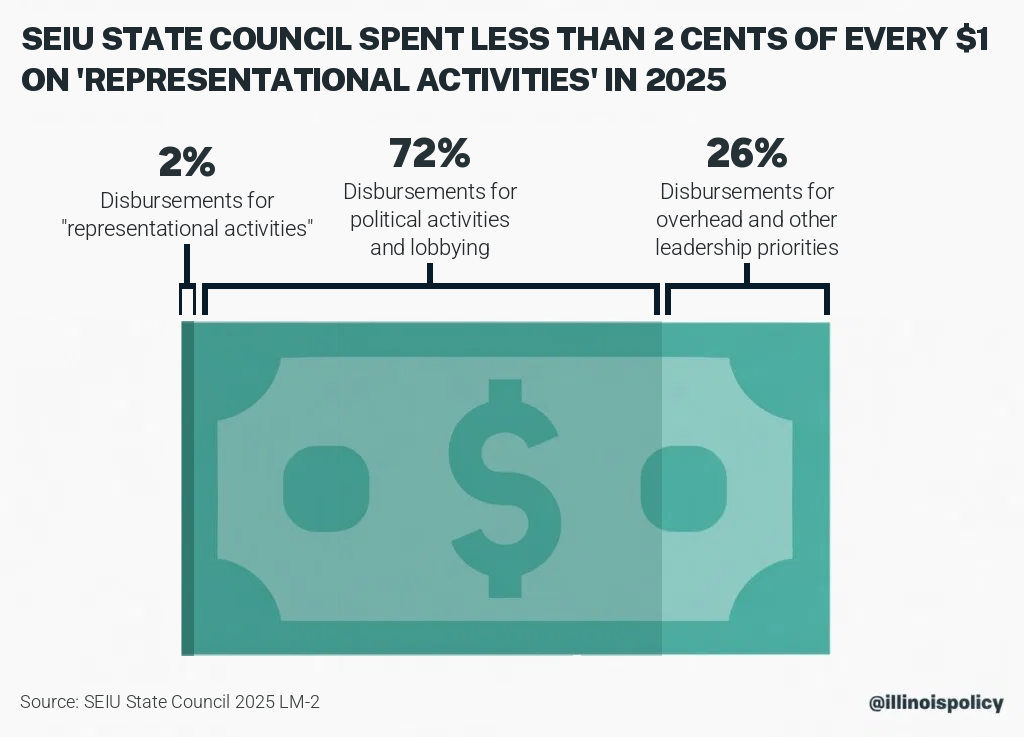
To put this in perspective, the Better Business Bureau’s Standards of Charitable Accountability say at least 65% of a nonprofit’s expenses should be used for program activities.
SEIU State Council spent 38 times more on politics in 2025 than it did on representing members
Most of the union’s spending went toward politics. SEIU State Council spent $1.6 million on political activities and lobbying in 2025. Political spending made up 72% of its total spending.
Over $1.1 million went to the SEIU State Council’s political action committee. From there, members have no say on what causes or candidates that money supports.
Altogether, SEIU State Council spent 38 times more on politics than it did on representing members. That wasn’t a one-time spending spree. The SEIU State Council routinely spends more on politics than it does on representing workers.
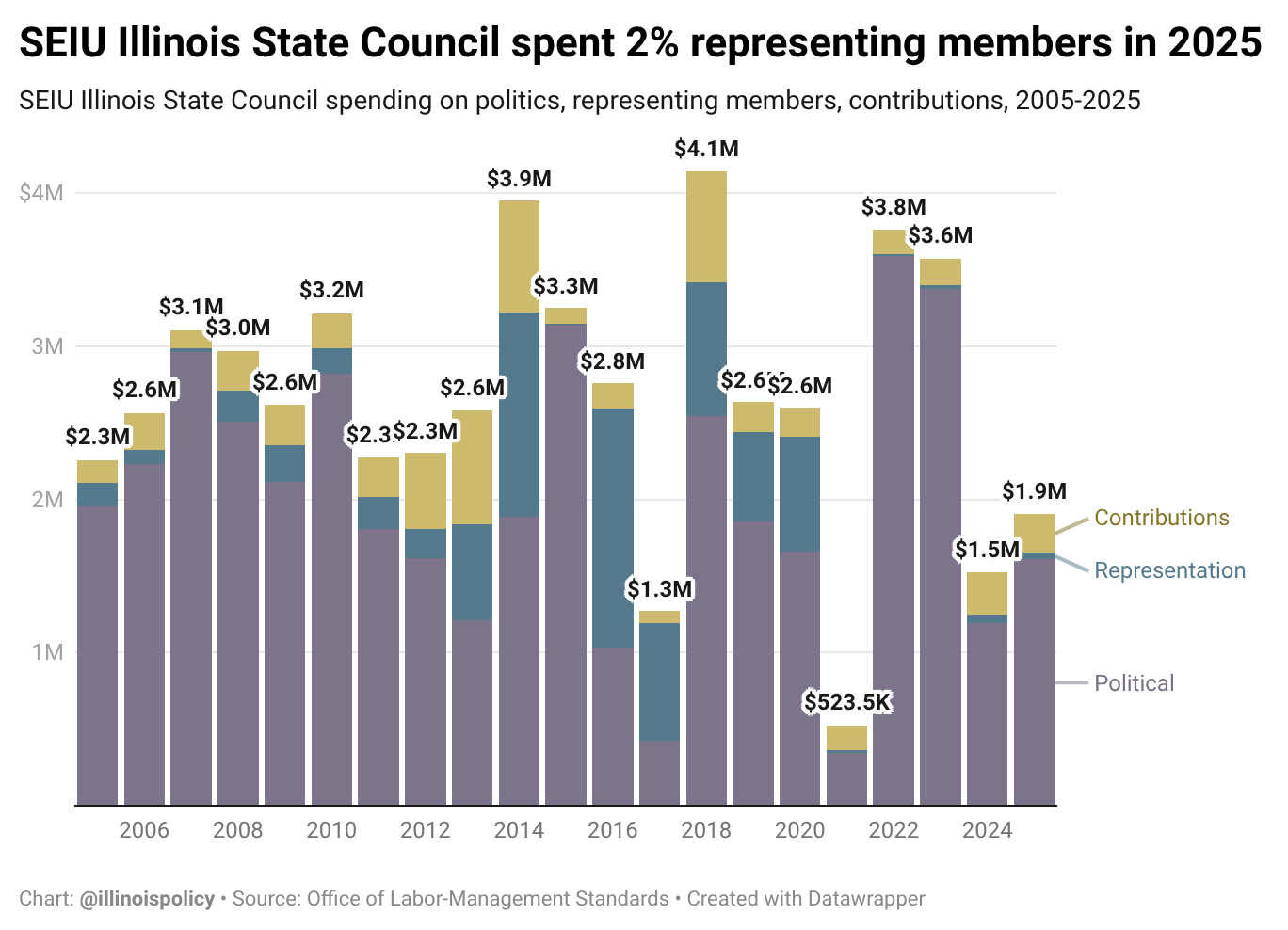
In addition to politics and lobbying, in 2025 the union made more than $250,000 in “contributions, gifts and grants,” which are often political in nature. For example, the union funneled $15,000 to Equality Illinois, which works to defeat bills limiting girls’ sports to biological females, a polarizing issue for many Illinoisans. SEIU State Council also gave $10,000 to the Illinois Democratic County Chairs’ Association, which was formed to support the agenda of the Democratic Party.
One-in-five workers represented by SEIU State Council have rejected union membership
SEIU State Council claims it is “a union 160,000+ members strong.” But its report shows it had just 129,346 members in 2025.
That difference of over 30,000 members means one in five have rejected union membership.
It’s no wonder, when the union spends 38 times more on politics than it does on representing its members.
State and local government workers who don’t agree with the union’s spending practices can opt out of union membership and keep their jobs.
By opting out, workers can stop paying dues to the union yet retain all benefits in their collective bargaining agreements.
For more information on how to opt out, visit LeaveSEIU.com.
Related articles: