
SEIU Healthcare misleads about member numbers, spends little on the ones it has
While its members make modest wages, dozens of the union’s staffers are paid $100,000 or more.
Federal reports filed each year by SEIU Healthcare might concern its thousands of members across Illinois. The union is even misleading them about its membership.
The most recent report, filed with the U.S. Labor Department, shows that:
- Thousands of workers represented by SEIU Healthcare have rejected union membership.
- Less than 20% of SEIU Healthcare’s spending is on representing workers.
- SEIU Healthcare spends millions on politics.
- Dozens of SEIU Healthcare’s leaders and employees rake in over $100,000 a year — in stark contrast to the modest wages of its members.
- SEIU Healthcare spent nearly $1 million on travel and food, for unknown reasons.
State and local government workers don’t have to be SEIU Healthcare members to keep their jobs. They can opt out of membership and stop paying dues without losing any benefits in their contracts. Learn more at LeaveSEIU.com.
Thousands of workers have rejected SEIU Healthcare membership
SEIU Healthcare claims to represent 90,000 workers across Illinois, Indiana, Missouri and Kansas. But its most recent report to the Labor Department paints a different picture:
The union admits it had just 73,898 members in 2025 in that report.
That means over 16,000 workers have rejected union membership.
That doesn’t mean those workers lose out on raises or benefits negotiated by the union. Employers must treat union members and nonmembers the same. Government workers represented by SEIU Healthcare can opt out of union membership and keep all the benefits provided by their employers in the union contract. Learn more at LeaveSEIU.com.
Less than 20% of SEIU Healthcare’s spending is on representing workers
Most of SEIU Healthcare’s money was diverted away from “representational activities,” which should be the core purpose of a union. Again, that’s according to the union’s own accounting.
Of the nearly $65.7 million SEIU Healthcare spent in 2025, just over $13 million went to representing members. That’s not even 20%. The rest went to overhead, politics and other priorities set by the union’s bosses.
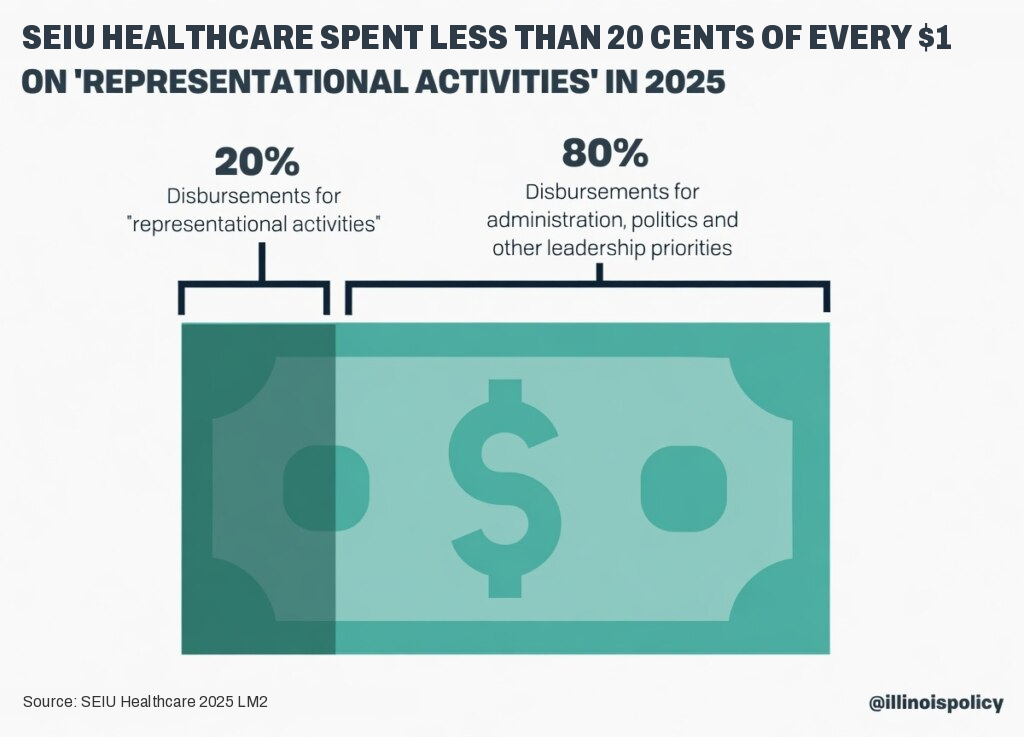
The Labor Department defines representational activities as including the negotiation of a collective bargaining agreement and the administration and enforcement of the resulting contract — the core purposes of a union.
Yet SEIU Healthcare has this backwards: Not even 20% of its spending is on core programming. To put this in perspective, the Better Business Bureau’s Standards of Charitable Accountability say at least 65% of a nonprofit’s total expenses should be used for program activities.
SEIU Healthcare spends millions on politics
SEIU Healthcare says it spent $2.2 million in 2025 on “political activities and lobbying.”
The largest recipient was its own political action committee, which received more than $1 million. From there, members have no say about the political causes and candidates that money supports.
The union also spent $381,000 in other contributions, gifts and grants, which can be political. It donated $15,000 to Missouri WIN, an organization that does “progressive educational outreach,” according to Charity Navigator.
Dozens of SEIU Healthcare’s leaders and employees rake in over $100,000 a year — in stark contrast to the modest wages of its members
Those who work for SEIU Healthcare are well compensated. The top 13 union staffers all made over $150,000 in 2025, with 58 its officers and employees earning six-figure incomes.
This is in stark contrast with the wages of the workers the union represents.
Thousands of SEIU Healthcare workers provide care through government-funded programs, such as personal assistants in Illinois’ Home Services Program and child care providers in the Child Care Assistance Program.
Personal assistants were paid $18.75 an hour in 2025, according to SEIU Healthcare’s collective bargaining agreement with the state.
Child care providers receive a daily rate, per eligible child, based on the county and the age of a child. As of July 1, 2025, a child care provider in Cook County providing a full day of care for an eligible 3-year-old would receive $47.51 for the day. A provider in Peoria County would earn $42.76 for the same child, and one in La Salle County would earn $33.63. If the care was less than five full hours, providers received only a part-day rate.
The most a child care provider could receive was a daily rate of $56.05 for an eligible child under 2 in Cook County and some collar counties.
Personal assistants and child care providers then hand over $264 to $1,260 a year in dues.
SEIU Healthcare spent nearly $1 million on travel and food, for unknown reasons
SEIU Healthcare spent over $1 million on airlines, hotels, transportation and food in 2025, generally for unspecified purposes.
The union spent over $175,000 on airlines. But the listed purpose on its federal report for each line item was either “airline” — which doesn’t reveal a purpose for the spending — or not itemized at all.
Similarly, the union spent over $198,000 on restaurants and catering, but the only reason given was “meals,” or else no reason was given at all.
Union members can only guess why the union spent this money.
State and local government workers may not agree with the union’s spending practices, or they may feel the union doesn’t represent them well. Whatever the reason, they don’t have to be union members to keep their jobs.
As former SEIU Healthcare member Karena Cozad once put it, “There’s no benefit to [being in the union.] As far as I’m concerned, union [leaders] seem to be out for themselves.”
By opting out of union membership, workers can stop paying dues to the union yet retain all benefits in the collective bargaining agreement with their government employer. That includes personal assistants and child care providers who are paid by the state.
For more information on how to opt out, visit LeaveSEIU.com.
Related article:
1-in-3 reject union membership in AFSCME Council 31