

Violent crime can hurt job opportunities in high-poverty neighborhoods
Policymakers can create conditions to help businesses and residents succeed.
Persistent violent crime can make finding a path to a career difficult for Chicagoans living in high-poverty neighborhoods.
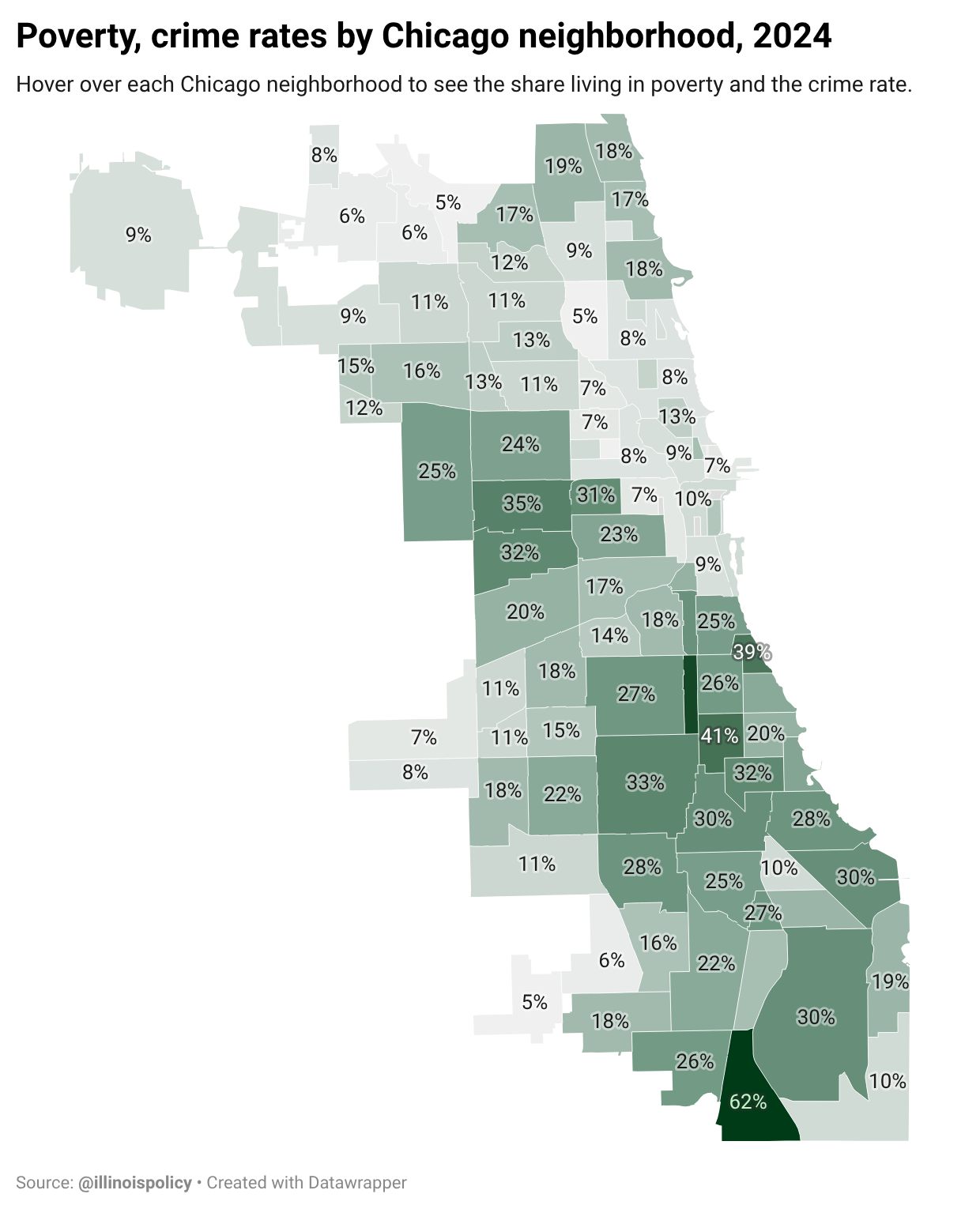
Most violent crimes reported in Chicago in 2024 were in “high-poverty” neighborhoods, despite those communities accounting for only a third of the city’s population.
These neighborhoods — where more than one in five residents live in poverty — accounted for 63% of all violent crimes and 79% of homicides that year.
Citywide, neighborhoods with higher rates of violent crime tended to have higher rates of poverty and unemployment.
While it’s not clear that poverty causes crime, research shows that persistent unemployment and a lack of economic opportunity can contribute to conditions associated with more crime.
Once crime becomes entrenched, it can further weaken the economic opportunities residents need to escape poverty.
Employment is one of the clearest paths out of poverty. In 2024 in Chicago, only 2.4% of people with a full-time job were living below the poverty line.
That year the U.S. poverty threshold was $15,060 for an individual or $31,200 for a family of four.
Link between more crime, fewer jobs
Chicago crime data and federal poverty data show that communities with higher crime rates also tended to have higher unemployment.
The Brookings Institution has identified fewer work opportunities, weaker professional networks, abandoned businesses and vacant lots as common factors associated with neighborhood poverty and violent crime.
Research from the Urban Institute found that increases in gun violence across three major cities were associated with fewer business establishments, fewer jobs and lower business sales.
The research found that in a given Minneapolis census tract, each additional gun homicide was associated with 80 fewer jobs the next year.
Economic opportunity belongs in the public safety conversation. Limited access to work can contribute to conditions associated with crime. Persistent crime can make it harder to create the jobs, businesses and investment needed to reverse those conditions.
For residents trying to escape poverty, these conditions can compound each other. When violent crime is common, businesses may be less willing to open, expand or invest in a neighborhood. Residents may be less willing to spend time in local businesses or feel like they can travel safely to jobs and services.
Fuller Park on Chicago’s South Side illustrates how these challenges can overlap.
More than half of Fuller Park residents lived below the poverty line in 2024, and more than one in five were unemployed. The neighborhood also reported higher rates of crime, violent crime and homicides per resident in 2024 than any other Chicago neighborhood.
Breaking the crime and poverty cycle requires creating conditions in which Chicago residents and businesses can succeed. Chicagoans are already taking steps to create these conditions in their own communities.
Ways to improve conditions
The Center for Poverty Solutions works with block club leaders operating in some of the city’s highest-poverty neighborhoods. One is Jeff Maxwell, founder of the Chicago Peace Initiative.
These community-based organizations have taken an on-the-ground approach to the problem — working to expand access to workforce training and employment opportunities and building civic cohesion at the block level.
Since starting his work in his home neighborhood of Englewood more than a decade ago, Maxwell has helped over 3,000 people reenter the workforce as a way to combat gang violence.
“The Chicago Peace Initiative helps address this gang problem by offering youth an alternative…,” Maxwell said. “We teach them life skills that they’re going to need, whether it’s help getting their GED, financial literacy training or connecting them with economic opportunities at a young age.”
Policymakers can help strengthen the efforts of community-based organizations like Maxwell’s by focusing on reforms that reduce barriers to work and expanding those opportunities citywide. State and city leaders can help by pursuing policies that have been shown to reduce crime and create pathways to employment such as reducing barriers to work, activating vacant lots and expanding access to workforce training for in-demand careers.
These policies cannot solve violent crime by themselves. But expanding economic opportunity can help break the cycle and give Chicagoans a stronger path out of poverty.