How will Chicago address a projected $882 million budget deficit?
Aldermen have warned Mayor Brandon Johnson what they will not support.
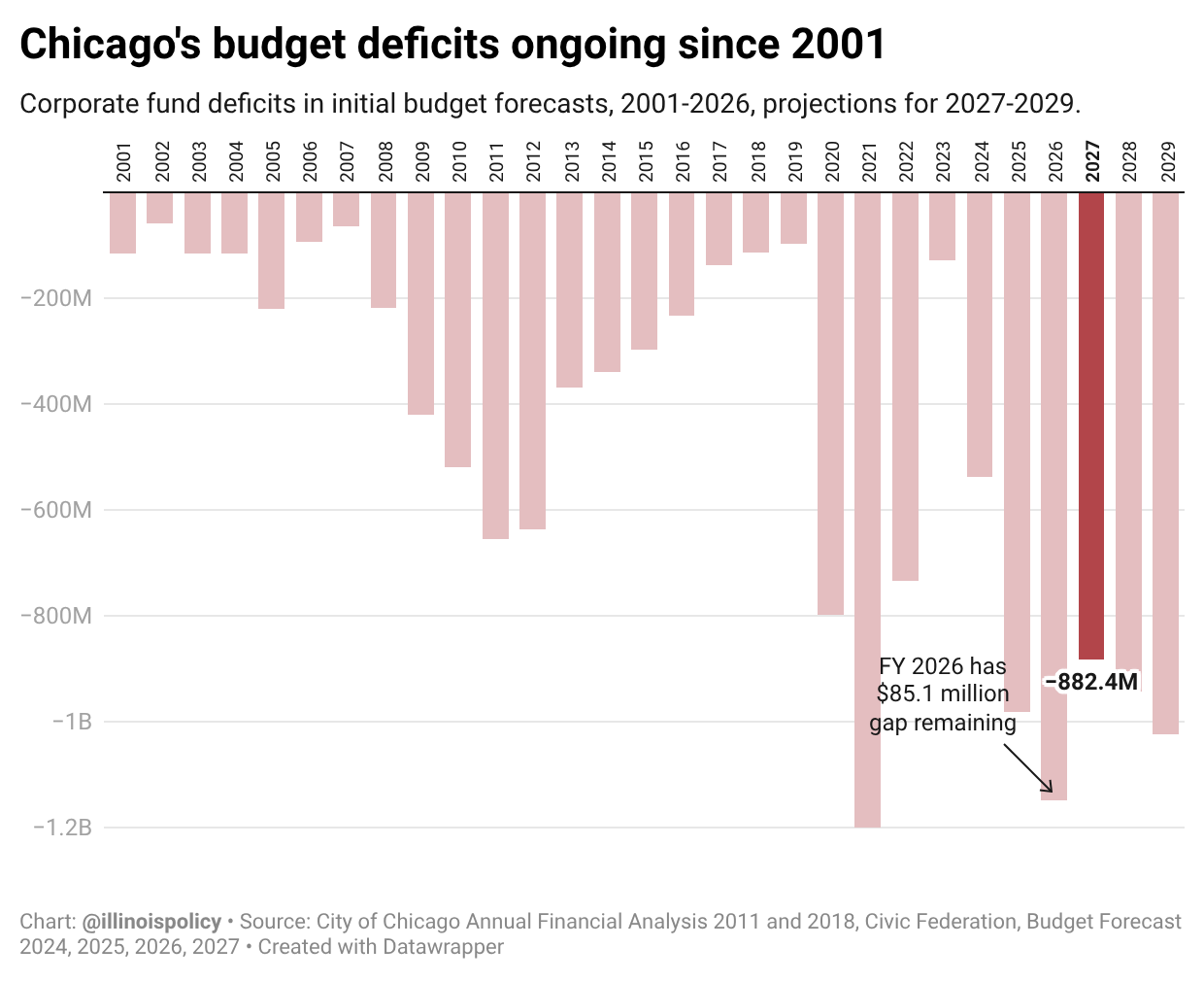
Chicago faces a projected budget deficit for at least the 27th straight year.
In advance of negotiations on how to close it, a group of 29 aldermen have demanded reforms, writing to Mayor Brandon Johnson that Chicago needs to address the structural imbalances in its budget and not rely on “one-time money” to “paper over a permanent problem.”
Those aldermen say they will not support a head tax on corporations, a property tax increase or relying on revenue from Springfield that has not yet been approved. They want the city to reduce wasteful spending and improve government efficiency.
Johnson has said he will not raise property taxes.
The city projects it faces an $882.4 million deficit for fiscal 2027, on top of the $85.1 million gap it still has to fill for the remainder of 2026. The mayor has said he plans to close the remaining 2026 gap with bond refinancing.
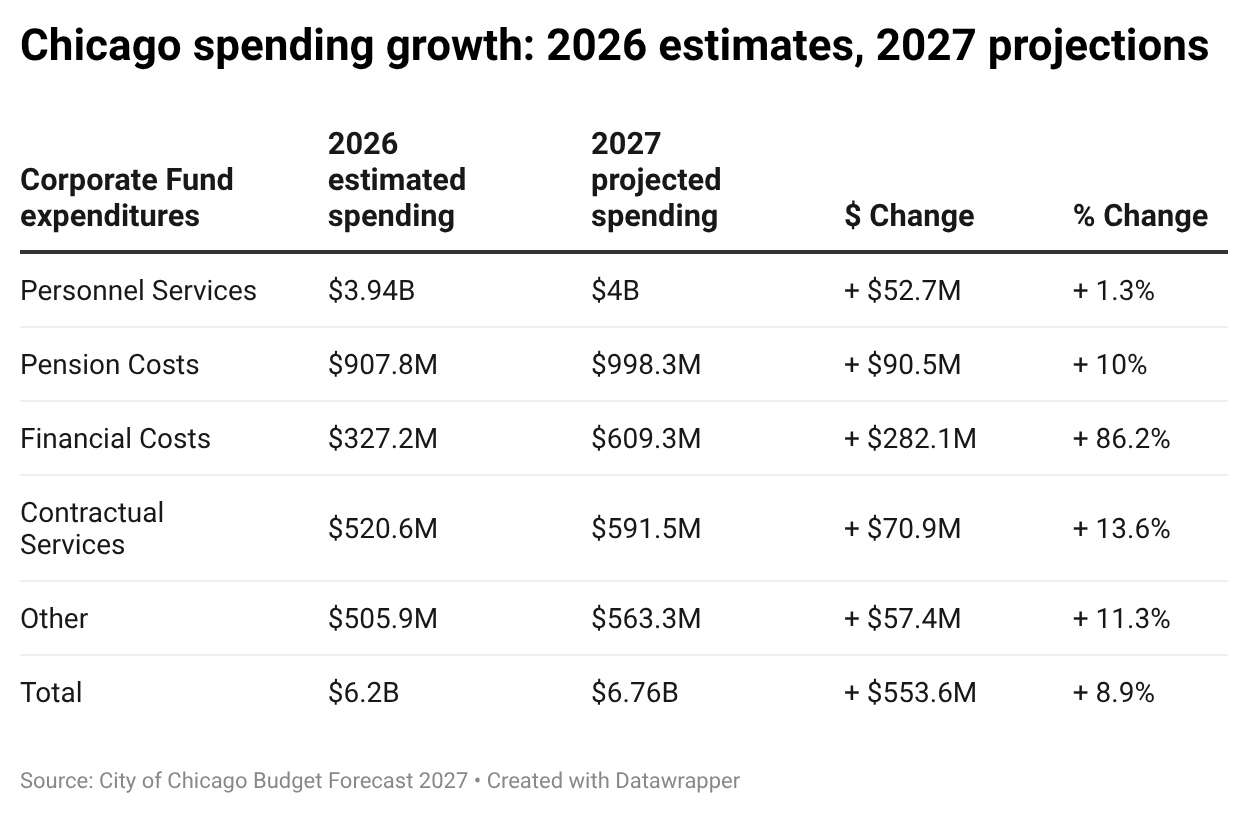
The projected deficit is driven primarily by a projected growth in expenditures of $554 million, or 8.9%. That would bring corporate fund spending to a record $6.76 billion.
Personnel will continue making up the majority of corporate fund spending, increasing by $52.7 million from 2026. Financial costs, including bond payments, are expected to skyrocket by 86%, or an additional $282.1 million. Pension costs are slated to go up by $90.5 million.
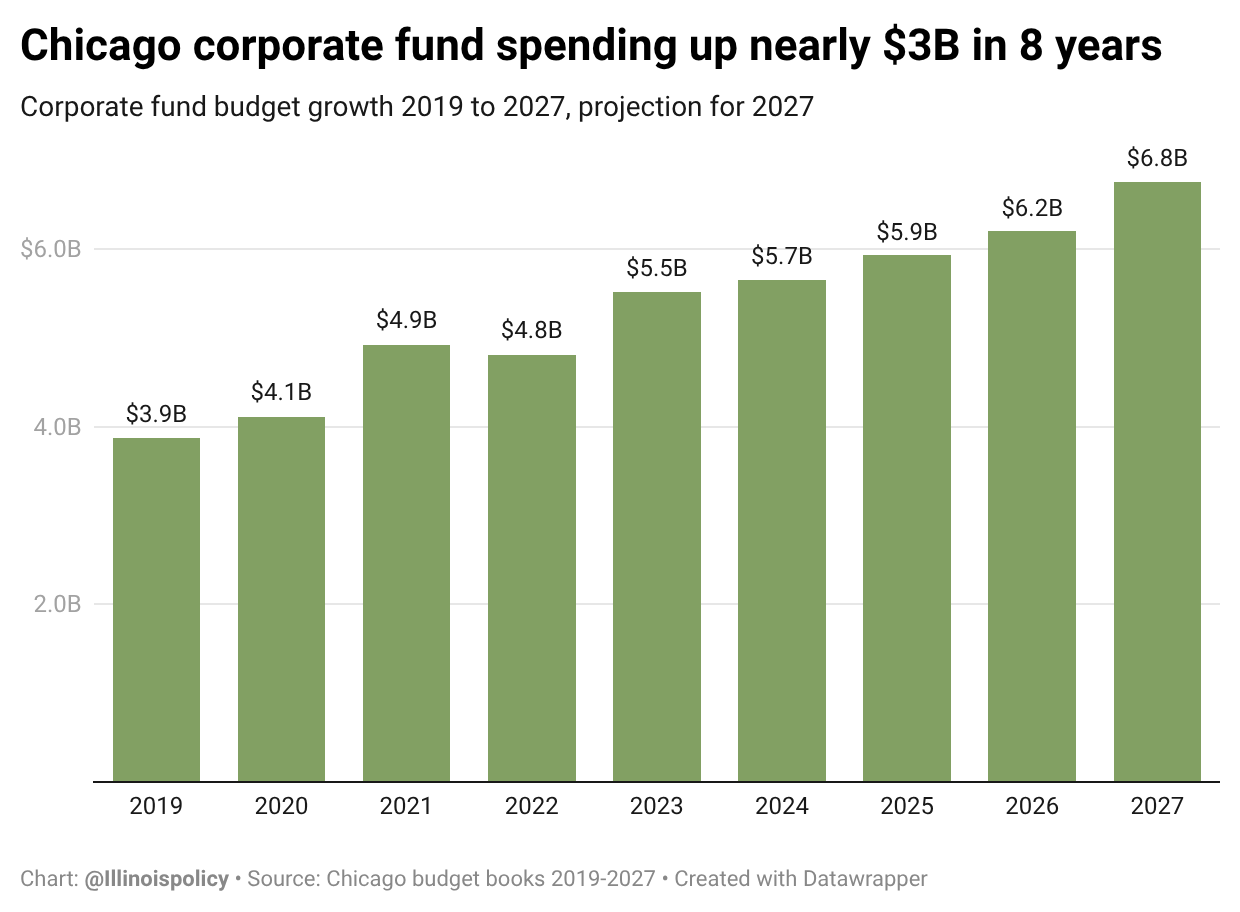
The rapid growth in spending is part of a trend. Since 2019, corporate fund spending has increased by nearly $3 billion, or 74%. Historically that has been driven primarily by growth in personnel-related expenditures, such as salaries and benefits, pensions and overtime. Despite substantial growth in city revenues over that time, the unsustainable growth in expenditures has created recurring budget shortfalls.
Making matters worse, corporate fund revenue is projected to fall by $244 million. That decline is attributed to a fall in one-time tax revenues used to plug previous budget shortfalls, not a reduction in the tax base or a decreasing tax burden on Chicago residents.
In fact, local tax revenues used to finance the corporate fund, which excludes property taxes, are expected to increase by $72 million, mainly from higher revenue from transaction-related taxes such as the real estate transfer tax.
Overall revenues are still expected to fall because of the elimination of non-recurring items, including “$166 million in one-time borrowing [and] $156.7 million from additional TIF surplus” that the city relied on last year.
With growing spending and fewer resources, Chicago leaders will have to decide how to balance the budget. Historically, rather than pursuing structural budget reforms, the city has relied on one-time revenues and budget gimmicks to close the gap, such as declaring a TIF surplus and relying on improved revenue projections.
This repeating budget imbalance is a significant factor in Chicago’s low credit rating, which drives up the city’s borrowing costs.
In February, both Fitch Ratings and KBRA downgraded Chicago’s credit rating from A- to BBB+, only three notches above junk status. The agencies cited the structural budget imbalance resulting from the recurring projected budget gaps as primary concerns for the city’s credit rating.
Fitch explicitly cited the “consecutive operating deficits since 2023, the still high dependence on non-structural solutions and assumptions underpinning the adopted 2026 budget” as primary factors in its downgrade.
Chicago must solve this chronic issue rather than continue to shift the burden onto the next year’s budgeting process, which ultimately ends up degrading the city’s credit rating and harming taxpayers who must pick up the bill.