Five reasons school districts shouldn’t lock students out of extracurriculars
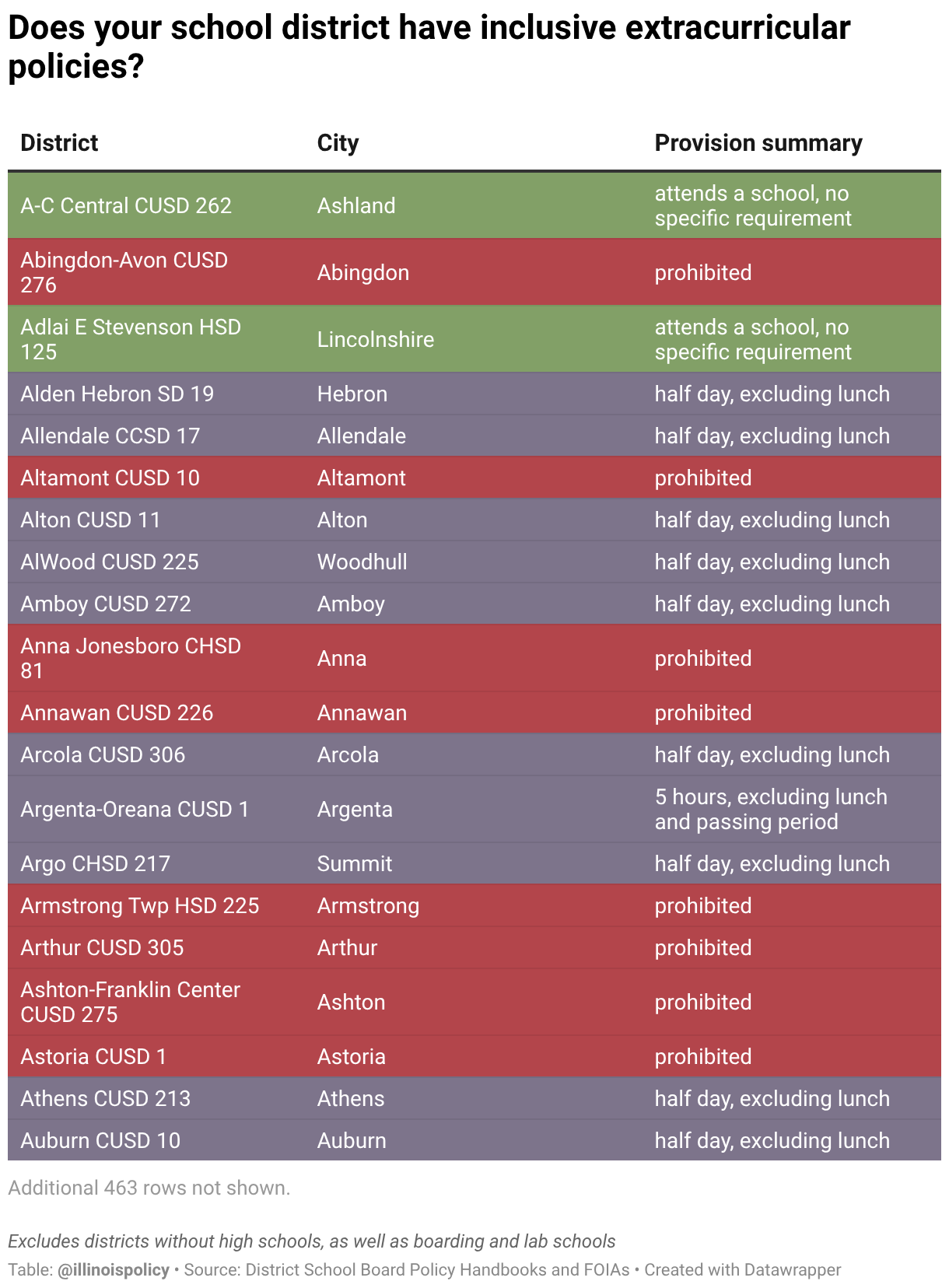
More than 160 districts in Illinois bar participation by those who aren’t full-time students in their schools.
More than 160 Illinois school districts don’t allow kids who aren’t full-time students in their schools to participate in extracurricular activities.
Their school boards should change that. Here are five reasons why:
1) Illinois allows it
State law allows part-time attendance and mandates that such students can participate in co-curricular activities. That makes it an easy jump for districts to also let part-time students participate in extracurriculars.
Illinois law allows part-time public school attendance under these conditions:
- The request is made by May 1 of the previous school year.
- There is enough space in the school.
- The student lives within the school’s attendance zone.
No minimum number of hours are required to be part-time.
Illinois law also requires districts to allow part-time students to participate in any “extracurricular component” that’s part of a course they’re taking. “For example,” says the Illinois State Board of Education, “a homeschooled student enrolled in band at a local public school would be allowed to attend band practice after school if after-school practice was a required part of the course.”
Notably, some co-curricular activities, such as marching band, have an interscholastic competition aspect. Those students may not be allowed to participate in such activities if their districts prohibit interscholastic competition for part-time students.
2) Top schools allow it
Some of Illinois’ top schools allow nonpublic school students to participate in district activities with minimal attendance requirements, proving the feasibility of the policies.
Take Adlai E. Stevenson High School District 125, which had the highest combined average SAT scores in 2024 and second-highest combined average ACT scores in 2025, according to state report card data. The district’s policy manual says a nonpublic school student is eligible for interscholastic competition and non-athletics extracurriculars as long as the student “attends a District school.” No minimum attendance hours are listed.
Policies are similar in other top-performing districts, including Lake Forest School District 115, Indian Prairie School District 204 and Barrington Community Unit School District 220.
Mahomet-Seymour CUSD 3, whose high school is ranked the No. 1 public high school in Champaign County by Niche.com, allows nonpublic students to participate in activities if they are enrolled in just one course during the regular school term.
3) Taxpayers should get what they pay for
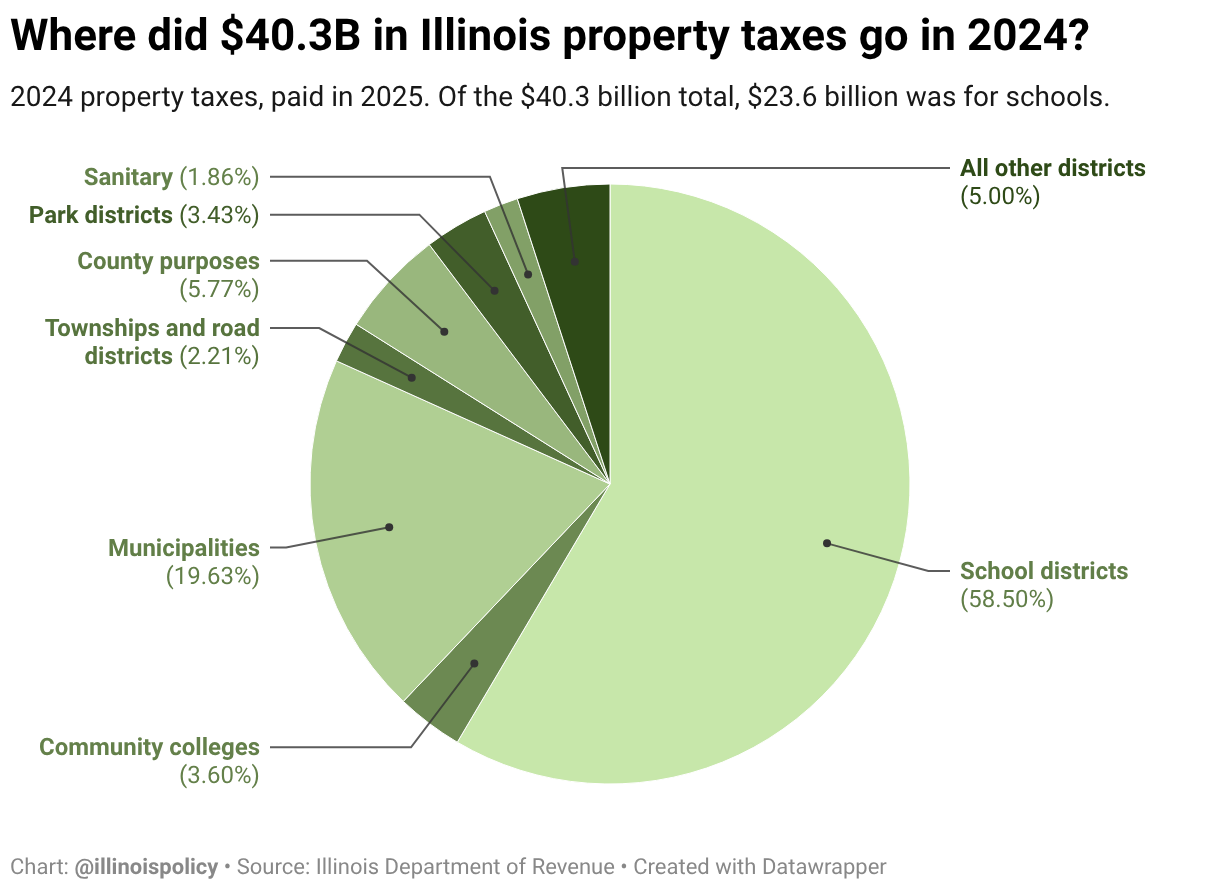
Illinoisans paid a median $5,399 in property taxes in 2024, according to U.S. Census Bureau data. The largest share goes to school districts.
For extension year 2024, the taxes paid in 2025, nearly 60% of Illinois property taxes went to school districts.
Even nonhomeowners are affected, as landlords pass along the high property tax burden in the form of higher rent.
Thousands of Illinois parents with children in private school or who homeschool pay for school district services they do not get.
4) School funding won’t go down — and could go up
Opponents may argue that allowing part-time students access to district activities will encourage other families to also choose private school or homeschooling. That will decrease enrollment and thus district funding, they may say.
But a district does not lose any state funding when families choose homeschooling or private schools. The funding is not dependent on enrollment numbers.
In 2017, Illinois adopted an “evidence-based funding” formula, which does not rely solely on enrollment. The formula includes a “base funding minimum,” which guarantees a district will not receive less money than it did before.
When asked in an interview if the base funding minimum will ebb and flow based on the number of students in a district, Michael Jacoby, then executive director of the Illinois Association of School Business Officials, answered unequivocally, “No.”
This base funding minimum is further explained in the Illinois Association of School Boards’ May/June 2023 Journal, in which an ISBE supervisor writes, “Each year that districts receive Tier Funding, that funding becomes part of the next fiscal year’s (base funding minimum), so districts are always receiving at least the funding that they received the year prior.”
In other words, a school will not lose state funding if enrollment goes down.
On the other hand, a district could receive registration fees from new part-time students — money it wouldn’t otherwise get. With year-over-year enrollment in Illinois public schools dropping 13 times in the past 15 years, allowing nonpublic school students to participate in extracurriculars could act as a bridge to register them as part-time students for the classes they take and provide the district registration fees.
5) IHSA affiliation is not at risk
The Illinois High School Association allows nonpublic school students to participate in sports with minimal requirements. By-law 3.011 provides the following (emphasis added):
“A student must attend a member school and may only represent in interscholastic competition the member school the student attends. For purposes of this by-law, the term ‘attend’ shall mean that the student is enrolled at the member school, and is taking at, or under arrangements approved by, the member school, a minimum of twenty-five (25) credit hours of work for which credit toward high school graduation will be granted by the member school upon the student’s completing and passing the courses.”
The by-law also says “A homeschool student must be taking and passing at least one credit-bearing [course] at the member school and enrolled in a program approved by the member school on a weekly and semester basis in which they are taking and passing a minimum combined total of twenty-five (25) credit hours of work.”
Here’s what it means for traditional private school students:
- The high school student must be taking at least 25 credit hours that count toward graduation.
- That coursework can be “at” the public school OR “approved” by the public school.
- The IHSA doesn’t have an in-person requirement to participate in sports, as long as the member school approves the private school student’s courses.
It’s the same for homeschool students, except the by-law explicitly requires one course be taken at a district school. It does not have to be a core class, such as math or English.
Want to know where your district lands? Use our lookup tool.