Jonathan Ingram
Director of Research at Foundation for Government Accountability. Lawyer. Libertarian.

Preview: ObamaCare at the Supreme Court
Next week, the U.S. Supreme Court will hear oral arguments in the ObamaCare litigation. The case, Florida v. United States Department of Health and Human Services, pits the Obama administration against a bipartisan group of twenty-six states and the National Federation of Independent Businesses. Two other states, Oklahoma and Virginia, are part of separate lawsuits also aimed at undoing...
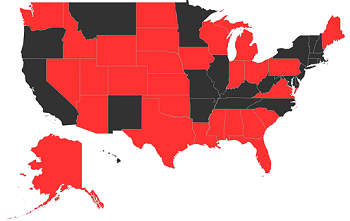
Next week, the U.S. Supreme Court will hear oral arguments in the ObamaCare litigation. The case, Florida v. United States Department of Health and Human Services, pits the Obama administration against a bipartisan group of twenty-six states and the National Federation of Independent Businesses. Two other states, Oklahoma and Virginia, are part of separate lawsuits also aimed at undoing ObamaCare. States that are challenging the law are red in the map below.
On Monday, the Court will hear arguments on whether the Tax Anti-Injunction Act, or AIA,
applies. The AIA prohibits individuals from challenging a tax unless they’ve paid the tax and had their request for a refund rejected by the IRS. The question, then, is whether the fine that the IRS imposes on individuals for refusing to buy health insurance is a tax. Here, the Obama administration and thestates agree: the individual mandate is enforced through a penalty, not a tax. Since penalties and taxes are treated differently under the law, they argue, the AIA does not prohibit this suit. Because both sides agree, the Court has appointed a lawyer to argue the other side, but the case is expected to move forward.
On Tuesday, the Court will hear the main argument: whether the federal government can force people to buy health insurance. Never before has the federal government tried to compel individuals to buy goods or services as a condition of residency. The states and NFIB argue that’s because Congress simply doesn’t have the power to do so. As the Eleventh Circuit noted last year, the administration‘s theory would fundamentally transform the federal government into one of unlimited powers. If Congress can compel us to buy health insurance, after all, they can compel us to buy anything, from broccoli, Chevy Volts, and gym memberships to government bonds. Indeed, despite litigating the issue for more than a year, the federal government has yet to provide a meaningful limit to their theory.
On Wednesday, the Court will hear arguments on whether to strike down the entire law if one or more aspects are found unconstitutional. Here, again, both sides agree that if the Court strikes down the individual mandate, at least some of the provisions must fall with it. The Obama administration agrees that some regulatory provisions are inseverable from the mandate. Without the mandate, these provisions would impose huge uncompensated costs on health insurance companies, employers and consumers. But the states and NFIB argue that the entire law must be invalidated. The mandate is tied to so many provisions of ObamaCare, they argue, that there is no practical way to sever the mandate from the rest of the law.
Also on Wednesday, the Court will hear arguments on whether the federal government can force states to expand their Medicaid programs. Here, the states argue that this massive expansion is unconstitutionally coercive. When Congress wants states to do something that it cannot force them to do — such as administering the Medicaid programs — it will entice them with federal funding. That funding comes with strings attached, and each state must evaluate whether or not to accept the money based on the terms of the agreement. What the federal government did with ObamaCare, however, was attach new terms to the pre-existing funding agreement.
Instead of conditioning new or additional funding on expanding Medicaid, the federal government told states that if they want to receive any federal Medicaid funds, they had to expand the program. The states argue that this leaves them trapped. If they do not expand the program, they lose billions of dollars in pre-existing funding that are needed to continue to fund the joint program for the poor. If they do expand the program, they overload a system that is already failing to meet the health care needs of the poor. The administration, on the other hand, argues that they can change the conditions at any time.
The Institute will be be sending updates on the oral arguments next week. To receive those, join our Health Care segment by clicking here, and we’ll make sure that they’re sent straight to your inbox.