
Pritzker has spent $545 million on politics over past 10 years
The governor’s money has gone to Illinois and national political committees since 2016.
Gov. J.B. Pritzker’s political spending extends to Illinois’ Democratic supermajority, with big money going to himself, to advertising and to state, local and even national organizations.
Since 2016, Pritzker has contributed $545 million of his personal wealth to political committees, with more of that spending coming during Illinois gubernatorial election years. The governor is seeking a third term Nov. 3.
Pritzker has given $47.3 million directly to national political committees and $58.5 million directly to Illinois political committees.
Of the $443.4 million that went to his own campaign committee, JB for Governor, nearly half has gone to media and a notable $77.2 million transferred to committees such as the Democratic Party of Illinois and Democrats for the Illinois House.
Nearly half of Pritzker’s campaign spending goes to media
JB for Governor has spent substantially more during Illinois gubernatorial election years than in the years between elections. As of Oct. 26, the committee’s spending in this campaign has reached $44 million.
Media is the largest spending category for JB for Governor, accounting for $191.2 million, or 48%, of the committee’s $399 million in expenditures since 2016.
Four media firms received $175.4 million, or 92%, of that spending:
- Shorr, Johnson, Magnus Strategic Media: $62.6 million
- Grassroots media: $62.4 million
- Gambit Strategies: $31.8 million
- Pier 91 Media: $18.5 million
Gambit Strategies, founded by the Biden presidential campaign’s digital director and the former head of Democratic super PAC Priorities USA, has been linked to controversial advertising efforts, including a Democratic-linked PAC presenting itself as conservative during Virginia’s 2021 gubernatorial election and advertisements targeting a Republican Senate primary in Montana in 2024.
Pritzker has supported political advertising through contributions to other committees too. During the 2022 Illinois Republican gubernatorial primary, Pritzker contributed $24 million to the Democratic Governors Association, which spent at least $19 million on advertisements attacking Richard Irvin while portraying Darren Bailey as “too extreme” for Illinois.
According to the Chicago Tribune, the ad was a way to encourage conservative Republican primary voters to support Bailey for the nomination to become Pritzker’s opponent. Bailey won the Republican nomination before losing to Pritzker that November.
His financing has allowed JB for Governor to spend heavily on political advertising, consultants, voter outreach and contributions to other political organizations.
Pritzker provides nearly one-third of Democratic Party of Illinois’ receipts
Pritzker’s campaign spending extends beyond advertisements and his own gubernatorial elections.
From 2016 to mid-October 2026, JB for Governor has transferred about $84.7 million to other Illinois political committees, including $29.2 million to the Democratic Party of Illinois. That’s 32% of the committee’s funding during that period.
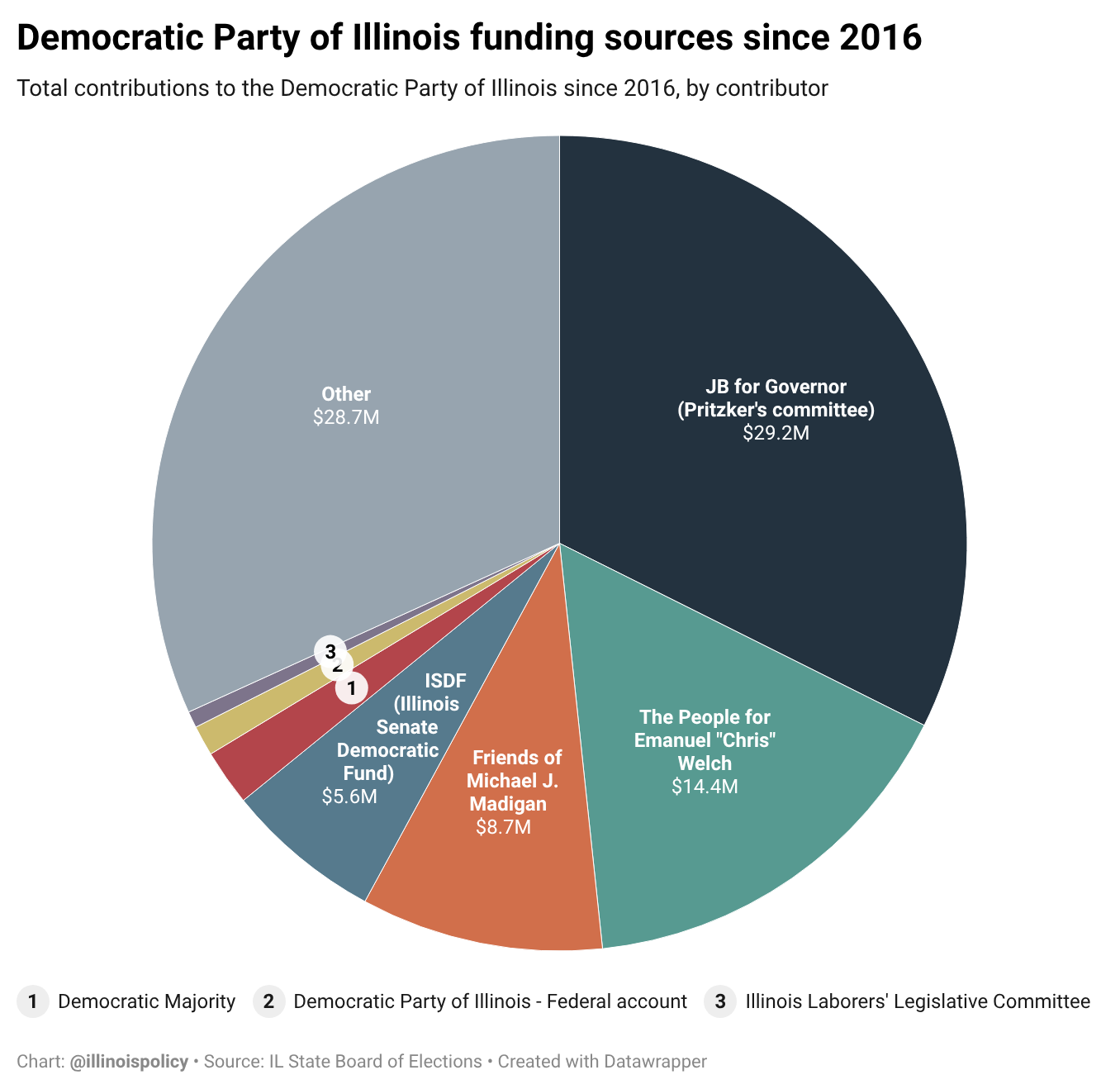
Other major recipients of money from JB for Governor include Democrats for the Illinois House, which received $10 million; the national group Democratic Majority, which received $7 million; and the Rock Island County Democratic Central Committee, which got $3.7 million.
Pritzker political financing extends beyond Illinois
The governor’s personal political contributions have also reached national Democratic organizations.
Since 2016, he has contributed approximately $47.3 million directly to national political committees, including organizations supporting congressional candidates and national Democratic political efforts.
Pritzker refuses to rule out running for president in 2028, leading to speculation about the connection between his national political activity and a potential presidential bid.
Pritzker’s financial influence is already deeply established in Illinois politics. His expanding political activity could broaden his influence, regardless of whether he seeks the West Wing.