Taxed out: 10 reforms to stop Illinois from losing people and jobs
By Jared Walczak
Taxed out: 10 reforms to stop Illinois from losing people and jobs
By Jared Walczak
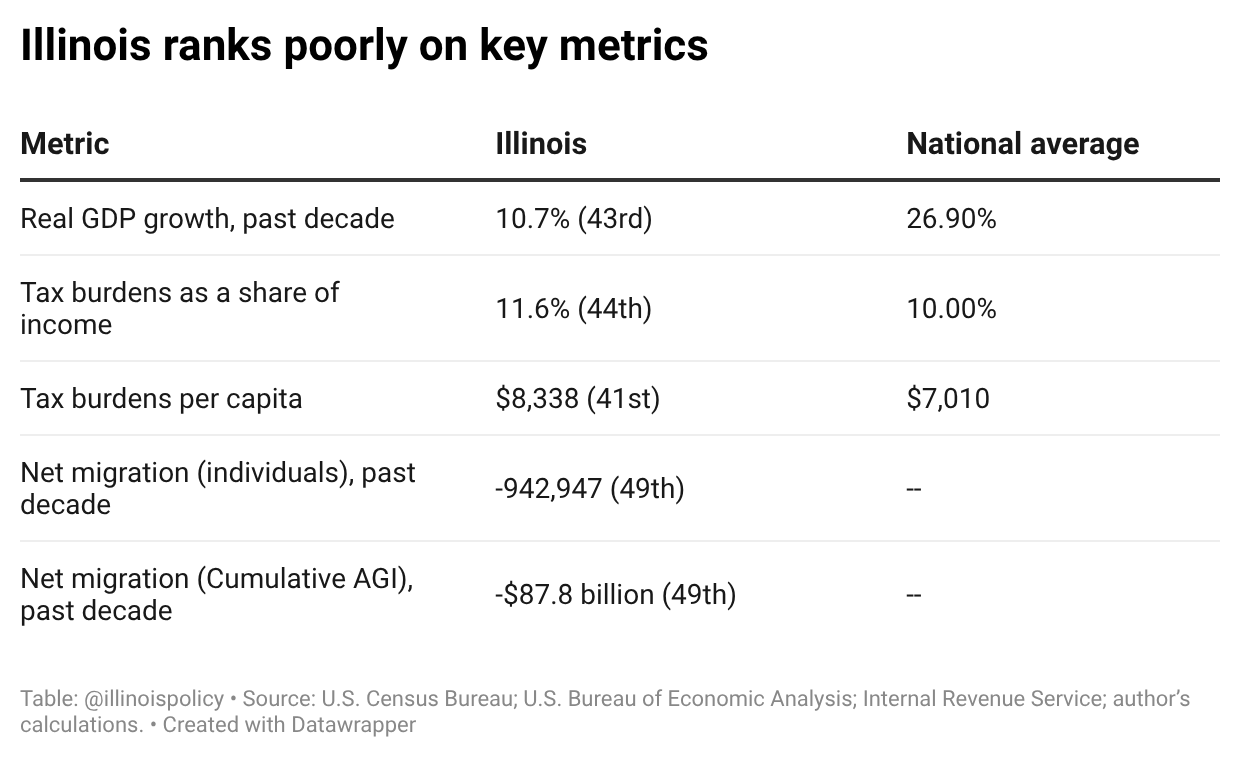
Illinois’ tax code stands in the way of the state’s economic competitiveness. The combination of high tax burdens and a poor tax structure contributes to the loss of jobs and investment to other states. From a place of former economic dominance, Illinois now ranks 45th in gross state product (GSP) growth over the past decade and 49th in interstate migration, losing some 943,000 people and nearly $90 billion in adjusted gross income to net outmigration over the past decade. Taxes are not the only reason for Illinois’ challenges, but they are an important contributor.
This research identifies 10 reforms that would enhance the state’s tax competitiveness. Some represent substantial changes while others are comparatively modest, but independently or as a whole they would make Illinois a better place to live, work and start (or grow) a business. They are:
- Eliminating the throwback rule, which raises little revenue but makes it hard for some remaining businesses, especially small manufacturers, to operate in Illinois, because it imposes Illinois’ high tax rates on all income not taxed by another state.
- Providing first-year expensing for machinery and equipment to eliminate the current tax code’s bias against capital outlays and treat these investments like other ordinary business expenses.
- Evaluating economic development incentives, curtailing the least efficient credits and reforming others to yield a better return on investment and free up revenue that could provide broad-based tax relief.
- Decoupling from a tax on international income (NCTI) that distorts the federal-level tax it attempts to copy and increases costs for Illinois businesses and consumers.
- Permanently uncapping net-operating-loss (NOL) deductions to ensure that businesses don’t face effective rates well in excess of the actual statutory tax rate, and to eliminate a particularly egregious penalty on startups.
- Repealing the corporate franchise tax, an antiquated tax that imposes high compliance costs and is levied without regard to ability to pay.
- Modernizing the sales tax base to make the tax fairer and more economically neutral, and to pay for reductions in the tax rate.
- Repealing the estate tax, which drives many high-net-worth households out of the state in the final years of their lives, harming the state’s economy and depriving the state of other tax revenue from them in those years.
- Expanding property tax levy limits, stripping out restrictions that have rendered them largely ineffective and turning these limits into a meaningful tool to rein in property tax burdens.
- Reforming unemployment insurance taxes to better align them with the overall policy goal of reducing unemployment.
Illinois is a high-tax state. That makes it even more important that policymakers get the tax structure right. These reforms, separately or in combination, will make Illinois more competitive, helping the state attract and retain jobs and grow the economy.
Introduction
Illinois has a tax problem — and unfortunately for the state, its high tax burdens and poorly structured tax code constrain economic growth. Many other states would, of course, love to have Illinois-level personal incomes and economic output, but while they are growing aggressively toward those goals, Illinois’ once-dominant economy shrinks each year.
Moreover, much of Illinois’ perceived advantage is offset by taxes and a higher cost of living. While Illinois residents earn more on average than their Indiana peers, Hoosiers’ lower tax burdens and lower cost of living yield growing parity in after-tax purchasing power — about $63,500 in purchasing power (adjusted per capita after-tax income) in Illinois, compared with $59,500 in Indiana, with the gap closing. Illinois’ sustained underperformance on economic growth, net migration, employment and business formation, moreover, exacerbates the state’s long-term fiscal challenges, particularly its looming pension crisis.
Illinois’ poorly designed tax code undercuts some of its natural advantages. The state has doubled down on high rates and adopted less competitive tax policies, such as expanded taxation of international income and worse treatment of business losses, while most other states have cut rates and made their tax codes more competitive.
Taxes touch virtually every aspect of our economic lives. They influence where we live, what we do and what we buy. Sometimes these effects are splashed across the front page, such as when a company chooses to expand elsewhere or a high-net-worth taxpayer leaves the state. More often, however, the effects are hidden even from those making some of the decisions.
When a company moves, people notice. It can be harder to see when a company chooses to do all its future hiring out-of-state, or when a company passes over Illinois for investment. The net result, however, is slower growth, reduced economic opportunity, and losing out to other states on jobs and opportunities.
Choices about how to structure the corporate tax code affect what industries locate in the state and the kinds of capital investments they make. Decisions about sales and excise tax design affect consumption patterns and sometimes production decisions. Property taxes affect where businesses and individuals locate and what mix of amenities they prioritize.
Big-ticket items such as income tax rates clearly matter, but so do more obscure provisions, such as throwback rules, and opaque systems, such as the unemployment insurance tax regime. Here are 10 reforms — some big, others small — that Illinois lawmakers could consider to boost the state’s tax competitiveness and promote greater economic growth.
Eliminate the throwback rule
When a multistate corporation earns income that isn’t taxable where it is earned, some states respond by claiming that income for themselves under what is called a “throwback rule.” The result of Illinois’ throwback rule is a much higher tax rate on some Illinois businesses, particularly small to midsize manufacturers — higher taxes that can be avoided by shifting operations to states without a similar policy. Illinois should repeal its throwback rule, which harms Illinois businesses and does little or nothing for state revenues.
State-level corporate income taxes use “formulary apportionment” to determine what share of a multistate corporation’s net income is taxable within the state. Although states can use any combination of sales, payroll and property factors to apportion income, most states, including Illinois, now use single-sales-factor apportionment. Under that method, the share of a corporation’s profits subject to Illinois’ income tax is based on the share of its sales into Illinois. If, for instance, a company has $100 million in profits nationwide, and 4% of its receipts are in Illinois, then Illinois taxes $4 million in profits.
Although every state uses formulary apportionment, their formulas vary, and some states lack nexus — the minimal connections that grant states the legal authority to impose tax — on businesses that sell into the state. Consequently, sometimes two states tax the same share of profits, resulting in double taxation, while in other instances, a certain share of income isn’t taxed by any state (called “nowhere income”), yielding what some call “under-taxation.” Double taxation is substantially more prevalent than under-taxation under state corporate income taxes, but states tend to focus more on the existence of some corporate income that goes fully untaxed. Throwback rules are one response to this concern.1
Under the best corporate income tax regime, all net income (profits) would be taxed once. No net income would be taxed by two states, and “nowhere income” would not exist. Both results are achievable, but only with
coordinated policy changes that states are almost guaranteed not to adopt.2 In the world as it exists, Illinois policymakers face a narrower decision: whether the throwback rule achieves its aim and, if so, at what cost.
A federal law, Public Law 86-272, prohibits states from taxing income arising from the sale of tangible property into the state by a company whose only activity in that state is the (remote) solicitation of sales.3 Imagine an Illinois-based company selling into Michigan. If that company has any property in Michigan, has salespeople in Michigan, delivers products into the state or services those products in-state, it has nexus with Michigan and is subject to Michigan’s corporate income tax. If, however, a large multistate retailer picks up goods from the manufacturer’s place of business in Illinois (so-called “dock sales”) and then sells them in Michigan and elsewhere, the manufacturer may not have nexus with Michigan. Similarly, if an online retailer based in Illinois sells products into Michigan and ships them through an outside carrier rather than distributing them itself, the retailer also may lack nexus with Michigan. That company would collect and remit Michigan sales tax but may have no exposure to Michigan’s corporate income tax.
None of this inherently affects Illinois’ corporate income tax collections. Because Illinois uses single-sales-factor apportionment, it taxes companies, located in-state or out-of-state, based on their share of sales into Illinois. The sales into Michigan are (ordinarily) irrelevant, and Michigan’s inability to tax some of those outbound sales does not affect Illinois. But in response to this “nowhere income,” some states, including Illinois, have adopted throwback rules. As the name implies, the rule “throws back” the untaxable out-of-state sales into the origin state’s sales
factor. Because Michigan is unable to tax that share of the corporation’s income, Illinois does, as if the sale were destined for Illinois.
From one perspective, this seems fair: Even if, ostensibly, the “wrong” state is collecting the tax, it avoids having some income go untaxed. (It may seem less fair given states’ complete disinterest in adjustments to avoid the double taxation that arises from apportionment mismatches.) But it also makes conducting certain business operations in states with a throwback rule uniquely costly and frequently drives some business activity to states without throwback rules.
Imagine an Illinois-based business with $10 million in profits, with sales split equally across 10 states, including Illinois. Without throwback rules, Illinois would tax one-tenth of the company’s profits ($1 million), with its 9.5% corporate tax yielding $95,000 in corporate income tax liability. But now imagine that the company lacks nexus in two other states, and Illinois’ throwback rule incorporates those sales into its own sales factor. The state now taxes $3 million in profits even though the in-state share is only $1 million, increasing tax liability to $285,000. This is the equivalent of a 28.5% corporate income tax on the Illinois-based activity.
Few businesses will have this degree of nowhere income, but for those that do, operating out of Illinois makes very little sense when other states do not tax that out-of-state income. Unsurprisingly, the economic literature finds that affected corporations are uniquely sensitive to throwback rules. Several studies have concluded that in the long run, throwback rules do not raise revenue,4 and one significant study concluded that they ultimately lose revenue, because the businesses most affected by the tax (mostly small manufacturers, as larger corporations almost always have nexus in other states) have such a strong motivation to locate elsewhere.5 Illinois loses revenue from small manufacturers that leave the state or establish facilities across state borders, and the affected businesses that remain are at a disadvantage compared to their out-of-state competitors. The throwback rule appeals to a sense of fairness at one level but fails in others and ultimately backfires on the state.
Recent developments in tax policy have sharply reduced the scope of “nowhere income.” Many states have adopted rules for companies with multiple subsidiaries and affiliated entities that attach nexus to far more entities. More dubiously, some states have attempted to work around the protections of Public Law 86-272 through creative redefinitions that define internet cookies or other online connections as establishing physical presence in the state and thus creating nexus. The situations that throwback rules were meant to address are becoming rarer, but to the extent they still exist, Illinois’ rule penalizes its small manufacturers and shifts more manufacturing to competitor states.
Throwback rule repeal would eliminate a policy that drives jobs and businesses out of state. Repeal would cost revenue in the short run, because some businesses are subject to the rule, but economic evidence suggests little or no cost in the longer run (or even modest revenue gains), because the rule functions as a near-prohibition for certain businesses that would otherwise operate out of Illinois and pay other taxes to the state. Taxpayers and government alike should want to avoid a policy that harms business activity without benefiting state coffers.
Provide first-year expensing for machinery and equipment
The cost of machinery and equipment is a business expense, not profit, but that’s not how it is treated under Illinois’ tax code. While the federal government and many states allow businesses to deduct the full cost of machinery and equipment in the year of purchase, Illinois requires deductions to be spread out over multiple years, penalizing investment and taxing businesses on income they have yet to earn. From a state revenue perspective, first-year expensing is largely a timing shift, but for Illinois businesses, it would ensure that taxes aren’t a reason to avoid investing.
The corporate income tax is levied on net income (profits). Consequently, when businesses pay income taxes, they deduct ordinary business expenses from revenue to determine taxable income, on which tax liability is based. These ordinary business expenses include employee compensation, the cost of goods sold, and many other operating expenses. When a business makes capital investments, however — in land, facilities, machinery, or equipment — then deductions can be spread out over multiple years, sometimes for decades. Tax codes that disallow first-year expensing of capital investment costs, penalize investment and yield taxable income in excess of actual income on a cash-flow basis.
At the federal level, corporations were permitted to take 50% first year “bonus depreciation” on machinery and equipment purchases until 2017, when the amount was temporarily raised to 100% under the Tax Cuts and Jobs Act (TCJA) before being allowed to phase out. Full first-year expensing was restored under H.R. 1 in 2025. Eighteen states conform to this provision, while another two offer smaller first-year bonus depreciation.6 Illinois is fully decoupled from the provision.
To a substantial degree, the cost of conforming to full expensing for machinery and equipment under IRC § 168(k) is a timing effect. When businesses are required to deduct their expenses over multiple years, they still get to deduct the full cost of that expense, but the delay comes at a cost in terms of inflation and the time value of money. Additionally, some businesses may have cash flow issues, particularly in their early years. They may have significant research expenses but not be profitable. More to the point, they may appear profitable — and be taxed as if they are profitable — if their revenues are counted in the current year but the bulk of their capital expenditures are shifted to later years. Using depreciation schedules for deductions can tax firms at the wrong time, when they have limited ability to pay.
Over time, the cost of conforming to IRC § 168(k) is reduced dramatically, because fully expensed machinery and equipment do not generate additional deductions in future years. In time, a rough equilibrium is reached. States, of course, generate additional revenue by using depreciation schedules, because doing so erodes the present value of the deductions. But this additional revenue through inflation and other timing penalties is not particularly large, it is economically damaging, and its use is logically inconsistent.
Depreciation makes sense from an accounting standpoint: A business that buys $1 million in machinery has not lost $1 million. It has converted $1 million in cash into $1 million in productive assets. Over time, that property will lose value (depreciate) and be worth considerably less than $1 million. But what works for accounting does not make sense for the corporate income tax, which is based on profits, not net worth. Machinery and equipment costs are not profits, and tax codes should not treat them as such.
Illinois’ current system penalizes business capital investment. Adopting first-year expensing would ensure that corporate income taxes do not create cash flow issues for businesses that choose to invest and grow, aligning corporate income tax liability with profits, not expenses.
Evaluate economic development incentives
Illinois should scrutinize its economic development incentives, reforming underperforming incentives and eliminating those that deliver little benefit. When Illinois forgoes revenue through inefficient, poorly targeted credits, the result is higher taxes on everything else.
All states offer economic development credits, and all states come in for criticism from economists for doing so. From a national perspective, such credits are highly inefficient: They misallocate resources as companies adjust their investments and activities to qualify for incentives; they frequently reward economic activity that would have been undertaken even without the incentives; they favor some companies and industries over others; and even when they “work,” they often do so simply by shifting investment geographically.
From states’ perspectives, however, incentives are hard to give up. Even if incentives simply represented states fighting over slices of the same pie, it can be difficult for a state to back off unilaterally when its peers remain at the table. At a minimum, however, Illinois lawmakers should scrutinize the incentives the state offers to ensure they are not dramatically larger than the anticipated economic benefits could possibly justify, and that they are designed in ways that do not create needless inefficiency.
Illinois’ film production services credits, for instance, have undergone recent expansion,7 despite strong evidence that film tax incentives do not grow states’ economies. In fiscal 2024 (most recent data), Illinois gave away $107.5 million in film tax credits.8 About 4,800 people were employed in film and television production in Illinois that year, representing 2.10% of nationwide employment in that sector. (Illinois represents 3.90% of all employment nationwide.)9 Two decades prior, Illinois had 1.59% of the industry, so the incentives might be working in the narrowest of senses — but even if every additional industry job were directly attributable to the credits, they would come at a taxpayer price tag of about $72,000 per job per year. Fewer claims were made in 2024 than in previous years, which is moderately good news for taxpayers. Tax year 2023 was worse, at $156.2 million and $118,000 per additional job.
Proponents of such credits commonly assert that the real benefit is in indirect employment — additional jobs in construction, hospitality, catering, and other industries benefiting from in-state film shoots. Economically, however, these credits provide an incredibly low return.
The Massachusetts Department of Revenue, in an analysis of its own program, concluded that the state spends more on credits than the industry spends in the state, that Massachusetts recouped only 11 cents on the dollar in tax revenue, and that the average new job — direct and indirect — cost $119,000.10 A Michigan legislative study found that publicly touted “job creation” statistics often meant little, with the average new job lasting only 23 days.11 In 2015, Maryland estimated that its film tax credits generated $0.06 in state tax revenue for each dollar in credits, and a subsequent 2025 analysis noted that motion picture employment has declined in Maryland despite the credit.12 Other states have found similarly disappointing results.
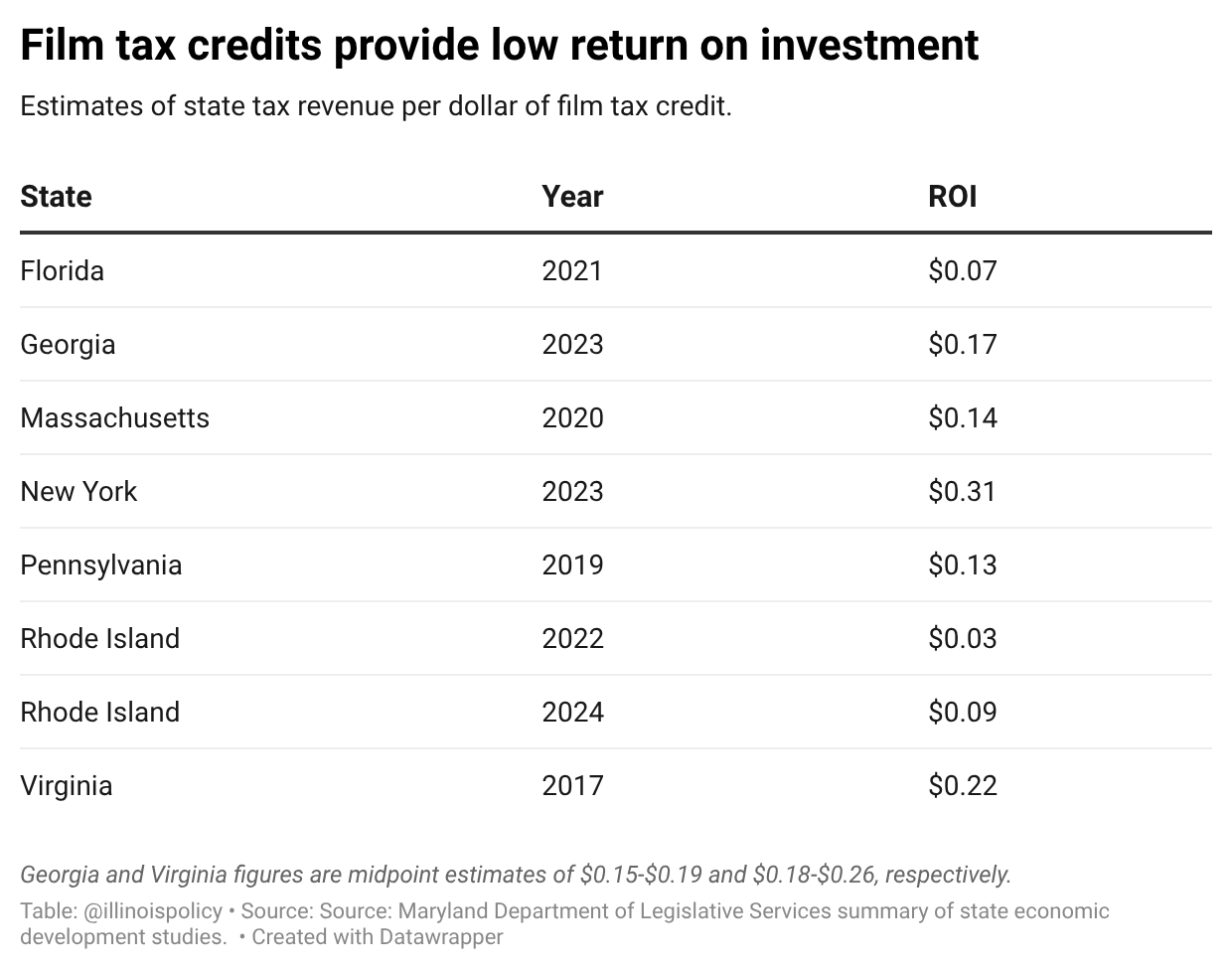
Despite lackluster results in Illinois, and notwithstanding the findings of studies elsewhere that find that film tax credits lose 69 to 97 cents on the dollar while doing very little to promote employment, Gov. J.B. Pritzker continues to tout the credits as a success.13 They attract some filming in the state, at a considerable cost to taxpayers, but they do almost nothing for the Illinois economy. Inflated job creation numbers that include extras who work for as little as one day may sound good, but they do not stand up to scrutiny.
In 2023, Illinois spent more on film tax credits than on either its Economic Development for a Growing Economy (EDGE) or research and development (R&D) tax credits. In 2024, with a dip in film tax credit claims, these credits eclipsed film tax credits, but only narrowly. Taxpayers claimed $129 million in EDGE credits, $114 million in R&D credits, and $108 million in film tax credits.
These other credits, at least, benefit a broader range of investment, and research and development has positive spillover effects that can benefit the broader economy. But lawmakers should insist on scrutiny of these programs as well to ensure that the tax expenditures are justified. EDGE credits, notably, are available only for investments that would not be made in Illinois “but for” the credits. Lawmakers should monitor the program to ensure, within reasonable tolerances, that this is the case.
Routine evaluations of existing tax incentives, and regular review of the economic evidence for the benefits of different kinds of incentives, should not only be conducted but acted upon. To the extent that incentives still play a role in Illinois’ tax code, lawmakers should favor those that benefit investment broadly rather than putting lawmakers in the role of picking winners and losers. By reducing reliance on credits and reforming remaining credits to avoid distorting investment decisions, lawmakers can promote greater economic efficiency while also freeing up revenues that can be used for more pro-growth tax relief.
Decouple from NCTI
When Congress restructured the taxation of multinational corporations’ foreign earnings, it essentially imposed a minimum tax, taxing these companies here only to the extent that they are minimally taxed abroad. Illinois conforms to only half the equation, adopting the tax on the international income of companies that share a corporate parent with a company doing business in Illinois, without the adjustment for taxes paid to other countries. The result is an extremely aggressive and unbalanced tax on activity that has nothing to do with the state, and that discourages multinational businesses from expanding their footprint in Illinois. Lawmakers should reverse this counterproductive policy.
On July 1, 2025, Illinois implemented a new tax on Global Intangible Low-Taxed Income (GILTI),14 but the federal tax to which it conformed had already been superseded by a new tax on Net CFC-Tested Income (NCTI).15 Illinois’ tax was out of date before it began, and legislators quickly updated the law to reflect the replacement tax, with very little consideration of whether the new provisions made sense to include in the Illinois tax code.
Prior to the Tax Cuts and Jobs Act (TCJA) of 2017, the U.S. taxed the worldwide income of U.S. corporations and their affiliates, including controlled foreign corporations (CFCs) based abroad, while allowing such companies to take credits against their U.S. tax liability for foreign taxes paid. Under the TCJA’s territorial tax system, foreign income is not taxed by default, but Congress wanted to counteract profit-shifting activity, whereby companies locate intellectual property in low-tax countries and shift profits there to defer U.S. tax liability. GILTI was intended as a minimum tax on certain foreign earnings, undermining the potential tax benefit of such profit-shifting. The new NCTI regime arguably provides a better calibration at the federal level but a far worse one for states incorporating the provision into their own tax codes.16
GILTI taxed “supernormal returns,” which were intended to serve as a rough proxy for intangible income from patents, trademarks, copyrights, and other forms of intellectual property. NCTI, by contrast, begins by bringing all the income of CFCs into the tax base, but then applying credits for taxes paid to other countries. Functionally, this turns NCTI into a minimum tax. If companies face significant tax burdens abroad, reflective of actual economic activity in other countries, they do not pay any additional U.S. tax. If they pay little or no tax abroad, the U.S. imposes what is effectively a top-up tax.
States, however, do not offer foreign tax credits. Under the federal regime, a corporation owes additional tax under NCTI only to the extent that its foreign tax payments are below the established minimum. In Illinois, companies pay an apportioned share of NCTI on all the income of these foreign subsidiaries, no matter how much tax they pay abroad.
This matters not just because state-level NCTI taxation has little logic or justification, but also because it makes the taxing states less competitive. By adopting what is known as the Finnigan rule, Illinois has largely preempted one strategy for avoiding NCTI: reducing in-state sales into states that tax NCTI by using third-party distributors or routing billing through out-of-state entities.17 However, the state’s unusually aggressive approach, under which global NCTI is taxed but the sales generating that income are excluded from apportionment calculations (because they would dilute the sales factor), makes it more costly for multinational corporations to sell into Illinois, which can show up in prices for goods and services sold in the state. Also, adopting NCTI, particularly while excluding CFC activity from sales factor calculations, exposes Illinois to potential legal challenges.
Adopting NCTI indisputably increases Illinois’ revenues, but this state-level tax, offered without foreign tax credits or factor representation, lacks any real justification. It taxes activity that has no connection to Illinois, no matter how heavily that activity was taxed in another country. Because Illinois lawmakers originally intended to tax GILTI, they may not have given much consideration to whether it also made sense to tax NCTI at the state level. It is a decision worth revisiting.
Taxing NCTI discourages multinational businesses from expanding in Illinois, and it increases costs for Illinois workers and consumers, because a meaningful share of corporate tax burdens is passed along in the form of lower wages and higher prices. Taxing GILTI was misguided, but taxing NCTI is far worse. Lawmakers should repeal the tax on NCTI.
Permanently uncap net-operating-loss deductions
Ordinarily, when businesses incur net losses, they may carry them forward to offset future years’ profits, so that corporate income taxes are paid on income net of both profits and losses. But Illinois limits corporations’ ability to apply these losses, meaning they pay income tax on an inflated measure of profit. This is particularly harmful for new or struggling businesses. The fiscal 2026 state budget adopts a slow restoration of the deduction. Lawmakers should accelerate this transition and resist any efforts to postpone NOL cap restoration once again.18
As an administrative matter, corporate income taxes are levied on an annual cycle (typically with more frequent payments), but the economic tax base is profits over a longer time horizon. Businesses frequently have losses in some years and profits in others, and if the corporate income tax applied in years in which the company was profitable, with no offset for years of losses, it would dramatically overtax overall profitability. To guard against this problem, all state corporate income taxes, as well as the federal tax, permit net-operating-loss (NOL) carryforwards, allowing businesses to deduct past losses against future taxable income. This allows businesses to smooth their income, making the tax code more neutral over time.
Illinois is an outlier in occasionally curtailing its NOL provisions as a temporary revenue-raiser. (It has company in California, which has a similar history of altering NOLs.) After imposing a $100,000 cap for tax years 2022 through 2024, Illinois extended the cap, revised to $500,000.19 The 2026 budget yielded further delays, slowly phasing the deduction back up, starting at a 15% cap in 2028 and rising to 80% (matching the federal standard) by 2032.20 Businesses with significant losses, including pandemic-era losses, are limited in their ability to use them to offset profits in later years, thereby harming their recovery.
Consider a business with $6 million in cumulative net income (profits) over 10 years, but with significant year-to-year swings. Imagine, for instance, that it earns income in seven of the 10 years, but posts losses in the other three. In the example below, the business has three years with combined net losses of $4.5 million, and seven years of combined profits of $10.5 million, yielding $6 million in actual profits over the period. With a properly functioning net-operating-loss regime, Illinois would over time tax $6 million at 9.5%, yielding $570,000 in corporate income tax liability. But when the amount of loss carryforwards that can be applied in any given year is capped at $500,000, cumulative tax liability at the end of 10 years is $712,500, for a net rate of 11.88%, significantly higher than the 9.5% statutory tax rate.
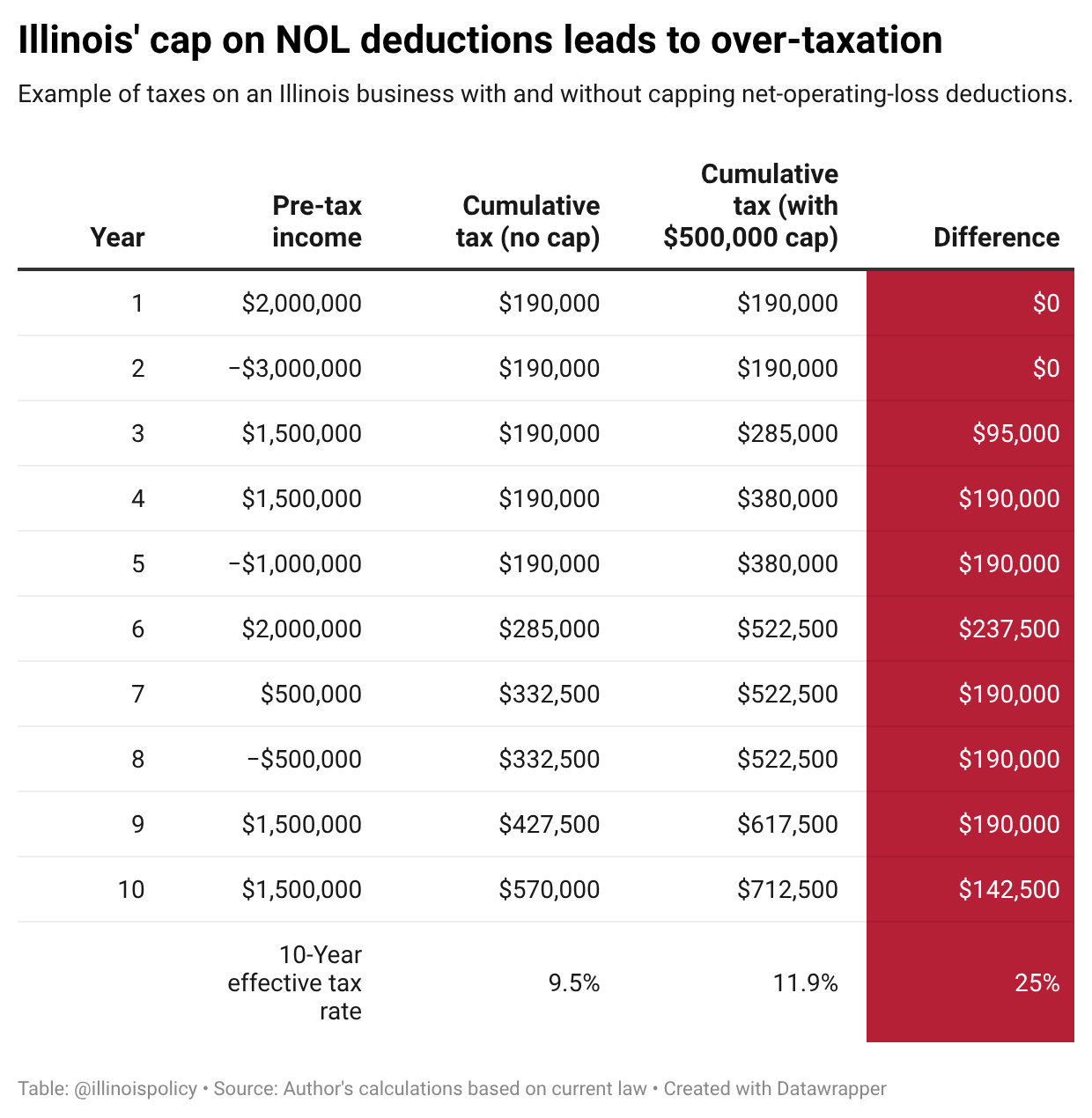
This system penalizes businesses with more cyclical or volatile business models and is particularly harmful to newer businesses transitioning to profitability after years of early losses. Lawmakers should hasten the cap’s elimination — and they could consider a constitutional amendment guaranteeing uncapped net operating losses, giving businesses greater certainty in the future.
Repeal the corporate franchise tax
Illinois imposes an annual tax on equity investment. It does not raise much revenue, but it imposes substantial compliance costs on hundreds of thousands of businesses and distorts business investment decisions. The corporate franchise tax is levied on equity but not debt financing and is imposed regardless of profitability. It is an outdated tax, a remnant of the pre-corporate-income-tax era. The legislature already voted to repeal it once, then paused its decision. The time has come to follow through.
Illinois is among the minority of states with a tax on capital stock, with Illinois’ tax designed as a tax on paid-in capital of corporations at an annual rate of 0.1% of paid-in capital value plus a 0.15% first-year rate on any increases to capital. Paid-in capital is the amount shareholders have paid directly to the company for stock, plus other funding raised from investors. It represents equity investment, not profit or revenue, making the corporate franchise tax a recurring tax on capital investment.
While changes exempting the first $10,000 in franchise tax liability (as of 2025) have eliminated tax payments for most businesses, all corporations remain obligated to file a report. In fiscal 2022, even with a lower $1,000 exemption, only 12% of filers had tax liability, with more than 300,000 companies going through the complex process of filing a $0 corporate franchise tax return that then had to be processed by the Secretary of State’s office.21
The corporate franchise tax leads to tax pyramiding under many business structures, since capital is taxed for each business at an entity level. If one company invests in another company that owns a subsidiary, all three companies can be taxed on the same capital. The tax also favors debt over equity financing, distorting business decision-making.
Although the tax raises only a fraction of 1% of general fund revenues (0.34% in fiscal 2022),22 the costs of complying with the tax are considerable. For multistate businesses, Illinois paid-in capital is calculated using allocation factors that differ from the apportionment factors used for corporate income tax purposes and that require determining which assets should be attributed to business activities within Illinois.23 These allocation factors take both sales and capital into account, even though only paid-in capital is taxed.
Real property is the most straightforward: Either it is geographically in Illinois or it is not. Revenue is deemed to be derived from tangible property in Illinois if the sale occurs in Illinois or a product is shipped from Illinois, focusing on origin rather than destination, the opposite of how the state’s corporate income tax apportionment regime applies to tangible property.
Trademarks, copyrights and patents are included if acquired, produced or primarily used in Illinois, while investments are included to the extent that notes, securities, or certificates are physically in the state, and accounts receivable are included if they arise from Illinois sales. Dividends from a subsidiary are included if the subsidiary transacts business primarily within Illinois. Service income is allocated to the state if income-producing activity is performed in Illinois or is administered or managed in Illinois.24 Rents, royalties, and different kinds of investment income all have their own complex allocation rules. Businesses are required to calculate all this even if — as is true for most businesses — they have no actual liability.
The corporate franchise tax predates the state’s corporate income tax and raises only a tiny fraction of what the corporate income tax generates. It is a relic of a bygone age, costly to calculate while raising relatively little revenue. Lawmakers voted to repeal it prior to the pandemic,25 then paused implementation because of early pandemic economic uncertainty. The case for repeal is as strong as ever, and if Illinois could afford repeal in 2019, it can today. To put this in context, in 2023 the state lost more revenue from film incentives than it generates from a tax that imposes complex filing requirements on 340,000 businesses. It is past time to repeal this antiquated, uncompetitive tax.
Modernize the sales tax base
Illinois’ sales tax base is outdated and doesn’t apply to many types of personal consumption. Because the base is narrow, rates are higher than they otherwise would be. By modernizing the sales tax base, Illinois lawmakers can reduce the economic distortions created when the tax system favors some types of consumption over others. Base-broadening paired with a commensurate rate reduction is a revenue-neutral policy that makes the tax code fairer and promotes greater economic growth.
Illinois’ sales tax is divided into a Retailers’ Occupation Tax and a Service Occupation Tax, both with corresponding use taxes.26 Despite their names, both taxes apply to the sale of tangible personal property. The Service Occupation Tax is levied on tangible personal property transferred in the course of a service, such as parts used to repair a vehicle or appliance (with no tax on labor). Consumer services themselves are generally exempt from sales tax in Illinois,27 as are most digital products, because they are intangible rather than tangible property.
Books are subject to sales tax, but e-books are not. Online subscriptions and streaming services escape sales tax, as do everything from haircuts to landscaping. The city of Chicago, however, imposes a 10.25% amusement tax on streaming services, with the entire amount going to the city. There is no reason why streaming services should be exempt from sales tax, though at the same time, there is no justification for applying a special excise tax on such services, as Chicago does.
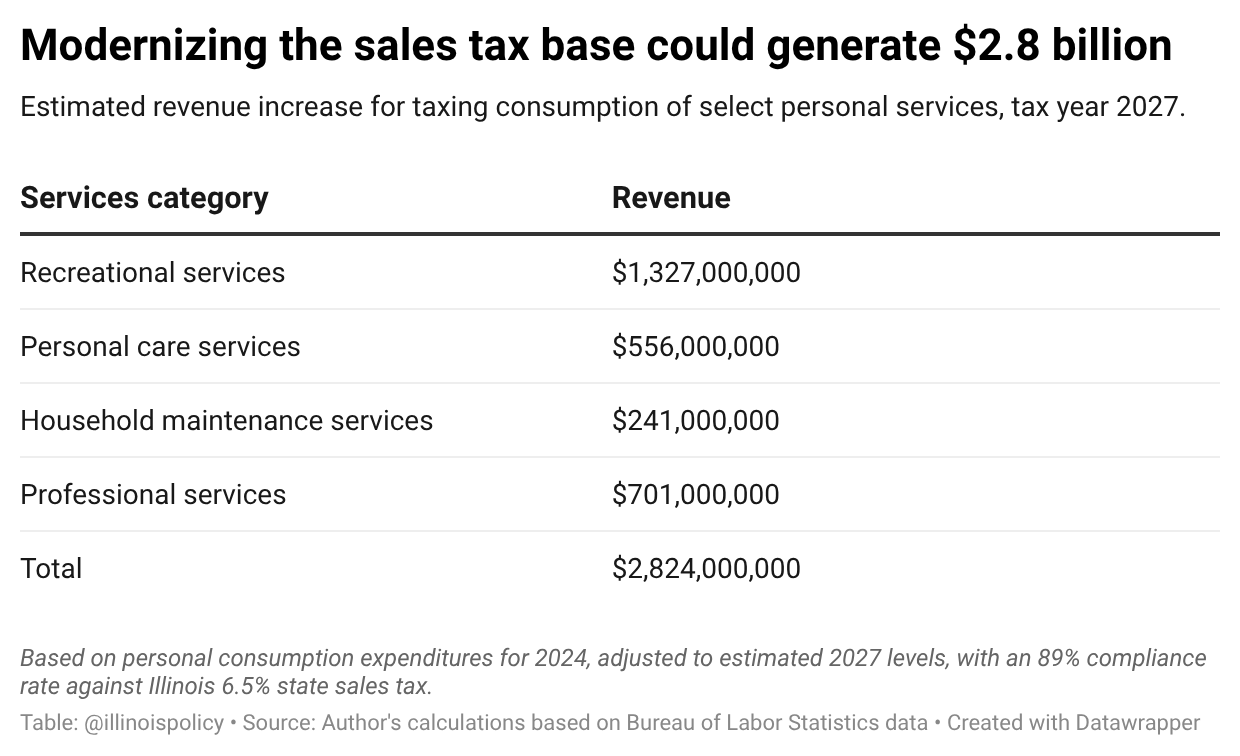
If Illinois taxed a wide range of recreational, personal care and household maintenance services, the state’s 6.25% sales tax would bring in an additional estimated $2.1 billion in 2027. A more aggressive expansion that also included personal consumption of professional services, including legal and accounting services purchased by individuals, would generate $2.8 billion in total.28
While the latter expands beyond what most peer states tax, many states already tax some or all recreational, personal care and household maintenance services, and digital products are increasingly a part of state sales tax bases. Furthermore, many of the providers of these services are already collecting and remitting sales tax on tangible property utilized in providing these services, limiting the compliance costs associated with bringing new payers into the system.
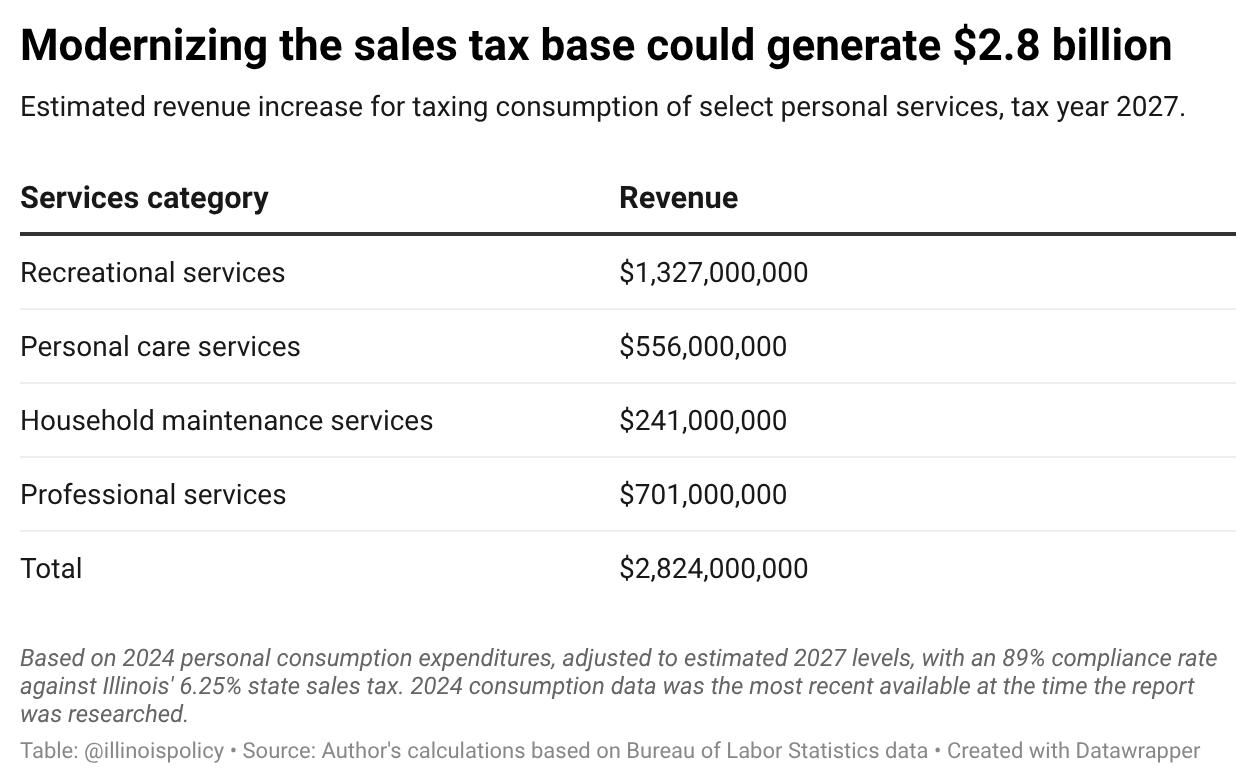
These estimates are broadly consistent with prior estimates of sales tax base-broadening. In 2017, the state estimated that taxing the same services as Iowa would have generated at least $1.2 billion per year in fiscal 2020, while matching Wisconsin’s services base would generate at least $588 million per year in additional revenue.29 A 2023 study from the Chicago Metropolitan Agency for Planning estimated that base-broadening to additional consumer services would raise about $1.9 billion at the state level in 2026.30
Even with the narrower expansion, base-broadening could increase sales tax collections by 19% in 2027. If the increased revenue were used to pay down the sales tax rate reductions, it would be sufficient to fund a full percentage-point decrease to 5.25%. Even targeting first-year revenue neutrality, moreover, would yield revenue gains in the out years compared to current policy, as it would combat the continued base erosion the state experiences as ever-larger shares of personal consumption shift to services. Because services tend to comprise a larger share of consumption for higher earners, sales tax modernization is also distributionally progressive, addressing non-neutrality in the current system. Lawmakers should modernize the sales tax base and use that broader base to cut sales tax rates.
Repeal the estate tax
Illinois’ estate tax drives many wealthy residents out of state and reduces the economic returns from those who remain. Wealthy retirees make investment decisions that would otherwise be economically inefficient in an effort to shield some of their assets from the estate tax, and many move out of state, depriving the state of income tax revenue and of those taxpayers’ broader economic contributions. Illinois should follow in the footsteps of lawmakers elsewhere who have concluded that the estate tax is counterproductive.
Whether the estate tax raises revenue is a surprisingly difficult question to answer. At one level, the answer is clearly yes: While collections are volatile, they have averaged $557 million a year since fiscal 2021, and fiscal 2026 collections are likely to shatter records because of extraordinary stock market returns in recent years.31 Taking a broader view, however, the estate tax may be revenue-negative or very nearly so, because the outmigration of high-net-worth individuals years before their deaths deprives Illinois of income tax and other tax revenue. The amount the estate tax generates is known; how much the state forgoes in revenue from departing multimillionaires can only be guessed at.
The economic evidence, however, indicates that the effect is substantial. Ultra-high-net-worth retirees are extremely mobile. They are no longer tied down to their jobs, they have the resources to relocate, and they can easily afford to retain a second home in Illinois, if desired, while establishing their primary residence elsewhere.
An analysis by two prominent economists calculated that if the typical wealthy retiree who would otherwise be subject to state inheritance and estate taxes moved out of their home state five years prior to death, that state’s revenue losses could be as much as 1.73 times as large as the tax revenues that might have been collected from that person’s estate.32 This suggests a tipping point of about three years. They find, moreover, that estate taxes do indeed drive outmigration: For every 1 percentage-point increase in a state’s average estate tax rate for estates over $5 million, the number of federal estate tax returns filed in that state declined by nearly 4%.33
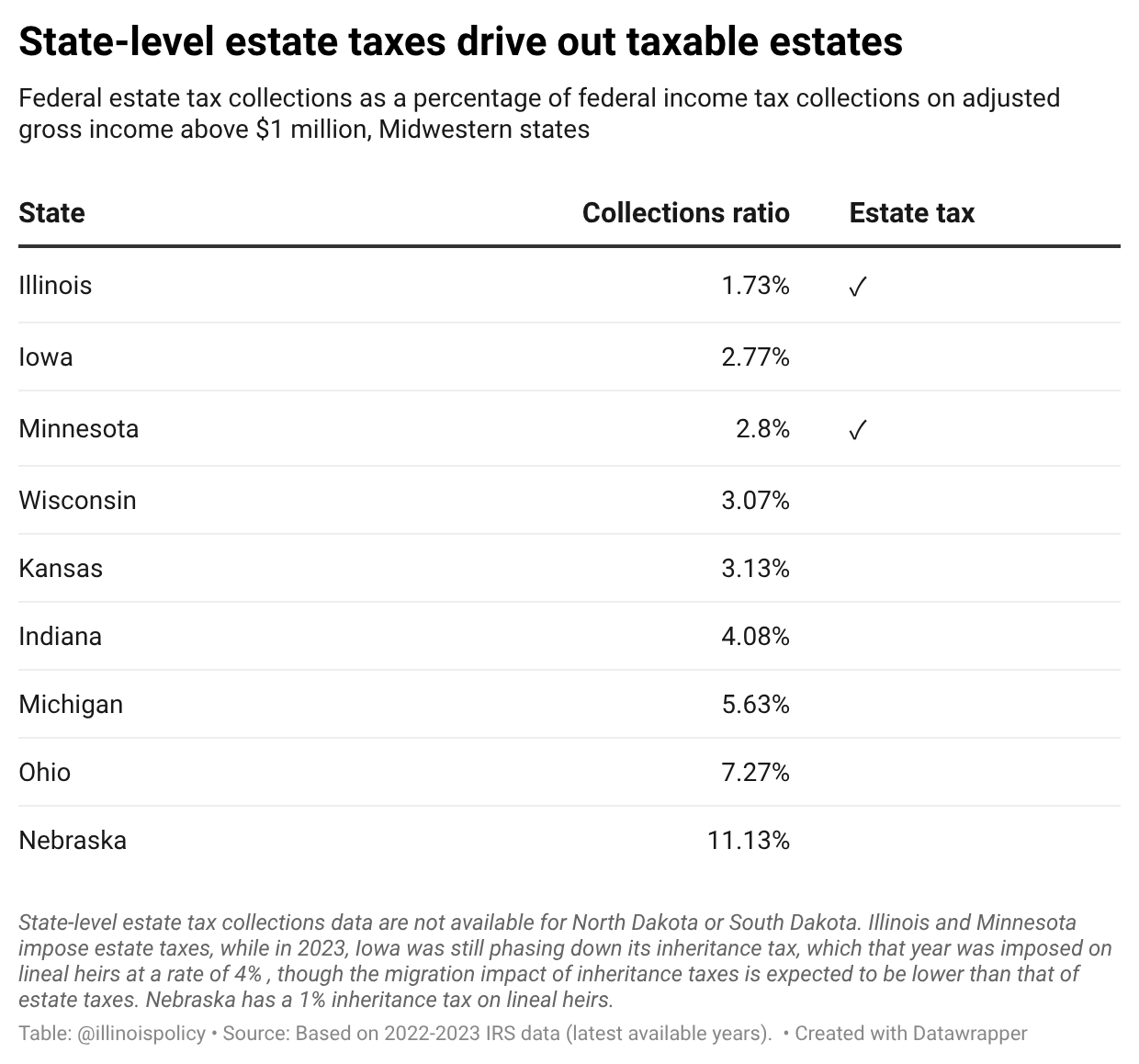
Federal estate tax data provides a compelling reason to believe that Illinois’ state-level estate tax is indeed driving out high earners in the years before their deaths. Illinois accounted for 3.85% of the nation’s personal income in 202334 and was responsible for 3.93% of federal income tax collections the prior year (2023 data are not yet available),35 but generated only 1.10% of federal estate tax revenue in 2023.36
States without an income tax, like Florida, Texas and Nevada, unsurprisingly fare far better, generating six, nine and 12 times as much federal estate tax revenue than Illinois as a share of state personal income, but even nearby Nebraska generates more than four times Illinois’ levels. Another measure also highlights the degree to which wealthy taxpayers leave Illinois late in life: Illinois’ federal estate tax revenue as a share of federal income tax revenue from returns above $1 million is only 25% of the national average. Clearly, high earners are leaving Illinois in substantial numbers before their deaths, with the state losing out on their investments, philanthropy and payment of other taxes.
Even when taxpayers remain, moreover, it’s not all good news for Illinois. Estate taxes influence economic decision-making in ways that harm the state’s economy. They lead business owners to divest prior to death or to take out costly insurance policies to provide liquidity when business ownership interests transfer to beneficiaries. They incentivize costly tax-avoidance strategies that create significant deadweight losses.
Some scholars have concluded that estate tax compliance costs approach the tax’s actual revenue yield.37 Almost 50 years ago, a Brookings Institution paper concluded that “because estate tax avoidance is such a successful and yet wasteful process, one suspects that the present estate and gift tax serves no purpose other than to give reassurance to the millions of unwealthy that entrenched wealth is being attacked.” Much has changed in the intervening years, but this observation still rings true.
Most alarmingly for governments imposing estate taxes, however, estate taxes can have a significant effect on how taxpayers invest, particularly toward end of life. The federal estate tax, for instance, has been estimated to have roughly the same effect on entrepreneurial incentives as a doubling of income tax rates even though the federal estate tax is responsible for less than 1% of federal revenue.38 The U.S. Joint Economic Committee estimates that over the course of the 20th century, the federal estate tax reduced the stock of capital in the economy by nearly $500 billion, or 3.2%.39
The question, therefore, may not be whether Illinois can afford to repeal its state tax, but whether it can justify the expense of maintaining it. The revenue it raises is real and quantifiable. The revenue it forgoes is equally real and quite possibly larger, though harder to quantify. Lawmakers should repeal Illinois’ estate tax.
Expand property tax levy limits
Illinois has the unenviable distinction of imposing the nation’s highest property taxes. The average statewide effective rate on owner-occupied housing is 1.88%, tied with New Jersey for the highest effective rate in the country, and more than twice the national average.40 While the state imposes some restrictions on local property taxes, they have not been effective in keeping property tax burdens in check. Illinois needs better property tax limitations. In particular, reforms to the existing levy limits, which restrict the growth of overall property tax collections, can dramatically enhance their effectiveness and provide much-needed property tax relief.
Rate limits exist in Illinois but are generally not binding on home-rule jurisdictions.41 They are also ineffective against tax increases resulting from assessed value increases. Since 1991, the Property Tax Extension Limitation Law (PTELL) has sought to limit those unlegislated property tax increases by capping the increase in the total levy on existing property at the lower of 5% or the rate of inflation for each year, but the limitation does not apply to home-rule taxing districts unless they opt in,42 and PTELL features enough exclusions to render it virtually meaningless. In a recent study, the Civic Federation of Illinois characterized the result as “a system that presents the illusion of a ‘cap’ to protect taxpayers while, in reality, governments are saddling property owners with ever-higher bills.”43
Levy limits cap the annual increase in property tax collections across a jurisdiction, rolling back rates (mill levies) to keep collections in check as values rise. It is generally agreed that levy limits should roll back rates based on the increase in value of existing properties, whereas new property should be outside the cap, since new businesses and a larger population create new costs for localities. Population or business growth should not reduce per-capita collections, but for levy limits to impose meaningful constraints, they should permit few exemptions or exclusions other than the exclusion of new construction.
In Illinois, however, funds for repaying bonds are outside the PTELL cap, and pension payments can be as well. Surpluses from tax-increment financing districts do not count against the cap, and property tax refunds do not reduce the cap.44 Home-rule jurisdictions, meanwhile, are exempt entirely.
Illinois’ levy limits can be overridden by voters, providing a mechanism for increases above the cap. This itself is not a problem: A conscious choice to raise property taxes, ratified by the voters, is markedly different from a hidden, unlegislated tax increase. But because the law provides this mechanism for tax increases, there is less justification for “uncapped” expenditures, particularly for pensions. As long as major expenditures exist outside the cap, Illinois’ PTELL can accomplish very little — it is too easily circumvented. Lawmakers should expand the scope of Illinois’ PTELL cap to provide real property tax relief.
Reform unemployment insurance taxes
Illinois has an unemployment insurance tax problem. The unemployment compensation program is underfunded despite above-average tax rates, and those rates rise automatically precisely when businesses can least afford them. Moreover, the way the tax is imposed harms new businesses and discourages companies from taking risks on new hiring when the economy isn’t doing as well. Lawmakers should reform the system to better align the tax’s incentive structure with the goal of lower unemployment.
Illinois’ unemployment compensation trust fund does not meet minimum adequacy levels and has not done so since 1974. As of 2025, the trust fund stood at 24% of the federal government’s recommended minimum solvency level. Only six states did worse. Similarly, Illinois is one of only six states that has not met minimum adequacy in the past 50 years.45
States finance their unemployment insurance systems through payroll taxes. These taxes are imposed on a taxable wage base that is typically a low amount of income per employee. The federal government’s taxable wage base is $7,000. Illinois’ wage base in 2026 is more than twice that, at $14,250. A new employer will pay a 3.35% rate on each employee’s taxable wage base this year, or $477.38 per employee per year, assuming each is retained long enough to earn at least $14,250.46
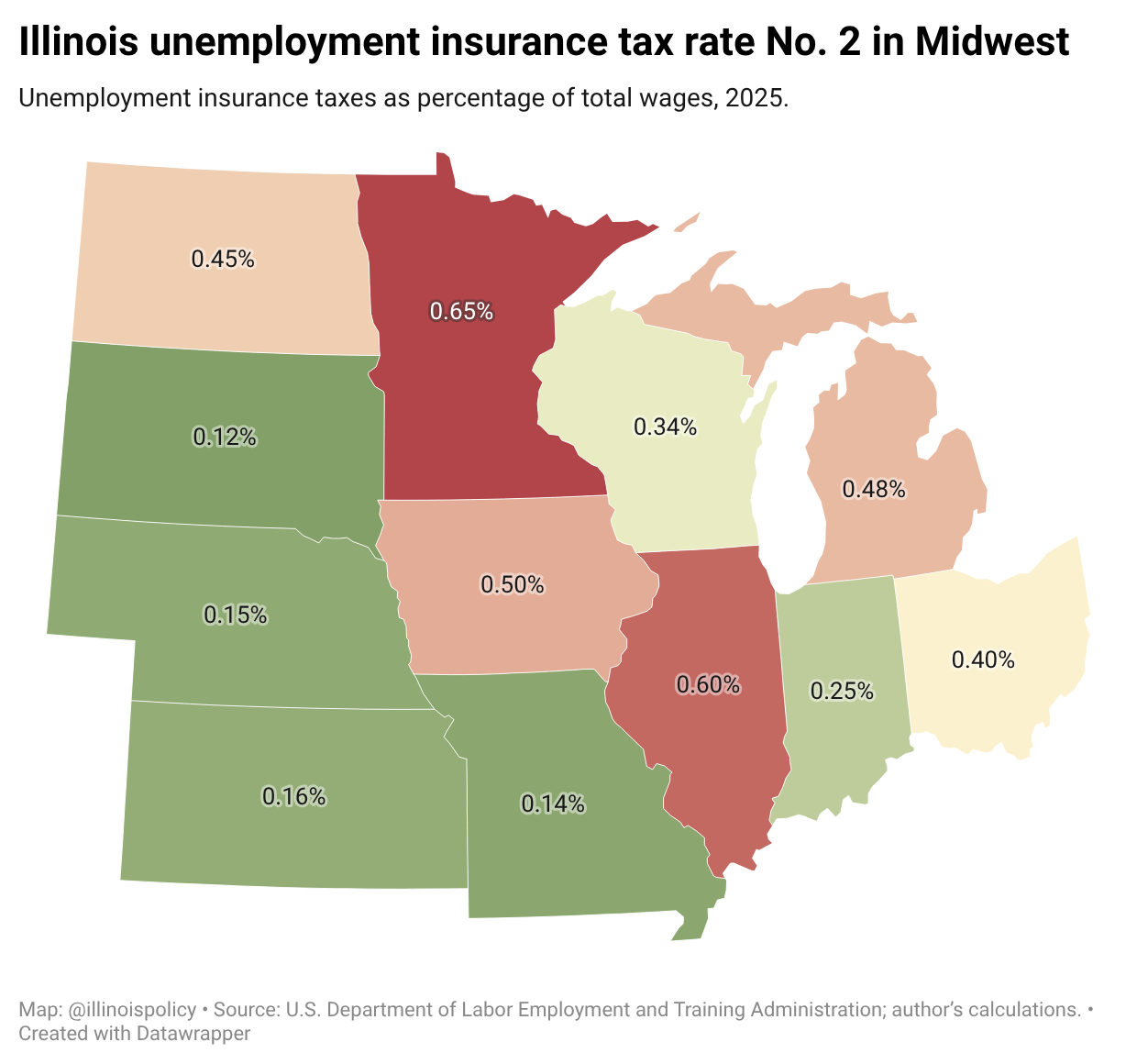
Once employers have established a three-year track record, they obtain an “experience rating” that determines their employer UI tax rate based on benefit charges assigned to them. Higher rates are assigned to employers with a history of layoffs, while lower rates are granted to employers with comparatively few benefits charged to their accounts. In 2025, Illinois’ average rate on its wage base was 2.7%, and its effective rate on total wages was 0.60%.
While Illinois’ taxable wage base is above that of many other states, the interaction of rates and wage bases is more important, and the average tax rate on total wages provides the best single point of comparison for states’ unemployment insurance tax rates. Illinois’ 0.60% is by no means the highest in the country, but it is substantially above the 0.39% national average and the second-highest in the Midwest.47 With Illinois, the weighted average for the Midwest is 0.38%; excluding Illinois, the region’s 11 other states have an average rate of 0.35% of wages.
Despite Illinois’ above-average tax rates, however, account balances are perpetually low. Illinois uses a solvency tax to increase rates when fund balances are low, but at this point, the solvency tax is in perpetual effect because the unemployment compensation fund remains functionally insolvent. Illinois cannot realistically align its rates with the national average without further compromising the fund’s ability to pay claims. Federal indebtedness always serves as a backstop, but ultimately a costly one that Illinois should seek to avoid.
If Illinois cannot trim rates, it can at least improve the tax’s design. In time, slightly higher “ordinary” rates without a solvency tax that increases precisely when businesses have the least ability to pay would improve stability and reduce the likelihood that rising tax burdens will accelerate layoffs during an economic downturn.
Illinois also could improve its unemployment insurance taxes by allowing new businesses to pay under their own experience rating after one year rather than three, and by changing charging methods to change incentives around hiring. Currently, if someone is laid off, their entire charge is booked to the account of their most recent employer, increasing that employer’s unemployment insurance tax liability. Some states instead allocate these out according to share of wages across a base period. This makes hiring less risky during a recession, because someone picking up a recently laid-off employee does not bear the entire burden if they are laid off again. Illinois’ system, by concentrating costs on the most recent employer, discourages taking hiring risks that could boost employment when it is needed most.
Smart reforms would include a one-year experience rating, allowing new businesses with a clean record to escape the new-employer penalty earlier. They would also include allocating charges based on a base-wage period rather than imposing the entire charge on the most recent employer, which discourages companies from hiring when the economy is shaky. And they would involve reducing the tax’s countercyclical reliance on higher rates during periods of economic distress.
Ultimately, however, Illinois’ unemployment insurance tax system is expensive because of employment churn. The most effective remedy is higher employment rates and economic growth.
Conclusion
Illinois is a high-tax state and would remain so under these proposals, but there are better and worse ways to raise a given amount of revenue. Some of the reforms considered here have costs, while others raise revenue or have negligible long-term revenue implications. None of them, however, fundamentally alters Illinois’ tax levels. Instead, they focus on greater neutrality and economic efficiency.
Debates over tax levels are often fraught; deliberations over tax design need not be. Given that Illinois is a high-tax environment, it is all the more important that the state’s taxes avoid provisions that unduly distort economic decision-making or unnecessarily discourage economic growth.