Pritzker has vetoed fewer than 1% of bills since taking office
Governors in other states with one-party rule use the power more frequently.
Gov. J.B. Pritzker rarely uses his veto authority to challenge legislation sent to him by the Democratic supermajority in the Illinois General Assembly.
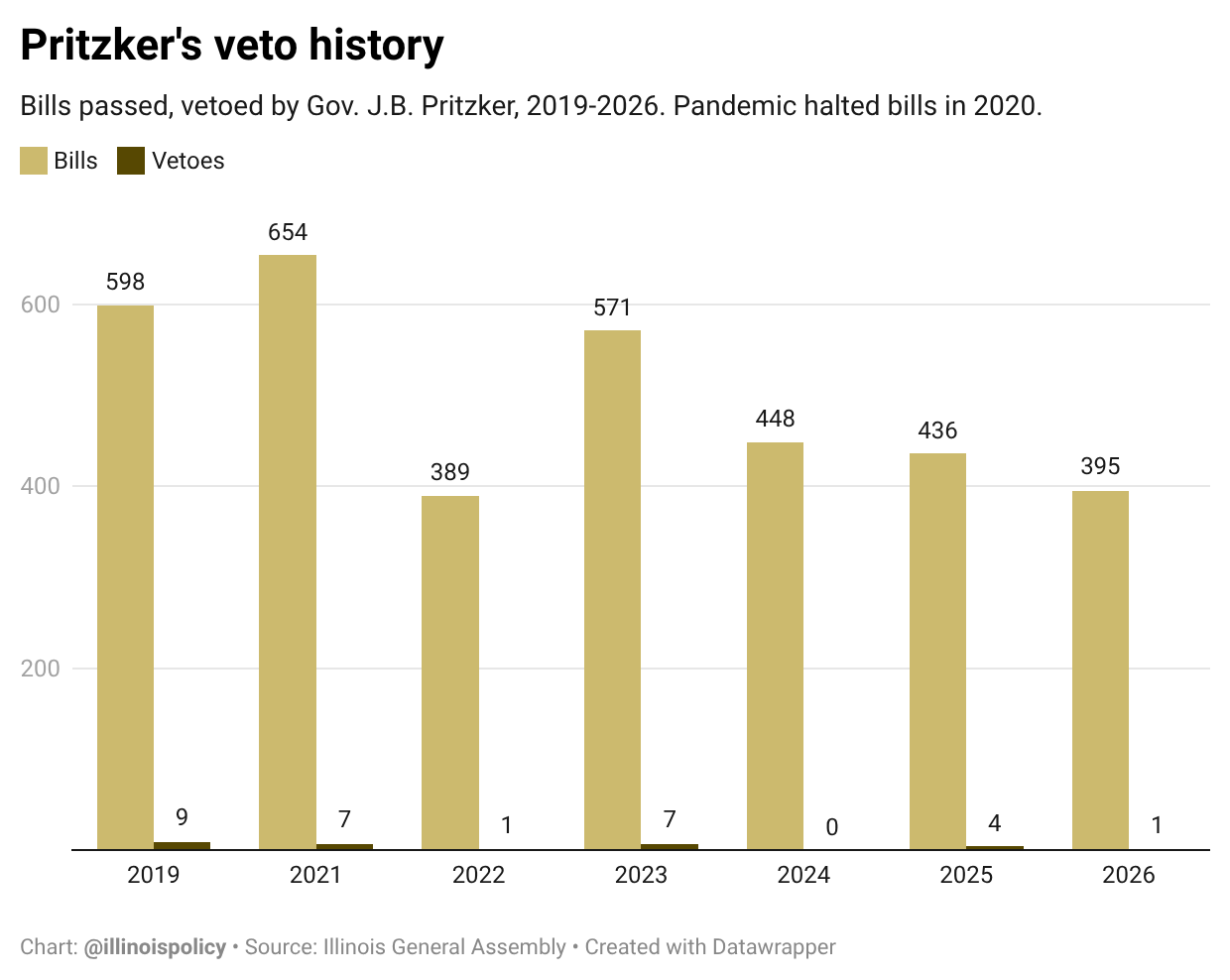
Lawmakers passed 395 bills in the 2026 regular session. Pritzker signed all of them and issued only an item and reduction veto to clean up drafting errors on the record-high $55.9 billion budget.
The governor’s reluctance to veto legislation is not unique to 2026. Since taking office in 2019, he has vetoed fewer than 1% of bills sent to his desk, continuing a pattern of rarely challenging Illinois’ Democratic supermajority.
The consequences of single-party rule in Illinois are reflected in the fact that Pritzker signs virtually all the bills sent to his desk.
More vetoes in other states
Governors in other states, both Democratic-controlled and Republican-controlled, issued substantially more vetoes in 2026 than Pritzker did.
California Gov. Gavin Newsom vetoed 120 of 1,160 bills, a rate of 10.34%, or more than 40 times Pritzker’s rate. Virginia Gov. Abigail Spanberger vetoed 31 of 1,157 bills.
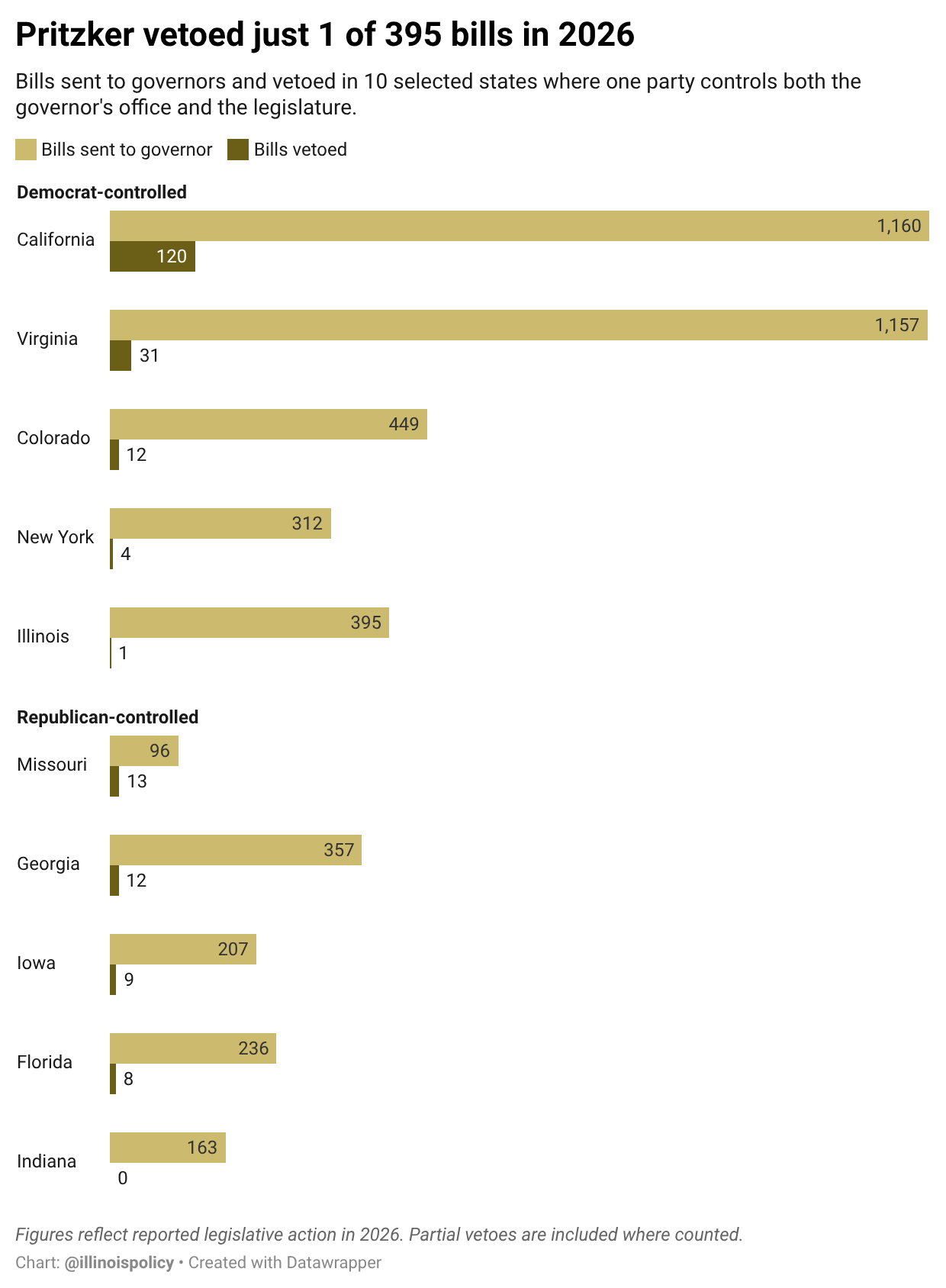
Republican governors also rejected legislation passed by legislatures their own party controls. Missouri Gov. Mike Kehoe vetoed 13 of 96 bills, or 13.54%, while Florida Gov. Ron DeSantis vetoed eight of 236, or 3.39%.
Pritzker’s limited use of vetoes
Since taking office in 2019, Pritzker has issued 29 vetoes on nearly 3,500 bills.
His highest annual veto rate was 1.51% in 2019, when he issued nine vetoes on 598 bills. His veto rate has remained below 1% for three consecutive years.
During that time, Pritzker has signed consequential legislation increasing taxes, expanding government spending and shaping Illinois’ political representation.
In 2019 he signed legislation doubling Illinois’ gas tax and adding automatic annual increases tied to inflation. In 2021 he signed partisan legislative and congressional maps despite pledging to veto maps drawn for political advantage.
Pritzker also has approved at least 63 taxes and fee increases since taking office. Seven of the eight state budgets he has signed set new spending records, including the $55.9 billion fiscal 2027 budget.
Illinois needs checks and balances, even under one-party control
Illinois Democrats control the governor’s office and hold supermajorities in both chambers of the General Assembly. The governor’s independent review of legislation is an important part of the state’s system of checks and balances.
The Illinois Constitution gives governors the authority to reject bills, recommend amendments or veto or reduce specific appropriations. Exercising those powers can compel lawmakers to reconsider bills and address concerns before they become law.
Governors also can influence legislation before it reaches their desks, meaning a low veto rate alone does not establish a lack of scrutiny. Still, Pritzker’s record demonstrates how rarely he publicly exercises his constitutional authority to challenge legislation.
The decisions in Springfield matter to Illinois families and businesses. State spending, taxes, pensions and regulations affect residents long after lawmakers leave.
Illinoisans deserve a governor willing to exercise his veto authority even when it means disagreeing with lawmakers from his own party.