
Pritzker’s record: partisan maps, doubled gas tax, record spending
With the governor running for a third term and eyeing the White House, Illinoisans should remember his policy decisions.
Many of Gov. J.B. Pritzker’s decisions have not helped families and businesses thrive in Illinois.
During his two terms, Pritzker has:
- Signed partisan legislative and congressional maps into law after promising to veto them.
- Doubled the state gas tax.
- Set record-high state budgets.
- Approved at least 63 tax and fee increases.
Here is a closer look at a record that speaks for itself:
Broke his promise to veto partisan legislative maps
As a candidate, Pritzker pledged to veto legislative maps drawn for partisan advantage. He broke that promise.
Instead, he signed new legislative and congressional district maps widely criticized for protecting Democratic majorities and incumbent politicians. Analysts at the Princeton Gerrymandering Project gave the new maps an overall F for partisan fairness, competitiveness and compactness.
In the 2024 presidential election, about 55% of the Illinois vote went to Democrat Kamala Harris, yet the party holds 66% of the seats in the General Assembly.
The partisan politics of the maps Pritzker OK’d are reflected in the statehouse: Over 90% of the bills that passed both chambers in the second regular session of the 104th Illinois General Assembly were sponsored by Democrats.
Doubled Illinois’ gas tax
One of Pritzker’s first major acts was signing the 2019 Rebuild Illinois capital plan. In doing so he doubled the tax to 38 cents a gallon.
The state had gone almost 30 years without raising the gas tax, which was 19 cents a gallon from 1990 to 2019.
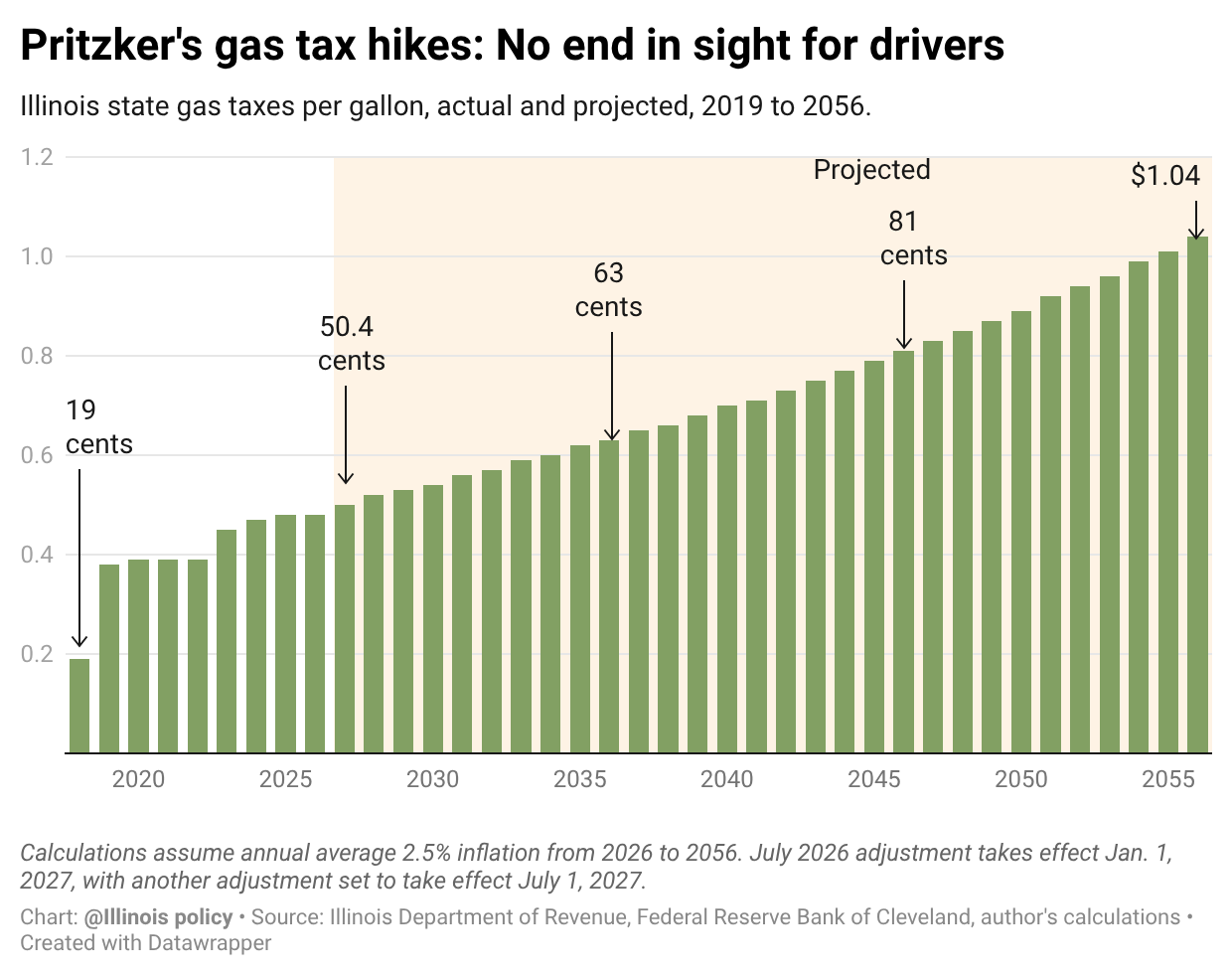
More consequentially, the law created automatic yearly increases linked to inflation. Because of that, Illinois drivers will likely pay more in state gas taxes each year for the foreseeable future unless lawmakers take action, as there’s no expiration date on the annual adjustments.
Illinois lawmakers this year gave drivers a six-month break from a gas tax increase.
Set record-high state budgets
Seven of the eight budgets Pritzker has signed set a new record.
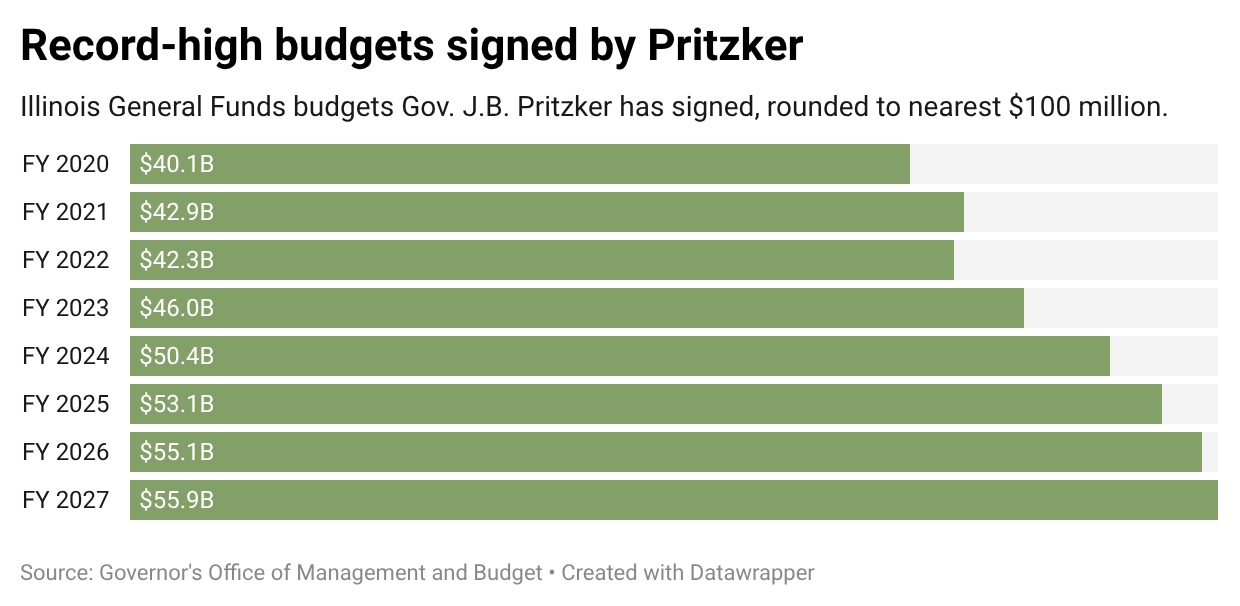
The fiscal 2027 budget totaled $55.9 billion. The record high follows a spending pattern in Illinois that relies on temporary revenues and new taxes while leaving the state’s structural financial problems unresolved.
Approved at least 63 tax and fee hikes
Pritzker has enacted at least 63 taxes and fee hikes since taking office. The tax burden on Illinois families and businesses increased under Pritzker almost $86 billion through fiscal 2026. Last fiscal year alone, Illinoisans paid $15.2 billion more in state taxes than they would have if taxes stayed consistent with pre-Pritzker levels.
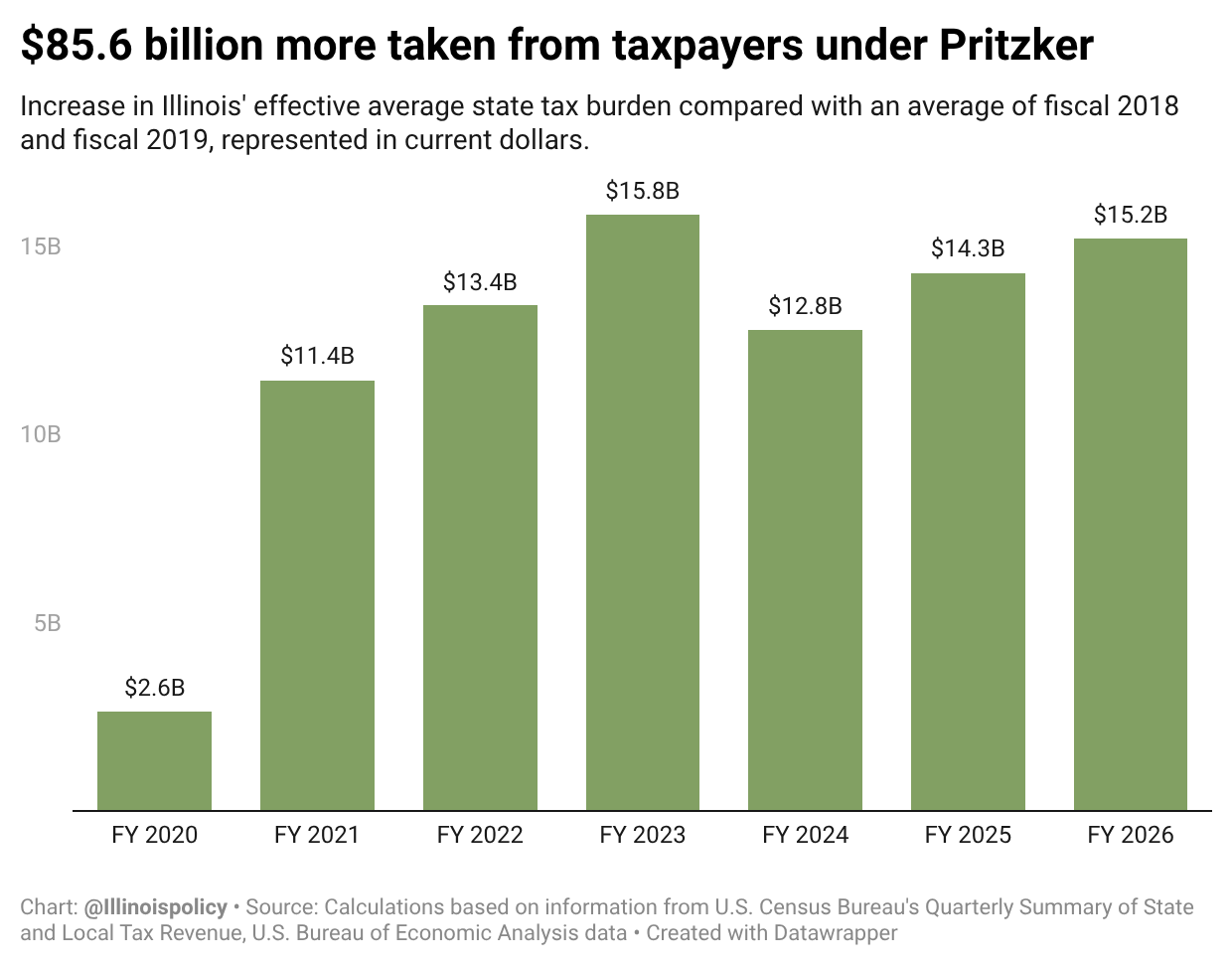
Illinois state tax collections were equivalent to 6.1% of state GDP in fiscal 2026, the third-highest tax burden in the last 30 years of Illinois history.
This is the norm under Pritzker’s leadership. The past six fiscal years make up the six highest tax burdens in Illinois in over 30 years.
To top off all of that, the governor ruled through the COVID-19 pandemic with repeated disaster declarations for more than three years. Illinois was one of the last states to end the state of emergency, nearly two years after the first Democratic governor terminated its statewide public health emergency.
By March 2022, Pritzker had issued 112 COVID-related executive orders and extended his emergency powers 27 times.
Disaster proclamations continued into May 2023, when Pritzker finally ended the state’s COVID-19 emergency.
Pritzker has expanded government, increased spending and raised taxes as Illinoisans already pay the highest combined state and local tax rate. Families and businesses are paying more for state lawmakers wasteful spending and their own salaries.
With Pritzker at the helm, the state is spending too much. Its priorities reflect politics, not what taxpayers expect for their money.
As Pritzker seeks another term as governor and builds a national profile, Illinoisans can judge his record not by campaign promises, but by the laws he has signed and their long-term consequences.